AI Agent Development in Saudi Arabia: Cost, Architecture, Use Cases & Implementation Guide
A strategic engineering and economic blueprint for Saudi enterprise leaders: comparing multi-agent architectures, calculating deployment costs and ROI, integrating core ERPs, and meeting PDPL sovereignty standards.

Executive Summary
As Saudi Arabia accelerates digital modernization under Vision 2030, enterprise technology leaders are moving decisively beyond brittle screen-scraping RPA and conversational chatbots in favor of autonomous custom AI agent development. Unlike passive assistants that merely answer prompts, enterprise AI agents plan, call authenticated APIs, query operational databases, and execute multi-step business transactions independently — from ZATCA Phase 2 e-invoice reconciliation and Odoo/SAP workflow synchronization to bilingual HR compliance across Qiwa and Muqeem. This guide delivers a definitive breakdown of AI agent development in Saudi Arabia: realistic cost tiers (PoC vs. MVP vs. Enterprise scale), sovereign multi-agent architecture, high-yield operational use cases, and strict compliance with the Personal Data Protection Law (PDPL) and SDAIA governance frameworks.
- Sub-90s Task Runs
- Autonomous execution across ERP, CRM, banking, and Saudi regulatory portals
- 100% In-Kingdom
- Zero-cross-border data leakage compliant with Saudi PDPL and SDAIA AI frameworks
- 45–65% OpEx Cut
- Replaces fragile legacy RPA and manual reconciliation with deterministic tool sandboxes
- Dialect-Native
- Full bilingual fluency across Najdi, Hijazi, Gulf business Arabic and technical English
Key Takeaways
- Custom AI agent development in Saudi Arabia marks a structural shift from passive conversational chatbots and [brittle RPA scripts](/blog/ai-agent-vs-chatbot-vs-rpa) to goal-driven software swarms that autonomously interact with enterprise systems of record.
- A production-grade AI agent deployment requires a three-tier architecture: multi-modal ingestion, an autonomous reasoning orchestrator (using models like [ALLaM or open weights](/blog/allam-microsoft-foundry-saudi-enterprise-architecture)), and deterministic API tool sandboxes.
- Total cost of ownership in Saudi Arabia ranges from SAR 35,000–65,000 for a 4-week Proof of Concept (PoC) to SAR 180,000–450,000+ for enterprise-wide multi-agent swarms integrated into [SAP](/blog/sap-ai-integration-odata-bapi-rfc) or [Odoo](/white-papers/odoo-erp-ai-dashboard-chat-with-data).
- Compliance with Saudi Arabia's Personal Data Protection Law (PDPL) requires in-Kingdom inference compute, database row-level security (RLS), and cryptographic audit logging — principles detailed in our analysis of [AI agents in Saudi enterprise operations](/white-papers/ai-agents-daily-operations-saudi-enterprises).
- Saudi organizations achieve maximum ROI by targeting high-friction administrative bottlenecks: ZATCA Phase 2 tax verification, supplier invoice matching, Qiwa HR compliance, and [autonomous real estate operations](/blog/ai-agents-in-real-estate-industry-scope).
The Shift to Enterprise AI Agents in Saudi Arabia: Beyond Chatbots and Brittle RPA
Under the ambitious economic and technological mandate of Saudi Vision 2030, enterprises across Riyadh, Jeddah, and the Eastern Province are re-evaluating their enterprise software investments. Over the past decade, digital transformation initiatives relied heavily on two technologies: Robotic Process Automation (RPA) and conversational chatbots. While both played initial roles in reducing paper records, both have encountered fundamental operational limits in production environments.
Traditional RPA relies on rigid, recorded screen positions and fragile click-paths. The moment an ERP interface updates, a web layout shifts, or a supplier sends an invoice with a non-standard column layout, the RPA bot breaks silently — creating expensive maintenance overhead for IT departments. Conversely, first-generation generative AI chatbots remain passive: they produce articulate conversational prose, but they cannot execute database transactions, query live ERP ledgers, or navigate complex regulatory workflows independently. When human staff must manually copy text out of a chat widget and paste it into business software, the human operator remains the primary bottleneck.
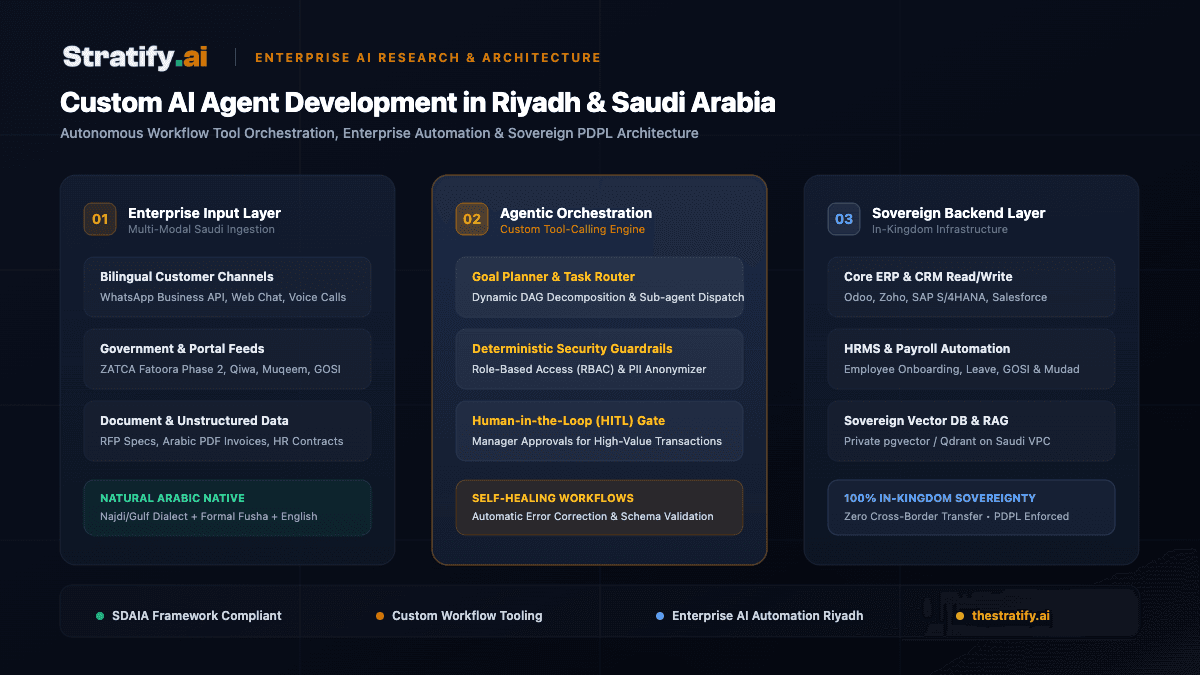
Custom AI agent development resolves this structural impasse. Unlike a chatbot that requires step-by-step human prompts, an autonomous enterprise AI agent is assigned a business objective — such as 'Reconcile all incoming vendor invoices against purchase orders in Odoo, verify ZATCA Phase 2 cryptographic QR hashes, and prepare approval vouchers.' The agent formulates a directed task graph, calls internal APIs, validates data schemas deterministically, and executes the end-to-end process autonomously, handing off to a human supervisor only at pre-defined governance gates. This transition from passive tools to autonomous swarms — explored in our guide to custom AI agent development in Riyadh and the shift to agentic AI workflows — is now the primary competitive differentiator for Saudi enterprise engineering.
Enterprise Multi-Agent Architecture: Ingestion, Orchestration, Tool Sandboxes & Sovereignty
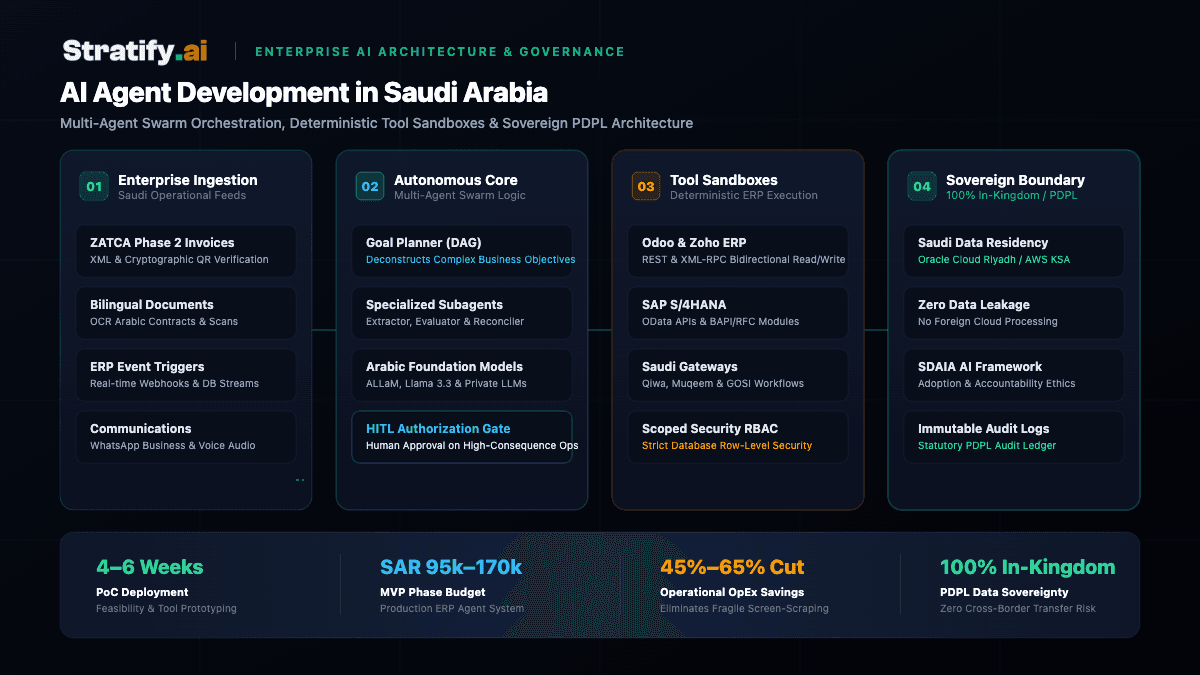
Deploying AI agents in enterprise environments requires a modular, defense-in-depth architecture. A monolithic language model prompt cannot reliably manage multi-step ERP transactions without instruction drift and catastrophic hallucinations. Production-grade systems engineered by Stratify AI decouple the reasoning model from deterministic execution across four distinct layers.
Layer 1 handles multi-modal enterprise ingestion: normalizing unstructured data from supplier emails, scanned Arabic PDFs, ZATCA Phase 2 XML payloads, and WhatsApp voice audio into structured JSON representations. Layer 2 represents the autonomous reasoning core: a central Orchestrator Agent decomposes the high-level objective into a Directed Acyclic Graph (DAG) of discrete tasks, assigning subtasks to specialized domain micro-agents (e.g., Schema Validator, Ledger Reconciler, Document Parser).
Layer 3 enforces deterministic tool sandboxes: language models are never granted raw or direct SQL write access. Instead, they interact with enterprise systems through strictly typed, parameterized API connectors with schema validation. If an agent attempts an unpermitted payload or invalid parameter, the sandbox deterministically rejects the call before it reaches the production database. Finally, Layer 4 establishes the sovereign in-Kingdom execution boundary, ensuring inference, embeddings, and telemetry remain strictly within Saudi cloud regions.
- 1. Multi-Modal Enterprise Ingestion Layer
- Extracts and normalizes bilingual Arabic/English documents, ZATCA Phase 2 XMLs, OCR scans, and ERP webhook events into structured execution contexts.
- 2. Orchestration & Subagent Delegation
- A central planning orchestrator coordinates specialized micro-agents (extraction, validation, synthesis) to isolate context windows and eliminate hallucinations.
- 3. Deterministic API & ERP Tool Sandbox
- Parameterized REST, GraphQL, OData, and database drivers that strictly validate payloads before modifying enterprise systems of record.
- 4. Human-in-the-Loop (HITL) Authorization Console
- Enforces mandatory cryptographic sign-off from authorized personnel on high-consequence operations (bank disbursements, contracts, personnel changes).
AI Agent Development Cost in Saudi Arabia: PoC, MVP, and Production TCO
For Saudi CIOs, CFOs, and digital transformation executives, evaluating an AI agent initiative requires transparent clarity around development budgets, operational expenses (OpEx), infrastructure costs, and multi-year return on investment (ROI). In Saudi Arabia, the cost of custom AI agent development is shaped by three key factors: integration complexity with existing ERPs, bilingual dialect handling requirements, and data residency infrastructure.
Organizations typically progress through three distinct commercial engagement stages: Proof of Concept (PoC), Minimum Viable Product (MVP), and Full Enterprise Deployment. A 4-week Proof of Concept typically ranges between SAR 35,000 and SAR 65,000, focusing on validating feasibility on a single high-friction workflow (such as automated supplier invoice matching). A production-ready MVP integrating live bidirectional read/write into systems like Odoo or Zoho typically ranges from SAR 95,000 to SAR 175,000 across a 6 to 8-week timeline.
Full enterprise multi-agent swarms — spanning multi-ERP synchronization, custom Arabic fine-tuning, automated government portal integrations (Qiwa, Muqeem), and high-availability VPC clustering — range from SAR 220,000 to SAR 480,000+. When evaluated against legacy RPA licensing (which costs tens of thousands of dollars annually per bot runtime) and hundreds of manual human auditing hours, custom agent systems typically deliver full capital payback within 4 to 7 months of production operation.
High-Impact Saudi Enterprise Use Cases: ERP, Finance, HR & Real Estate
Where does custom AI agent development deliver the highest return on investment for Saudi enterprises? In practice, the highest financial yield occurs in operational departments where knowledge workers spend 15 to 25 hours weekly cross-referencing documents between disconnected enterprise applications.
In financial operations, custom agents automate ZATCA Phase 2 compliance and invoice settlement. When an inbound invoice arrives via email or supplier portal, an ingestion agent parses the Arabic and English line items, checks the ZATCA cryptographic stamp and QR code, queries purchase order receipts in Odoo or SAP S/4HANA, and reconciles tax ledger entries in seconds. In human resources, AI agents streamline onboarding and Saudization (Nitaqat) compliance: screening CVs against localized quota requirements, generating standardized Ministry of Human Resources (MHRSD) contracts, and synchronizing records with Qiwa and Muqeem platforms.
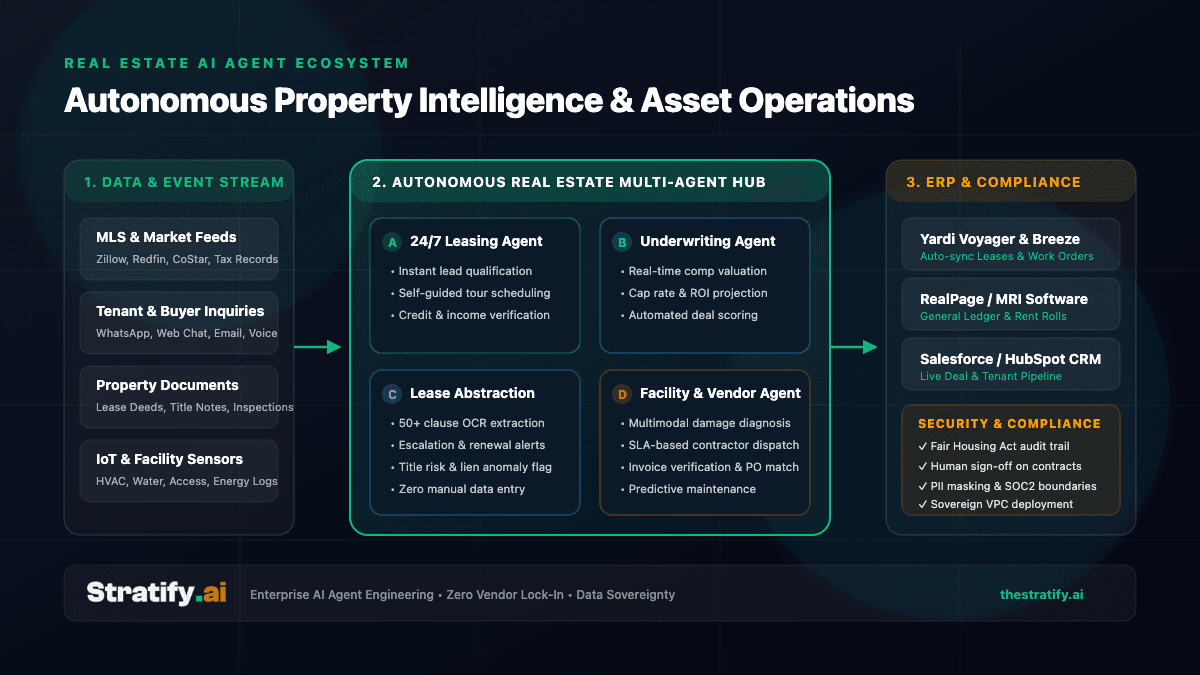
In real estate asset management, multi-agent pipelines manage 24/7 bilingual tenant qualification, property showing scheduling, and commercial lease abstraction into Yardi Voyager and RealPage — workflows explored in depth in our analysis of AI agents in real estate. Similarly, industrial enterprises deploy automated monitoring agents to parse shop-floor telemetry and trigger predictive work orders, as demonstrated in our paper on manufacturing automated dashboards and alerts.
- ZATCA E-Invoicing & 3-Way Matching
- Validates electronic invoice XMLs, checks supplier VAT registration against ZATCA databases, cross-references goods receipts, and generates draft ERP payment vouchers.
- Bilingual HR & Saudization Workflows
- Automates CV screening, verifies candidate data against Nitaqat tier rules, generates Qiwa-compliant contracts, and tracks Muqeem visa renewal deadlines.
- SAP & Odoo Supply Chain Synchronization
- Monitors safety stock thresholds, generates automated purchase requisitions via OData/BAPI calls, and notifies procurement managers upon supply disruptions.
- 24/7 Autonomous Commercial Operations
- Engages corporate clients in fluent Gulf Arabic or English via WhatsApp Business and Web, qualifying requirements and writing CRM leads into Zoho or Salesforce.
PDPL Compliance, SDAIA Governance & Sovereign In-Kingdom Deployment
In the Kingdom of Saudi Arabia, enterprise AI adoption is inextricably linked with regulatory compliance. Under the Personal Data Protection Law (PDPL), fully enforceable since September 2024, organizations face substantial statutory penalties if sensitive commercial or personal data is transferred across borders without explicit lawful grounds. For enterprise technology leaders, this makes off-the-shelf public cloud AI tools a substantial legal and security liability.
Stratify AI engineers every custom AI agent ecosystem around sovereign in-Kingdom infrastructure. Inference compute, vector databases, and agent orchestration servers are provisioned entirely within Saudi data centers — including Oracle Cloud Infrastructure (OCI) regions in Riyadh and Jeddah, local AWS Middle East zones, or air-gapped on-premise hardware clusters. This guarantees that customer PII, payroll data, and proprietary transactional records never cross international boundaries.
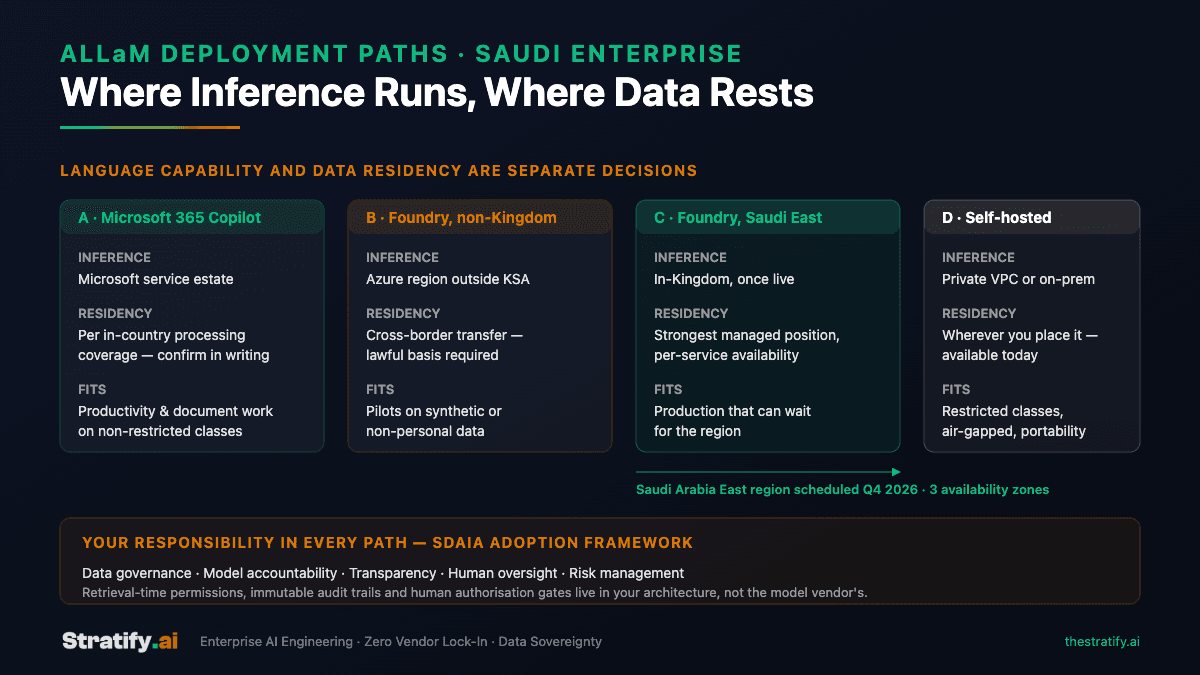
Furthermore, our architectures align directly with the Saudi Data and Artificial Intelligence Authority (SDAIA) AI Adoption Framework across all five governance pillars: data stewardship, algorithmic accountability, transparency, human oversight, and risk management. As examined in our architectural study of ALLaM on Microsoft Foundry and data residency, model choice must never compromise data residency. By implementing immutable cryptographic audit ledgers and database-level Row-Level Security (RLS), every action an agent executes remains fully auditable for regulatory inspections.
- 100% In-Kingdom Data Residency
- All LLM inference, embedding stores, and database transactions execute within Saudi Arabian sovereign cloud regions or private on-premise clusters.
- Deterministic Role-Based Access Control (RBAC)
- Agents inherit strict user permissions at the database engine level; language models cannot bypass security rules through prompt manipulation.
- Statutory PDPL Audit Trails
- Every data access event, tool call, API transaction, and human authorization decision is recorded in an immutable compliance ledger.
- Air-Gapped & Private LLM Deployment Options
- Self-hosted open-weight architectures (e.g., Llama 3.3, ALLaM, DeepSeek) for highly sensitive defence, banking, and government applications.
4-Phase Implementation Roadmap for Saudi Enterprises
Enterprise AI agent development should never begin with unstructured experimentation. Successful implementations follow a phased engineering methodology designed to mitigate architectural risk, prove measurable business ROI, and ensure operational adoption across internal teams.
Phase 1: Workflow Discovery & Data Audit (Weeks 1–2): We identify your highest-volume operational bottlenecks, map ERP/CRM API capabilities, classify data sensitivity under PDPL, and establish quantifiable ROI benchmarks (e.g., reducing invoice reconciliation cycle time from 4 days to under 2 minutes).
Phase 2: Agent Architecture & Tool Sandboxing (Weeks 3–4): Our engineering practice builds the specialized agent swarm, engineers bilingual Arabic/English prompt pipelines, and establishes deterministic tool wrappers with strict schema validation.
Phase 3: ERP Integration & Security Hardening (Weeks 5–6): We establish authenticated bidirectional connectors to your production systems of record (Odoo, Zoho, SAP, Qiwa), implement Human-in-the-Loop approval workflows, and conduct adversarial penetration testing against prompt injection.
Phase 4: Pilot Deployment & Operational Enablement (Weeks 7–8): Rolling out the agent system to pilot operational units, conducting tailored staff enablement workshops, and activating real-time observability dashboards to track execution latency and accuracy.
Whether your organization requires autonomous agents for finance, supply chain, HR, or custom software workflows, partner with Stratify AI. For a detailed breakdown of what these projects cost and what drives the numbers, see the guide to enterprise AI automation cost in Saudi Arabia. Explore our specialized custom AI agent development services, examine our AI systems integration practice, learn about our custom AI applications, or schedule a confidential architecture consultation with our Riyadh engineering team.
AI Agent Development Cost in Saudi Arabia: PoC, MVP, and Production TCO
Commercial and technical comparison between Custom Enterprise AI Agents, Generic SaaS Copilots, and Traditional RPA Bots for Saudi organizations.
| Evaluation Dimension | Custom AI Agent (Stratify AI) | Generic SaaS Copilot | Traditional RPA Bot |
|---|---|---|---|
| Scope & Objective | Autonomous, multi-step goal execution across ERP, CRM, and government gateways. | Conversational text generation and basic summarization within single apps. | Deterministic screen-scraping and repetitive keystroke automation. |
| Development Cost (SAR) | SAR 95,000 – 250,000 (One-time asset build with perpetual client IP ownership). | SAR 120 – 180 / user / month (Continuous recurring SaaS subscription). | SAR 40,000 – 90,000 / bot / year (Perpetual licensing + maintenance fees). |
| Deployment Timeline | 4–6 weeks for operational PoC; 8–12 weeks for production enterprise rollout. | Instant activation (limited to pre-built closed feature sets). | 8–16 weeks of brittle screen-path recording and UI testing. |
| ERP Integration Method | Direct bidirectional REST/OData/BAPI APIs with schema validation and self-healing retries. | Surface-level sidebar or iframe; cannot execute complex database transactions. | Brittle UI screen-scraping that breaks when button coordinates change. |
| Saudi Data Residency (PDPL) | 100% In-Kingdom within private client VPC or on-premise hardware. | Multi-tenant public foreign cloud with cross-border data transfer liabilities. | Local workstation runtime, but lacks intelligent governance guardrails. |
| Arabic Dialect Capability | Native handling of Najdi, Hijazi, Gulf business terminology and code-switching. | Generic Modern Standard Arabic (MSA) translated via foreign engines. | No natural language comprehension or document understanding. |
| Typical ROI Payback | 4–7 months through 45–65% reduction in administrative OpEx. | Unpredictable; often underutilized due to lack of deep system integration. | 12–18 months, frequently eroded by recurring UI maintenance costs. |
Frequently Asked Questions
A focused Proof of Concept (PoC) addressing a single business process typically ranges from SAR 35,000 to SAR 65,000 across a 3 to 4-week delivery window. A production-grade Minimum Viable Product (MVP) integrated bidirectionally with core ERPs (like Odoo, Zoho, or SAP) ranges from SAR 95,000 to SAR 175,000. Enterprise-scale multi-agent swarms with custom fine-tuning and multi-system orchestration range from SAR 220,000 to SAR 480,000+, with typical ROI payback achieved within 4 to 7 months.
Custom AI agents are deployed directly within private in-Kingdom cloud tenancies (such as Oracle Cloud Riyadh/Jeddah or local AWS regions) or on-premise enterprise infrastructure. No customer PII, financial records, or operational data are transmitted across international borders. Furthermore, all agent tool interactions enforce database Row-Level Security (RLS) and generate immutable cryptographic audit logs matching SDAIA regulatory standards.
Yes. Enterprise AI agents do not replace existing ERP platforms; they connect directly to them through authenticated REST, GraphQL, XML-RPC, or SAP OData and BAPI interfaces. The agent operates within a deterministic sandbox, reading inventory, validating records, and triggering transactions while respecting your established enterprise access control rules.
Unlike generic translation layers, our custom agents are engineered with localized Arabic foundation models (such as ALLaM and fine-tuned open weights). They fluently interpret formal Modern Standard Arabic (فصحى), Gulf business correspondence, and regional conversational dialects (Najdi, Hijazi), while accurately managing mixed Arabic-English technical terminology.
A production pilot typically achieves live operation within 4 to 6 weeks. Full enterprise integration, comprehensive security hardening, staff enablement workshops, and multi-department rollout are usually completed within 8 to 12 weeks from initial architectural discovery.
With Stratify AI, the client retains 100% intellectual property ownership of all custom agent orchestration code, proprietary prompt libraries, tool-calling schemas, and fine-tuned model artifacts upon project delivery. There is zero vendor lock-in or recurring per-seat licensing fees.
Related Articles

Let's Build the Future
of Enterprise AI
Have a project in mind or need expert guidance?
We'd love to hear from you.
Salah Ad Din Al Ayyubi Rd, Al Malaz,
Riyadh 12836, Saudi Arabia
Global Enterprise Partner
Empowering businesses across North America, Europe, Asia, and the Middle East.