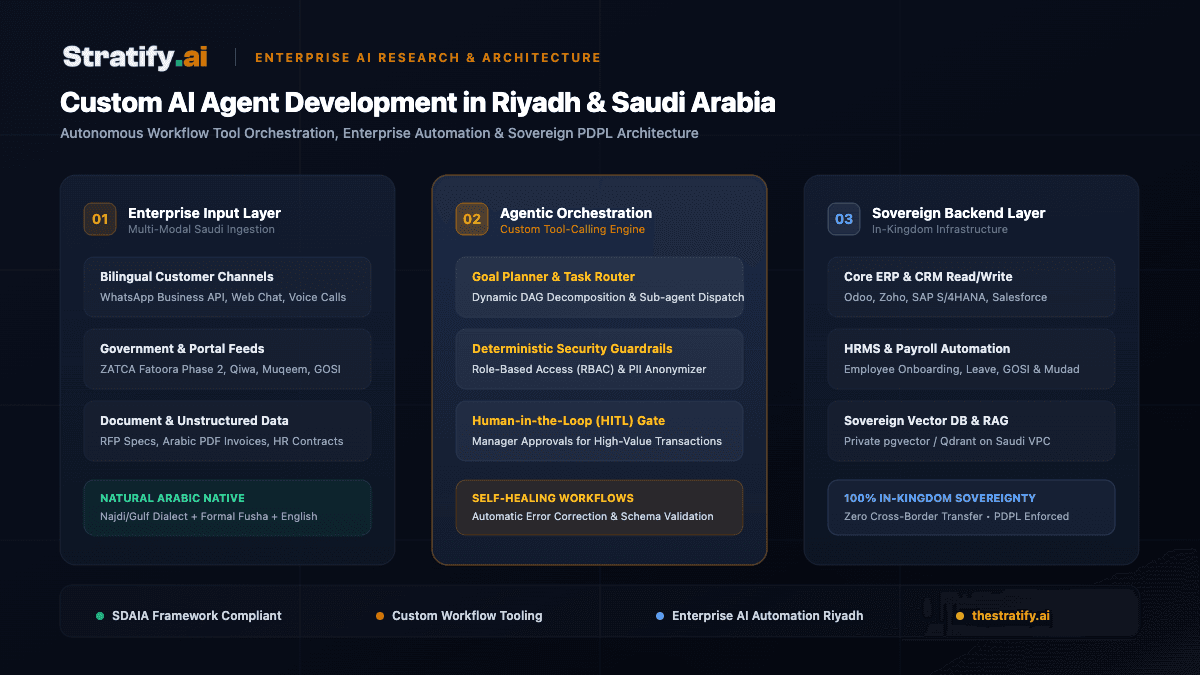
Custom AI Agent Development in Riyadh: Building Enterprise AI Automation & Generative Workflows in Saudi Arabia
How Saudi enterprises in Riyadh move beyond rigid RPA and off-the-shelf chatbots to deploy autonomous custom AI agents, custom workflow tools, and sovereign generative AI architectures.

Executive Summary
Enterprises across Riyadh and Saudi Arabia are rapidly shifting from experimental generative AI pilots to production-grade custom AI agent development. While generic SaaS chatbots fail to integrate with core ERPs or respect Saudi data sovereignty under PDPL, custom AI agent ecosystems execute complex, multi-step business goals autonomously: reconciling ZATCA Phase 2 tax invoices, orchestrating Odoo and Zoho workflows, automating bilingual HR and onboarding lifecycles, and conducting real-time enterprise research. This blueprint from Stratify AI breaks down the architecture, regulatory guardrails, and implementation roadmap for enterprise AI automation in the Kingdom.
- Sub-60s Execution
- Autonomous multi-step task completion across ERP, CRM, HRMS, and Saudi government gateways
- 100% In-Kingdom
- Zero-data-leakage architecture compliant with PDPL, SDAIA AI frameworks, and NCA sovereign guidelines
- 40–60% OpEx Cut
- Replacing brittle screen-scraping RPA with adaptive, self-healing generative workflow tools
- Arabic-Native
- Natural handling of Najdi, Hijazi, and Gulf business Arabic dialects alongside formal English
Key Takeaways
- Custom AI agent development in Riyadh replaces [fragile RPA scripts and passive chatbots](/blog/ai-agent-vs-chatbot-vs-rpa) with goal-driven, autonomous software systems that plan, call tools, and execute workflows — an architecture expanded across the Kingdom in our comprehensive [Saudi AI agent development guide](/blog/ai-agent-development-saudi-arabia-guide).
- Enterprise AI automation in Saudi Arabia requires strict adherence to the Personal Data Protection Law (PDPL); custom private VPC deployments eliminate cross-border data transfer liabilities as outlined in our analysis of [AI agents in Saudi enterprise operations](/white-papers/ai-agents-daily-operations-saudi-enterprises).
- Custom workflow tool development bridges generative models with core systems of record — enabling live bidirectional transactions into [Odoo](/white-papers/odoo-erp-ai-dashboard-chat-with-data), [Zoho](/white-papers/zoho-erp-ai-dashboard-chat-with-data), SAP, Qiwa, and Muqeem.
- AI for HR workshops and operational training empower Saudi talent to supervise, audit, and orchestrate agentic systems rather than perform repetitive administrative data entry.
- Partnering with an enterprise AI development agency in Saudi Arabia provides long-term IP ownership and sovereign infrastructure control compared to captive third-party SaaS platforms.
The Enterprise AI Mandate in Riyadh: Why Custom Agents Outperform Generic SaaS
Under the ambitious technological mandate of Saudi Vision 2030, organisations across Riyadh, Jeddah, and the Eastern Province are experiencing a structural transformation in enterprise software. For years, digital transformation meant purchasing off-the-shelf Western SaaS platforms and layering brittle Robotic Process Automation (RPA) scripts on top of repetitive workflows. While this digitised manual records, it introduced severe operational drag: rigid screen-scraping automations break whenever an interface changes, while generic AI chatbots remain passive conversational toys unable to execute database transactions.
Custom AI agent development fundamentally rewrites this paradigm. Unlike a standard chatbot that merely responds to isolated text prompts, an autonomous enterprise AI agent is given a high-level operational objective (e.g., 'Verify incoming supplier invoices against purchase orders in Odoo, validate ZATCA Phase 2 QR codes, and queue payment approval dossiers'). The agent autonomously decomposes the goal into a directed task graph, queries internal databases, invokes authenticated APIs, validates business rules, and flags edge cases for human review.
For Saudi enterprises subject to strict regulatory oversight from SDAIA and the National Cybersecurity Authority (NCA), custom AI agent architectures offer the decisive advantage of sovereign control. Rather than routing sensitive enterprise financial data, customer identities, or employee records through foreign public cloud endpoints, custom agents run entirely within private in-Kingdom infrastructure or local cloud tenancies.
Core Pillars of Enterprise AI Automation in Saudi Arabia
Modern enterprise AI consulting in Riyadh focuses on four high-impact operational pillars where custom autonomous workflows compress overhead and accelerate decision-making.
- 1. Custom Autonomous AI Agents (Multi-Agent Swarms)
- Specialized micro-agents working in coordinated teams — including dedicated Task Planners, Schema Validators, Document Extractors, and System Synchronizers that handle end-to-end commercial operations without human micro-management.
- 2. Custom Workflow Tool Development
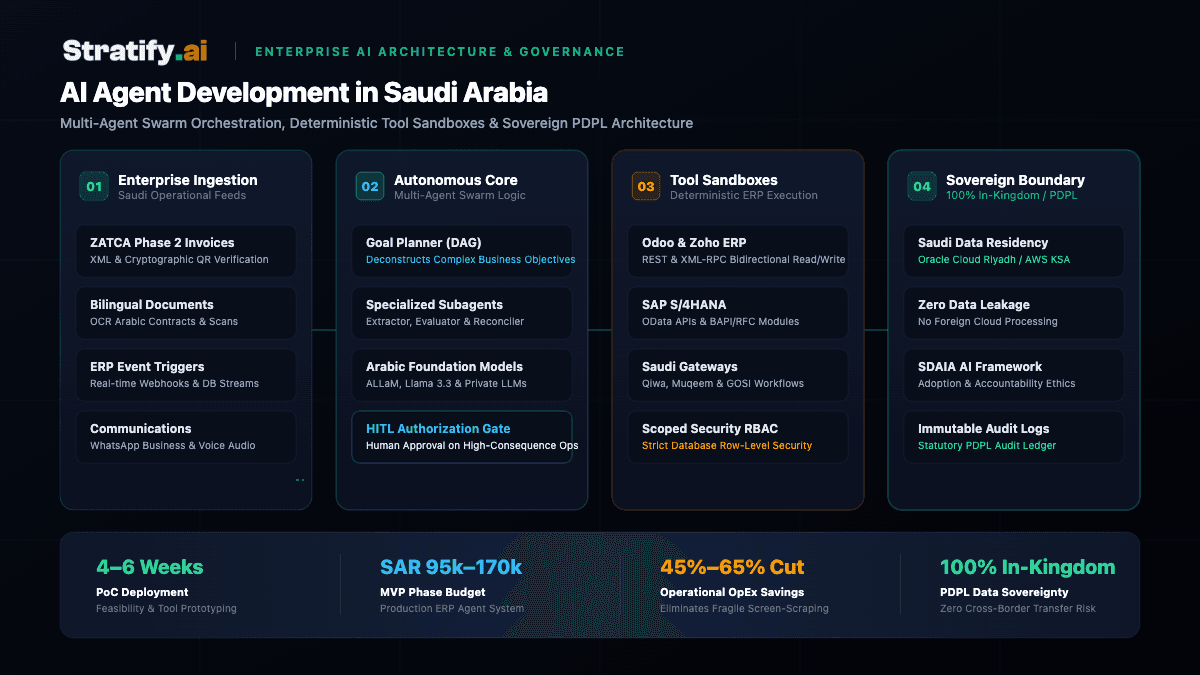
- Bespoke API connectors, database middleware, and deterministic business logic sandboxes that allow language models to safely read from and write to ERPs (Odoo, Zoho, SAP S/4HANA), CRM pipelines, and government gateways (Qiwa, Muqeem, GOSI, ZATCA).
- 3. Enterprise Generative AI Consulting & Strategy
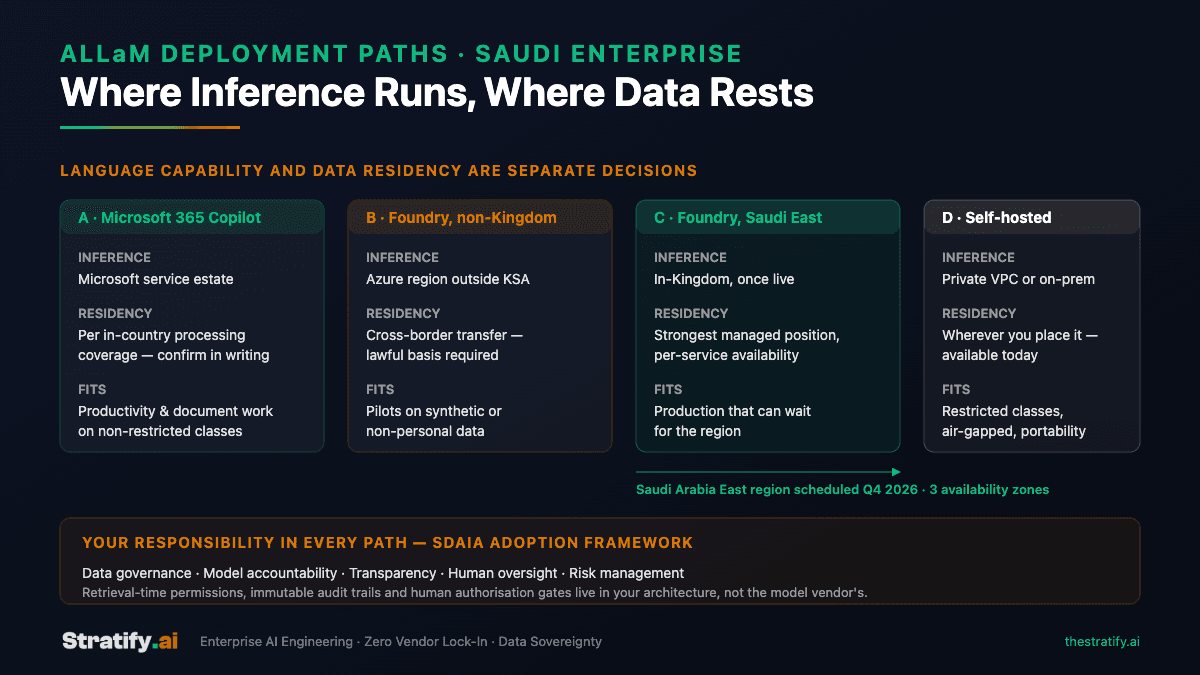
- Technical discovery, feasibility auditing, prompt security hardening, and vendor-neutral model selection (evaluating open-weight models, [ALLaM](/blog/allam-microsoft-foundry-saudi-enterprise-architecture), Llama 3.3, and commercial APIs against latency, cost, and residency constraints).
- 4. AI for HR & Enterprise Talent Workshops in Riyadh
- Interactive enablement workshops for HR directors, operations leaders, and executive teams — transforming manual recruitment screening, employee onboarding, and performance review workflows into supervised agentic pipelines.
Architectural Comparison: Traditional RPA vs. SaaS Chatbots vs. Custom Riyadh AI Agents
Enterprise decision-makers evaluating automation investments must distinguish between surface-level chatbots, legacy RPA, and custom agentic systems. The differences determine whether an initiative scales or collapses under maintenance overhead.
High-Friction Workflows Transformed: Procurement, ERP & HR Operations
Where does custom AI agent development deliver the fastest Return on Investment (ROI) for Saudi companies? In practice, the highest yield occurs in operational bottlenecks where human staff spend dozens of hours weekly cross-referencing documents across disconnected software.
In Saudi procurement and finance, custom invoice-matching agents intercept incoming vendor invoices, parse Arabic and English item descriptions using optical character recognition (OCR), verify the supplier's VAT registration and ZATCA Phase 2 compliance, check delivery receipts in Odoo or SAP, and prepare draft payment vouchers. What previously consumed 4–5 business days is completed in under 90 seconds, with complete audit logs preserved for ZATCA inspections.
In human resources, our custom AI for HR workflows in Riyadh automates the end-to-end recruitment and compliance lifecycle. Agents screen incoming resumes against Saudi nationalization quotas (Saudization / Nitaqat tiers), auto-populate candidate dossiers, verify employment records against Qiwa and GOSI requirements, and draft bilingual offer letters matching standard Ministry of Human Resources (MHRSD) contracts.
- Automated ZATCA & Tax Reconciliation
- Instant verification of electronic tax invoices against purchase orders, automated credit note matching, and real-time ledger synchronization.
- HR Onboarding & Saudization Compliance
- Autonomous screening of candidate credentials, Qiwa contract generation, Muqeem visa tracking, and automated GOSI wage compliance reports.
- Bilingual Sales & Commercial Follow-Ups
- Voice call transcription, Minutes of Meeting (MoM) synthesis, and contextual WhatsApp/Email follow-up drafts in Gulf Arabic, English, and Malayalam.
- 24/7 Intelligent Customer & Vendor Operations
- Conversational agents that answer inventory availability, track dispatch status, and create CRM leads directly within Zoho or Odoo.
Regulatory Alignment: SDAIA Frameworks, NCA Cyber Controls, and PDPL Governance
Deploying enterprise AI in Saudi Arabia is not solely a technical challenge; it is a regulatory one. The Kingdom's Personal Data Protection Law (PDPL), fully enforceable since September 2024, mandates strict legal bases for data collection, processing consent, and cross-border data transfer limitations—a framework explored in our white paper on AI agents in Saudi enterprise operations.
Stratify AI engineers every custom AI agent system around three non-negotiable architectural guardrails:
1. Deterministic Security Sandboxes: Language models are never granted unrestricted direct database access. Every agent operates through parameterized, role-based API tools with strict schema validation. If an agent attempts an unauthorized query or invalid data mutation, the tool boundary rejects the transaction deterministically before database commit.
2. In-Kingdom Data Residency: All inference compute, vector embeddings, and operational databases reside in private Saudi cloud regions (Oracle Cloud Riyadh/Jeddah, local AWS zones, or private on-premise clusters) to guarantee zero cross-border transfer risk.
3. Human-in-the-Loop (HITL) Authorization Gates: High-consequence actions—such as executing fund transfers above pre-approved thresholds, terminating employee records, or signing binding commercial contracts—require affirmative cryptographic sign-off from an authorized enterprise manager.
Engaging an Enterprise AI Development Agency in Riyadh: The Engagement Path
Organisations planning an enterprise AI initiative should avoid the trap of prolonged theoretical consulting. The most successful implementations follow a structured, rapid-deployment engineering methodology that validates ROI within weeks:
Phase 1: Workflow & Data Audit (Weeks 1–2): We identify your highest-friction business processes, audit existing ERP/CRM endpoints, classify data sensitivity under PDPL, and define quantifiable success metrics (e.g. reducing invoice processing time by 75%).
Phase 2: Custom Agent & Tool Prototyping (Weeks 3–4): Engineering specialized agents with deterministic tool-calling wrappers, integrating vector search over internal knowledge bases, and configuring bilingual Arabic/English prompts.
Phase 3: Security Hardening & Integration (Weeks 5–6): Connecting agents to live systems of record (Odoo, Zoho, SAP, Qiwa), implementing RBAC permissions, and stress-testing edge cases against hallucination filters.
Phase 4: Pilot Deployment & HR Enablement (Weeks 7–8): Rolling out to internal pilot teams, conducting tailored AI for HR and operations workshops in Riyadh, and establishing automated observability dashboards.
If your enterprise is looking to architect custom AI agents across the Kingdom, examine our nationwide AI agent development guide and cost framework, explore our custom AI agent development services, or schedule a confidential architecture review with the Stratify AI engineering practice.
Architectural Comparison: Traditional RPA vs. SaaS Chatbots vs. Custom Riyadh AI Agents
Technical and operational comparison between Traditional RPA, Generic SaaS Chatbots, and Custom AI Agent Systems engineered for Saudi enterprises.
| Capability Dimension | Custom AI Agent (Stratify AI) | Generic SaaS Chatbot | Traditional RPA Bot |
|---|---|---|---|
| Operational Trigger | High-level business goal or dynamic event; plans multi-step execution autonomously. | Single isolated user prompt; no state retention or planning. | Fixed schedule or exact rule trigger; cannot interpret deviations. |
| Handling Unstructured Data | Native multi-modal reasoning across Arabic PDFs, scanned invoices, WhatsApp audio, & emails. | Text matching; cannot parse complex multi-page commercial contracts. | Fails completely on unstructured text or changing document layouts. |
| Core System Integration | Deep bidirectional API read/write into Odoo, Zoho, SAP, ZATCA, Qiwa, & custom databases. | Isolated knowledge widget; no transactional authority. | Brittle UI screen-scraping that breaks with minor software updates. |
| Bilingual Arabic Nuance | Domain-tuned for Najdi/Gulf dialects, formal correspondence (فصحى), & technical code-switching. | Literal machine translation with unnatural tone and poor dialect comprehension. | No natural language comprehension. |
| Data Sovereignty (PDPL) | 100% in-Kingdom deployment within private VPC or on-premise hardware; zero external data leaks. | Data processed on shared foreign multi-tenant cloud servers. | Local execution but lacks intelligent security guardrails. |
| System Adaptation & Resilience | Self-healing tool calls, schema validation, and dynamic retry loops upon API schema changes. | Static answers that silently drift out of date. | Requires costly developer intervention whenever UI elements move. |
Frequently Asked Questions
A standard chatbot is reactive and conversational—it answers questions based on a fixed text prompt or search database but cannot take action. A custom AI agent is autonomous and goal-driven: it can break complex objectives into multi-step tasks, query databases, call internal APIs (like creating an invoice in Odoo or updating a lead in Zoho), validate outputs, and execute transactions without requiring step-by-step human prompts.
Custom AI agents are deployed directly within private in-Kingdom cloud infrastructure (such as Oracle Cloud Riyadh/Jeddah or private client VPCs). All data processing, vector embeddings, and database interactions remain within Saudi Arabia, eliminating cross-border data transfer liabilities under the Personal Data Protection Law (PDPL). Furthermore, sensitive PII is automatically redacted before entering reasoning context.
Yes. Custom AI agents communicate through secure REST/GraphQL APIs, OData connectors, or database drivers. They can read inventory, verify customer records, generate quotations, trigger purchase orders, and post journal entries directly into your existing system of record while respecting your existing role-based access control (RBAC) permissions.
Third-party SaaS AI platforms keep your enterprise data captive, lack native support for Saudi business workflows (like ZATCA Phase 2 or Qiwa integrations), struggle with Gulf Arabic dialect nuances, and charge unpredictable per-seat or per-token markup. Custom AI agent development gives your organization complete intellectual property ownership, dedicated sovereign infrastructure, and custom tools tailored exactly to your operating procedures.
Our AI for HR workshops are executive and operational training sessions designed for HR directors, talent managers, and operations leaders in Saudi Arabia. They demonstrate how to implement autonomous agents for resume parsing, Saudization (Nitaqat) compliance tracking, Qiwa contract generation, and automated employee onboarding, empowering HR teams to oversee AI systems effectively.
A production-grade custom AI agent pilot typically takes 4 to 6 weeks from initial workflow scoping to live testing, with full enterprise deployment and staff enablement completed within 8 weeks.
Related Articles

Let's Build the Future
of Enterprise AI
Have a project in mind or need expert guidance?
We'd love to hear from you.
Salah Ad Din Al Ayyubi Rd, Al Malaz,
Riyadh 12836, Saudi Arabia
Global Enterprise Partner
Empowering businesses across North America, Europe, Asia, and the Middle East.