AI Agents for Day-to-Day Operations in Saudi Enterprises
Where autonomous agents fit into routine operational work, and what the Saudi regulatory and language context changes about the design.

Summary
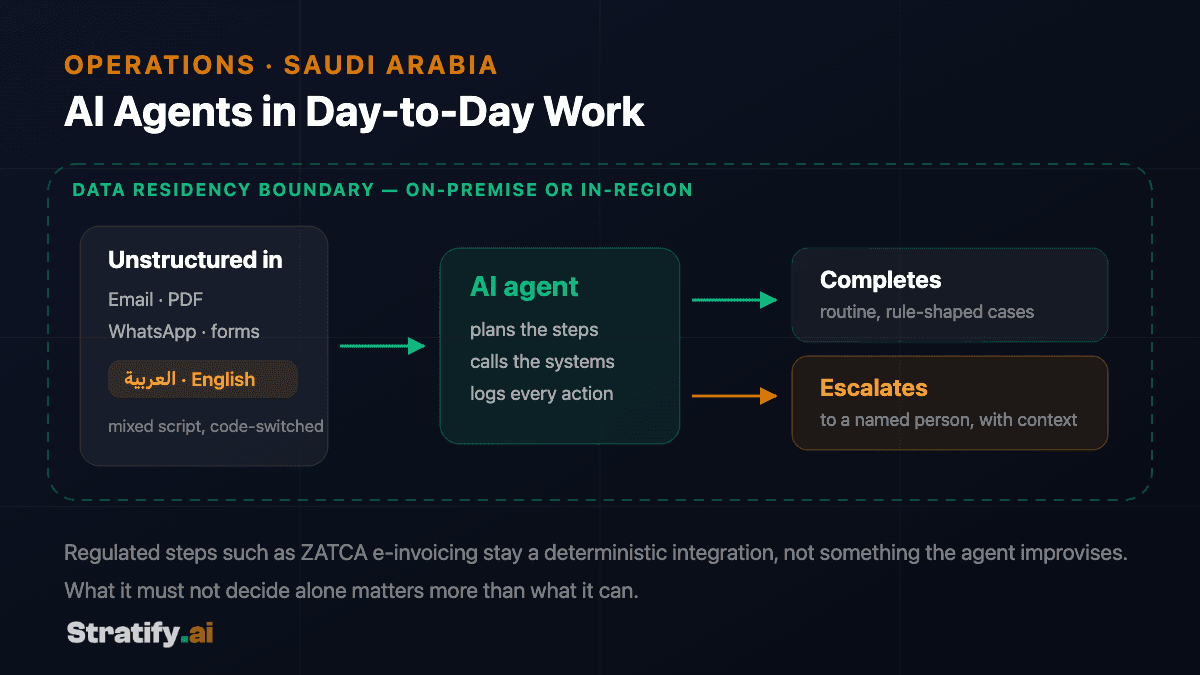
An AI agent applied to day-to-day operations takes a recurring task with a defined outcome — reconciling an invoice, triaging a request, chasing a missing document — and carries it through without a person driving each step. In Saudi enterprises the design is shaped by three specifics: bilingual Arabic and English working practice, data residency and personal-data obligations, and integration with regulated processes such as e-invoicing.
- Start unglamorous
- High-frequency and rule-shaped, not the hardest problem
- Arabic is three problems
- Formal register, dialect, and code-switching
- Residency picks the model
- Decided before the build, or you rebuild
- Escalation is the design
- What it must not decide alone matters most
Key takeaways
- The tasks worth automating are high-frequency, rule-shaped, and currently done by people reading unstructured input — not the complex exceptions.
- Arabic is not a translation layer. Mixed-script input, dialect in customer messages and formal regulatory register are three different problems.
- Data residency and personal-data obligations shape model selection at the start of a project, not at deployment.
- Regulated processes such as ZATCA e-invoicing are integration points to be respected, never steps for an agent to improvise around.
- Escalation design matters more than autonomy. The measure of a well-built agent is that it knows what it must not decide alone.
Choosing what to automate first
The instinct is to point automation at the hardest problem, because that is where the visible pain is. It is usually the wrong first choice. Complex exceptions are complex precisely because they require judgement, context and negotiation — the things agents handle least reliably and where errors cost most.
The better first candidates are unglamorous: tasks done many times a day, following rules someone could articulate if asked, currently performed by people reading email, PDFs or messages and then typing the result into a system. That combination — high frequency, articulable rules, unstructured input — is what agents genuinely do better than both humans and traditional automation. Robotic process automation fails on the unstructured input; people are perfectly capable but expensive and inconsistent at volume.
A practical filter: if the person doing the task could write down what they do in a page, and they do it more than a few times daily, it is a candidate. If explaining it takes an afternoon and ends in 'it depends', it is not a first project.
- Document-driven intake
- Reading incoming invoices, purchase orders or delivery notes and creating the matching system record, escalating on mismatch.
- Request triage
- Classifying and routing inbound customer or internal requests, resolving the routine ones and escalating the rest with context attached.
- Chasing and follow-up
- Pursuing missing documents, unconfirmed approvals or unpaid invoices on a schedule, in the recipient's language.
- Reconciliation
- Matching records between systems that do not talk to each other and surfacing only the exceptions for a person to judge.
Arabic is three problems, not one
Treating Arabic support as a translation feature is the most common design mistake in this market, and it produces systems that work in demonstrations and disappoint in production.
The first problem is register. Formal Modern Standard Arabic — the language of regulatory correspondence, contracts and official documentation — is well handled by general-purpose models. The second is dialect: how customers and staff actually write in messages, which varies regionally and bears limited resemblance to the formal register. A model competent at the first can be noticeably weaker at the second.
The third is code-switching. Saudi professional communication routinely mixes Arabic and English within a single sentence, often with technical terms and product names in English inside Arabic grammar, sometimes with Arabic written in Latin script. An agent that handles each language cleanly in isolation may still fail on the mixture, which is what most real messages look like.
Where this matters, fine-tuning on the organisation's own correspondence is the practical answer — the model learns the register its users actually write in, rather than the register a general corpus over-represents. Where it does not matter, saying so early saves a good deal of unnecessary work.
Data residency, personal data, and model selection
Saudi Arabia's Personal Data Protection Law establishes obligations around the processing and transfer of personal data, and the National Data Management Office publishes data governance standards that apply across regulated and public-sector contexts. For any agent touching customer or employee records, these constraints belong in the first design conversation rather than a pre-deployment review.
The practical consequence is that model choice is not purely a capability question. Where personal data cannot be transferred to a model provider operating outside the Kingdom, the options narrow to open-weight models deployed inside your own infrastructure or a compliant in-region environment. That is a viable architecture, but it constrains which models are available and shapes the surrounding design — so it has to be settled before the build, not after.
Where data can be de-identified before it reaches a model, more options open up, but de-identification is a design commitment in itself: it has to be reliable, testable, and applied consistently at every point data leaves the boundary. Half-measures here are worse than a clear decision either way.
Organisations should also expect to demonstrate this rather than assert it. An architecture where regulated data has no network path out of the environment is a far stronger position in front of a reviewer than a contractual undertaking that it will not be transmitted.
- Decide residency before model selection
- The constraint determines the option set. Choosing a model first and discovering the constraint later means rebuilding.
- Prefer architectural guarantees to contractual ones
- No available network path is a stronger control than a clause, and easier to evidence.
- Log what the agent accessed
- Auditability of which records an agent read matters as much as which actions it took.
- Scope access per agent
- An agent handling invoices needs the invoice store, not the finance system. Narrow service accounts you provision and can revoke.
Working with regulated processes, not around them
Saudi enterprises operate inside processes where the compliant path is prescribed. ZATCA's e-invoicing requirements are the clearest example: invoice generation, clearance and reporting follow a defined integration, and the compliant behaviour is not something an agent should be reasoning about independently.
The correct division is that the agent handles the work around the regulated step, and the regulated step itself remains a deterministic integration. An agent can assemble the data an invoice requires, check it for completeness, chase the missing pieces and prepare it for submission. Submission goes through the compliant integration path, unchanged, every time.
This is a specific instance of a general principle worth stating plainly: agents should be deployed where variability is the problem and removed from anywhere determinism is the requirement. Blurring the two produces systems that are both harder to certify and less reliable.
Escalation is the design, not the fallback
The instinct when specifying an agent is to describe what it should do. The more consequential specification is what it must not do alone, and teams that skip this end up discovering their escalation boundaries through incidents.
Useful boundaries tend to fall into categories. Financial commitment above a defined threshold. Anything with a contractual or regulatory consequence. Cases where the agent's own confidence is low. Cases where the agent has already attempted the task and failed. Anything touching a customer relationship flagged as sensitive.
Equally important is what happens at the boundary. An escalation that arrives as a bare notification saying the agent could not proceed wastes the work already done. A useful escalation hands over the context the agent gathered, the interpretation it reached, and the specific decision required — so the person spends their time deciding rather than reconstructing.
The measure of a well-designed agent, in operational settings, is not how much it does autonomously. It is that the things it escalates are the right things, and that they arrive in a form a person can act on immediately.
The regional working context
Some details are unremarkable individually and consequential in aggregate. The Saudi working week runs Sunday to Thursday, so an agent scheduling follow-ups on a Western calendar will contact people on their weekend and go quiet during the working week. Both Hijri and Gregorian dates appear in business documents, sometimes in the same document, and an agent parsing dates must handle this rather than assume.
Prayer times shape the working day, and an agent placing calls or scheduling meetings without accounting for them will be persistently mistimed. Ramadan changes working hours substantially, which affects both scheduling and what constitutes a normal response time for the purposes of chase logic.
None of these are difficult to handle. They are simply invisible in systems designed elsewhere, and they are what separates an agent that fits how an organisation actually works from one that people quietly stop relying on.
For the architectural argument behind these deployments — orchestrator and subagent roles, deterministic guardrails, and why a single model prompt is the wrong shape for this work — see the shift to agentic AI, our guide to custom AI agent development in Riyadh, and our comprehensive Saudi AI agent development and cost guide. The service itself is described under autonomous AI agents.
Choosing what to automate first
Comparison of autonomous AI agents, robotic process automation, and manual handling across the characteristics that determine which suits a given operational task.
| Criterion | AI agent | Robotic process automation | Manual handling |
|---|---|---|---|
| Unstructured input | Reads email, PDFs and free-text messages directly. | Not handled; expects fixed fields and stable screen positions. | Handled well — this is what people are good at. |
| When the interface changes | Largely unaffected; it works from meaning rather than position. | Breaks, and needs re-recording against the new layout. | Adapts immediately. |
| Consistency at volume | Applies the same rules on the hundredth case as the first. | Highly consistent within its fixed path. | Degrades with fatigue, time pressure and staff rotation. |
| Genuine exceptions | Escalates them, with the gathered context attached. | Fails, usually without a useful explanation. | Handled well — judgement is the human advantage. |
| Bilingual Arabic / English | Handles mixed-script and code-switched input, better still when fine-tuned. | Only where the text is in an expected field and format. | Native, assuming the staff are bilingual. |
| Cost of added volume | Model usage; no additional headcount or licences. | Bounded by how many bot licences you hold. | Linear in headcount. |
| Audit trail | Every action logged against the record it touched. | Execution logs, typically without reasoning. | Whatever the person recorded in the system. |
Frequently asked questions
With one task that is high-frequency, rule-shaped and currently done by someone reading unstructured input. Resist starting with the most painful problem — complexity is usually what makes it painful, and complexity is where agents are least reliable. A narrow first deployment also teaches the organisation what its escalation boundaries should be, which is knowledge that transfers to everything after it.
It depends which Arabic. Formal Modern Standard Arabic is handled well by general-purpose models. Dialect as customers actually write it, and mixed Arabic-English code-switching, are materially harder and are what most real messages contain. Where those dominate, fine-tuning on your own correspondence is the practical answer.
An agent should handle the work around it — assembling invoice data, checking completeness, chasing missing information, preparing submissions — while the regulated submission itself stays a deterministic integration. Compliant behaviour on a prescribed process is not something an agent should be reasoning about independently.
Escalation boundaries are defined in advance so higher-consequence decisions never sit with the agent alone, and every action is logged against the record it touched — so an error is traceable and reversible rather than silent. For financial commitments and anything with a regulatory consequence, the default is that the agent prepares the action and a person approves it.
Not if that is a constraint. Open-weight models deployed on-premise or in an in-region environment keep processing entirely inside your boundary. This has to be decided before the build rather than after, because it determines which models are available and shapes the surrounding architecture.
RPA repeats a fixed sequence and breaks when the interface changes; it also cannot read unstructured input. Agents interpret documents and messages, decide what to do next, and hand off where you have told them to. They are complementary in practice — RPA remains reasonable for stable, structured, high-volume steps.

Let's Build the Future
of Enterprise AI
Have a project in mind or need expert guidance?
We'd love to hear from you.
Salah Ad Din Al Ayyubi Rd, Al Malaz,
Riyadh 12836, Saudi Arabia
Global Enterprise Partner
Empowering businesses across North America, Europe, Asia, and the Middle East.