

AI Integration for Modern Enterprise

You Don't Need to Rip and Replace.
You Need to Reconnect.

Your ERP, CRM, and legacy systems already hold everything they need to think for themselves — they just need AI wired in. We integrate intelligence into what you already run, without the disruption of starting over.

Stratify Agent

Ask about deployment, cost or governance

Hi! I am the Stratify AI Integration Agent. Ask me anything about how we can securely connect LLMs and autonomous agents to SAP, Dynamics, Odoo, or legacy SQL databases.

What is enterprise AI integration?

Enterprise AI integration connects the systems you already run — ERP, CRM, databases, document stores — to AI models that can read that data and act on it. The systems stay where they are. What changes is that operational data becomes something a model can reason over, and a model's output becomes something your systems accept.

It is the alternative to the two approaches enterprises usually default to: replacing a working system because the vendor's AI add-on is the only route to AI, or wiring point-to-point scripts between tools until nobody can safely change anything. Integration keeps the system of record intact and adds an AI layer above it, connected through interfaces that survive the underlying software being upgraded.

Typical timeline
Most integration projects go live in three to six weeks, driven by database and endpoint complexity.
Existing systems
SAP, Oracle, Microsoft Dynamics, Salesforce, Odoo and custom SQL systems stay in place.
Deployment method
Built and tested in staging, then run in parallel with live operations before cutover.
Model keys
Models run under your own API keys, or fully on-premise where data cannot leave your estate.
AI INSIDE THE SYSTEMS YOU ALREADY RUN

Connected.
Not Replaced.

We put AI into SAP, Dynamics, Salesforce, Odoo and the legacy databases underneath them — under your own keys, inside your own boundary.

01
AI integrated into existing enterprise systems
INTEGRATION

Keep The Systems
You Have

No rip-and-replace. We connect AI to the ERP and CRM your organisation already runs on, through APIs or direct database access where no API exists.

  • SAP, Dynamics, Odoo
  • Legacy SQL Included
  • Middleware You Own
See what we connect
02
One-time integration setup instead of recurring vendor add-on fees
PRICING

Setup Once,
Not Every Month

Vendor AI add-ons like Einstein or Copilot Studio bill per user, every month, forever. A one-time integration avoids that entirely.

  • No Per-User Add-On Fees
  • One-Time Development Fee
  • No Runtime Licence
See the cost model
03
Models run under your own API keys inside your own infrastructure
CONTROL

Your Keys,
Your Boundary

Models run under your own API keys. Where data cannot leave your infrastructure, we deploy open-weight models inside a boundary you control.

  • Your Own API Keys
  • On-Premise Option
  • Data Residency Respected
Talk it through
04
Integration source code handed over so your team can extend it
EXTEND

Extend It
Yourself

The middleware source code and IP are handed over, so your own engineers can extend the integration without coming back to us for every change.

  • Source Code Handed Over
  • Add Systems Later
  • No Vendor Dependency
Talk it through
Intelligence Layered Into What You Already Run

Seamless Integration Layers

We build custom middleware, APIs, and AI connectors to add cognitive capabilities directly into your legacy stacks.

CRM AI Integration

CRM AI Integration

Add lead scoring, auto-follow-up, and conversational agents to your existing Salesforce, Dynamics, or Odoo CRM.

Lead Scoring
Auto-follow-up
Conversational Agents
CRM Connectors
ERP & MIS Integration

ERP & MIS Integration

Connect predictive analytics and natural-language reporting to your existing ERP data.

Predictive Analytics
Natural-language Reports
ERP Connectors
Real-time Queries
HR System Integration

HR System Integration

Layer AI screening, onboarding assistants, and policy Q&A onto your current HRIS.

Resume Screening
Onboarding Assistants
Policy Q&A Layer
HRIS Sync
Manufacturing System Integration

Manufacturing System Integration

Connect PDT/handheld devices, production systems, and middleware (e.g., Celery-based queues) to AI-driven monitoring.

PDT Device Integration
Production Systems
Celery Middleware
AI Monitoring
Legacy Database Integration

Legacy Database Integration

Bring even decades-old systems into the AI era via RAG pipelines and secure API bridges.

Legacy Systems
RAG Pipelines
Secure API Bridges
Query Optimization

Custom Integrations

Any system, any stack — if it has data, we can make it intelligent.

Tailor-Made

Built for your unique workflows

Any Data / System

Connects with tools & databases

Multi-language

Arabic, English, and beyond

Scalable by Design

Start small, scale effortlessly

OUR PROCESS

From AI App Preview to Continuous Growth

We build with you, not for you. See the solution early, shape it together, and scale with confidence.

01

AI App Preview

See it before we build it.

We rapidly build an interactive AI-powered app preview so you can experience the solution early.

  • Working AI App Preview
  • Core Workflows
  • Initial UI/UX
  • Live Demonstration
02

Document & Refine

Your business shapes it.

We document your processes, gather feedback, and refine the solution to fit your needs.

  • Process Mapping
  • Feature Refinement
  • Gap Analysis
  • Final Scope
03

Engineer for Production

Built strong. Built secure. Built to scale.

We turn the preview into a robust, enterprise-grade application with security and integrations.

  • Enterprise Architecture
  • API Integrations
  • Security & Compliance
  • AI Optimization
04

Go Live

Deploy without disruption.

We roll out in controlled phases with testing, migration, and training for a smooth launch.

  • UAT & Validation
  • Data Migration
  • Phased Rollout
  • User Training
05

Scale & Evolve

Keep improving. Stay ahead.

We continuously enhance the solution with new AI capabilities as your business grows.

  • New AI Agents & Features
  • Performance Monitoring
  • Continuous Improvements
  • SLA Support
Security & Compliance First
Your Data Stays Yours
Source Code & IP Handed Over
No Lock-in, Ever
Built to Connect, Not Replace

Secure & Compliant Tech Stack

Integration & Middleware

  • REST/GraphQL APIs
  • Celery-based task queues
  • n8n

AI Layer

  • Claude
  • GPT-4 class models
  • RAG pipelines
  • pgvector

Core Systems We Integrate With

  • Odoo, Salesforce, Microsoft Dynamics, SAP
  • Custom Django/PostgreSQL systems
  • Handheld/PDT devices

Infrastructure

  • AWS
  • Azure
  • On-premise/private cloud for enterprise data residency

Security

  • Encrypted data pipelines
  • Role-based access
  • Audit logging

Languages

  • Multilingual enterprise support
How the options differ

Integration vs. Replacement

Adding AI to an enterprise estate comes down to three structurally different routes. The distinctions below are architectural, not performance claims.

Comparison of AI integration into existing systems, full platform replacement, and point-to-point scripting, across disruption, ownership, maintenance, auditability and reversibility.
Comparison criterionAI integration layerRip-and-replace platformPoint-to-point scripts
System of recordStays as-is. The AI layer reads and writes through defined interfaces.Replaced, along with the migration and retraining that implies.Stays, but accumulates undocumented dependencies over time.
Data movementData stays in its source system; the layer queries it in place.Full migration, with the reconciliation risk that carries.Copies proliferate across scripts, and drift between them.
Who maintains itYou do — the middleware source code is handed over.The platform vendor, on their release cycle.Whoever wrote the script, if they are still available.
When a schema changesThe interface absorbs it; the change is versioned and tested.Vendor-managed, but your customisations may not survive it.Scripts fail silently until somebody notices the bad data.
Audit trailEvery AI-initiated read and write is logged against the source record.Whatever the platform chooses to expose.Usually none beyond application logs.
Rolling backDisable the layer; the underlying systems are untouched and still running.A second migration project.Depends which scripts have become load-bearing.
AI model choiceModel-agnostic — swap providers, or run open-weight models on-premise.Bound to whichever model the platform vendor embedded.Per-script, so the estate ends up with several inconsistent choices.

These describe how each approach is structured rather than measured outcomes. Which fits depends on the age of your systems, your data residency obligations and how much change your operations can absorb at once.

What it costs

You Pay Us Once. After That, Only Your Model Bill

One development fee to build it. Then the only ongoing cost is the model subscription you hold directly with the provider, on your own card, scaled to how much work gets done. Nothing recurring comes to us at all.

1 — DevelopmentPaid to us, once

Billed once, then never again

A one-time development fee, scoped to the work in question and fixed before we start. At handover the source code, the logic and the IP are yours to keep, extend or take elsewhere.

2 — Model usagePaid to the model provider

Your own LLM subscription, on your own card

Your integration needs model capacity to run. You hold that subscription directly with the model provider and pay them from your own card — it never passes through us, so there is nothing for us to resell or mark up. What it costs depends on how much work gets done, not on how many people you have.

3 — Later workOnly if you ask

Come back when you want more

There is no support contract and no retainer to sign. It keeps running on its own, and you hold the code. When you want it improved, extended or pointed at something new, you come back to us and we quote that piece of work like any other.

Where the development number lands depends on how many systems are involved and how clean the access to them is. Describe what you need and we will scope it properly — including an estimate of what the model subscription will cost you at your volumes — rather than quote a range that means nothing.

Get a scoped estimate
Where integration gets applied

Worked Scenarios

Three integration problems we see repeatedly across GCC enterprises, and the shape of the approach in each.

Illustrative scenarios. These are composite examples showing how this service is typically applied. They do not describe specific client engagements and are not case studies.

ERP & FINANCE

Making ERP data answerable in natural language

Situation
Operational data sits in an ERP that only reports through fixed templates, so any new question becomes a request to a reporting team.
Approach
A retrieval layer indexes the ERP's data model and lets staff ask questions directly, with every answer traceable back to the records it drew on.
What changes
The ERP stays the system of record and nothing is migrated. What changes is who can ask a question without waiting in a queue.
LEGACY SYSTEMS

Adding AI to a platform the vendor has stopped extending

Situation
A core system still does its job but its vendor ships no AI capability, and the roadmap offers none.
Approach
Middleware bridges the system's APIs and database to a model layer that runs under the enterprise's own keys, built and tested in staging first.
What changes
AI capability arrives without a replacement project, and the enterprise owns the bridge rather than waiting on a vendor roadmap.
DATA RESIDENCY

AI over regulated data that cannot leave the country

Situation
The obvious AI tooling is cloud-hosted abroad, and the data in question is subject to residency requirements that rule it out.
Approach
Open-weight models are deployed inside the enterprise's own region or on-premise, with the integration layer keeping every query within that boundary.
What changes
The residency position is architectural rather than contractual — the data has no path out of the environment it is required to stay in.

White Papers

Paper
Summary & Detail
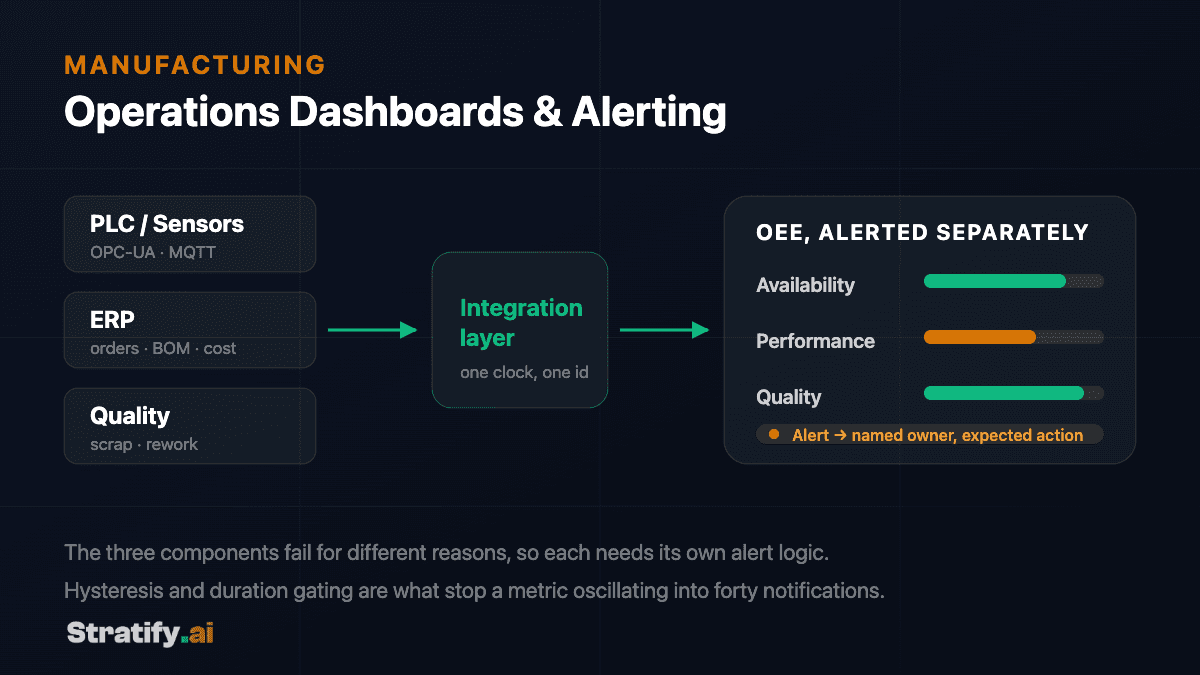
Diagram: PLC sensors, ERP and quality data feed an integration layer into a manufacturing operations dashboard, with availability, performance and quality alerted separately to a named owner.

Paper

Automated Operations Dashboards and Alerting for Manufacturers

Topic

Manufacturing

An automated operations dashboard for a manufacturer pulls live data from production systems, the ERP and plant-floor equipment into a single view, and pairs it with alerting that notifies a named person when a metric crosses a threshold that matters. The distinguishing feature is not the charts — it is that the system decides what deserves attention, rather than leaving that judgement to whoever happens to be looking at the screen.

Alert the components
Not composite OEE — the three parts fail for different reasons
Hysteresis + gating
What stops a metric oscillating into forty notifications
Owner and action
Required on every rule, or it is a status update
Rules over models
AI earns anomaly detection, not working thresholds

Frequently Asked Questions

No. Our integration services are designed to connect custom AI engines directly to your existing systems (such as Odoo, SAP, Salesforce, or custom SQL databases) via secure APIs and custom middleware, preserving your existing infrastructure investments.

No. We build and thoroughly test all integration middleware in staging environments and run them in parallel before full deployment to ensure zero downtime and zero disruption to your daily operations.

Yes. We regularly build secure API bridges and custom database connectors to integrate advanced LLMs and AI agents with legacy platforms including SAP, Dynamics, Salesforce, and custom-built enterprise databases.

Most integration projects go live within 3–6 weeks, depending on the complexity of the databases, API endpoints, and the specific automation logic required.

Yes, custom integration is highly cost-effective. A one-time integration setup avoids the recurring monthly per-user license fees of vendor AI add-ons (like Salesforce Einstein or Copilot Studio) and lets you run models under your own API keys.

Through SAP's own interfaces rather than around them — OData services, BAPI/RFC calls, or a read replica where direct access is restricted. The AI layer sits outside SAP and treats it as a system of record it queries and writes back to, which means the integration survives SAP upgrades and does not require custom ABAP that your SAP partner then has to maintain.

The integration talks to versioned interfaces, not to internal tables or screen positions, which is what keeps an upgrade from breaking it. Where a vendor changes an interface between major versions, the middleware is the single place that needs updating rather than every script that touched the system. Because you hold the middleware source code, that update is not gated on our availability.

Access is scoped per integration through service accounts you provision, so the AI layer sees only the records the task requires. Pipelines are encrypted in transit, access is role-based, and every AI-initiated read and write is logged against the source record. Where data cannot leave your estate at all, we run open-weight models inside your own infrastructure so no query crosses the boundary.

Usually yes, though the route matters. Direct database access against a read replica is the cleanest option where the schema is stable. Where it is not, we work through file-based exchange, message queues, or a thin service layer built over the system. What we avoid is screen-scraping the user interface, because that produces an integration that breaks on the next cosmetic change.

Yes. The middleware source code and IP are handed over as part of the engagement, in the same way as our application work. There is no runtime licence to us and no component that stops working if the relationship ends. Practically, that also means your own engineers can extend the integration without coming back to us for every change.

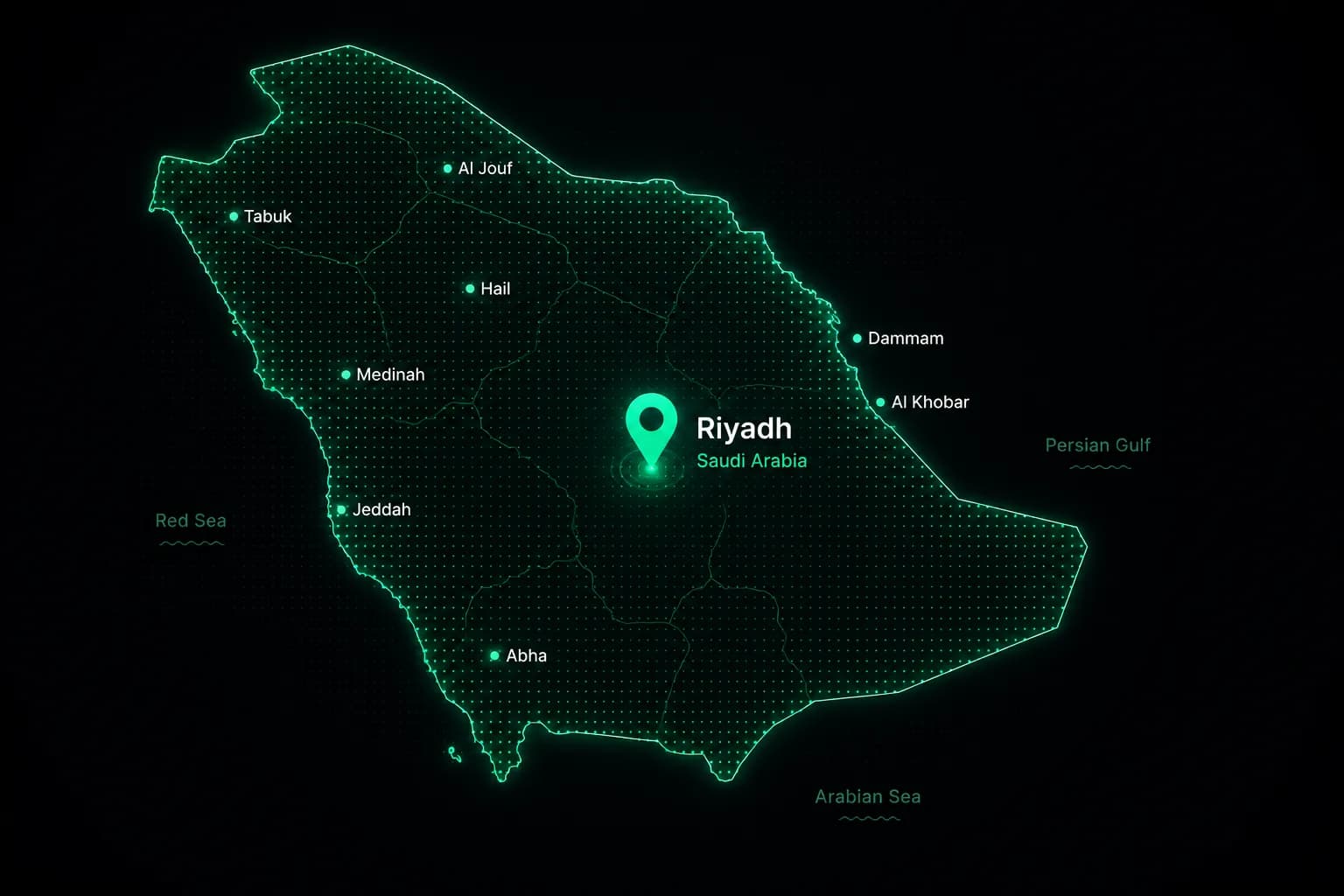
Riyadh Skyline
CONTACT US

Let's Build the Future
of Enterprise AI

Have a project in mind or need expert guidance?
We'd love to hear from you.

GLOBAL HEADQUARTERS
Stratify AISecond Floor, Diamond Building,
Salah Ad Din Al Ayyubi Rd, Al Malaz,
Riyadh 12836, Saudi Arabia
EMAIL
[email protected]
PHONE
+966 54 688 0286
Global Reach Map
Global NetworkWorldwide Presence

Global Enterprise Partner

Empowering businesses across North America, Europe, Asia, and the Middle East.

Send Us a Message

An engineer replies within one working day — not a sales sequence. No newsletter, no cold calls.

Your information is secure and never shared.