


AI Agent Deployment for Enterprise — Saudi Arabia & GCC

Autonomous AI Agents That Finish the Work. Not Just Answer Questions.

Give an agent a goal — reconcile this invoice, qualify this lead, resolve this ticket — and it plans the steps, reads the documents, calls your systems and carries the task through. Live in four to eight weeks, governed by escalation rules you set, with the source code and IP yours at handover.

Stratify Agent

Ask about deployment, cost or governance

Hi! I am the Stratify AI Workflow Agent. Ask me anything about how we build autonomous agents to automate operational tasks.

What is an autonomous AI agent?

An autonomous AI agent is software that pursues a goal rather than answering a question. Given an objective — reconcile this month's invoices, qualify this lead, resolve this ticket — it plans the steps, calls whatever systems it needs, and carries the task through without a human restarting it at each stage.

That makes it a different category from a chatbot, which replies and stops, and from robotic process automation, which repeats a fixed click-path and breaks when the screen changes. An agent reads unstructured input, decides what to do next, and hands off to a person at the points you define. The agents we build run against your systems under your governance rules, and the logic belongs to you.

Deployment window
Most enterprise agents go live in four to eight weeks, depending on data access and sandbox testing.
Licensing
No per-seat fees and nothing recurring to us. A one-time development fee; the LLM subscription is held directly with the model provider. You own the codebase and agent logic.
Governance
Human-in-the-loop by design — you set which decisions an agent may take alone and which it must escalate.
Data residency
On-premise or private cloud deployment available where data must stay inside a chosen region.
One agent, one job, end to end

What an Agent Actually Does All Day

Below is a single invoice reconciliation, start to finish. No human restarts it at any stage — but it stops itself at the one decision it was not given authority to make. That boundary is the whole design.

Where you draw the line

You define the tolerance in step 3 — and every other threshold like it. Below it the agent acts. Above it the agent prepares the action and a named person approves. For payments, contractual commitments and anything with a regulatory consequence, the default is always approval.

The same shape applies to a lead that needs qualifying or a ticket that needs resolving. What changes is the systems it reads, the tolerance you set, and who it escalates to. See how we connect agents to SAP, Dynamics and legacy databases for the plumbing underneath.

  1. 01
    Input arrives Shared mailbox

    A supplier invoice lands as a PDF attachment

    No fixed fields, no template, no consistent layout between suppliers. This is the point at which robotic process automation stops and an agent starts.

  2. 02
    Reads & matches CRM

    The agent extracts line items and matches them to the purchase order in CRM

    It reads the document rather than scraping fixed screen positions, then finds the corresponding purchase order and compares it line by line.

  3. 03
    Decision boundary Your tolerance rules

    Three lines match. One is 12% over the purchase order.

    That variance exceeds the threshold you set, so the agent does not post it. It has the ability to write the record and the instruction not to.

  4. 04
    Escalates Named approver

    It drafts the exception, routes it to a person, and waits

    The approver receives the invoice, the purchase order, the variance and the agent's own reasoning — not a bare alert asking them to go and investigate.

  5. 05
    Completes & logs Reconciliation record

    One approval, and the agent finishes the job

    It writes the reconciliation record, then logs every step it took and the human decision against the invoice. The audit trail is produced by the same system doing the work, not assembled afterwards.

AGENTS THAT DO THE JOB, NOT JUST ANSWER QUESTIONS

Bespoke Autonomous Solutions

AI agents tailored to your business workflows, systems, and goals — built to act, decide, and deliver. Our white paper on agents in daily operations at Saudi enterprises goes through the operational detail.

Sales & CRM Agents

Sales & CRM Agents

Qualifies inbound leads, chases the ones going cold, and keeps the pipeline honest across email, WhatsApp and voice — in Arabic and English.

Systems it works in
Your CRM, email, WhatsApp Business, calendar
Decides on its own
Qualifies and scores leads, books meetings into open slots, drafts and sends follow-ups, updates pipeline stages.
Always escalates
Discounting, contractual terms, anything a named account owner has flagged as theirs.
Customer Support Agents

Customer Support Agents

Resolves tickets end to end rather than deflecting them, and escalates the ones that genuinely need a person — with the history already attached.

Systems it works in
Helpdesk, order and account systems, knowledge base
Decides on its own
Answers from your own documentation, looks up order and account state, issues resolutions within the limits you set, closes the ticket.
Always escalates
Refunds and credits above your threshold, complaints, anything where the customer asks for a human.
Finance & Compliance Agents

Finance & Compliance Agents

Reconciles invoices, audits expenses and assembles regulatory reporting — producing the audit trail as a by-product of the work, not afterwards.

Systems it works in
Accounting system, invoice store, purchase orders, expense tooling
Decides on its own
Matches invoices to purchase orders, reconciles within tolerance, flags duplicates and policy breaches, prepares reports.
Always escalates
Every payment. Any variance over your tolerance. Anything with a regulatory consequence.

Operations Agents

Monitor inventory, trigger purchase orders, and flag exceptions before they become problems.

HR & Recruitment Agents

Screen CVs, schedule interviews, onboard new hires, and answer policy questions instantly.

Manufacturing & Supply Chain Agents

Coordinate production schedules, quality checks and logistics in real time.

Custom Agents

Built to your exact process, data, and language — if it's a repeatable decision, we can automate it.

Tailor-Made

Built for your unique workflows

Any Data / System

Connects with tools & databases

Multi-language

Arabic, English, and beyond

Scalable by Design

Start small, scale effortlessly

Which of your processes is the first one?

Tell us the workflow and we will tell you honestly whether an agent is the right tool for it — an engineer replies within one working day.

Start the conversation
OUR PROCESS

From One Workflow to Production, in Four to Eight Weeks

The agent is rarely the slow part. Getting clean access to your systems is, which is why it is stage two rather than an afterthought.

01

Pick the Workflow

One process, measured before we touch it.

We choose a single high-volume workflow and baseline what it costs you today in hours and errors.

  • Workflow selection
  • Volume & cost baseline
  • Success criteria agreed
  • Scope fixed in writing
02

Scope System Access

The real constraint, handled first.

We agree exactly what the agent may read and write, through service accounts you provision and can revoke.

  • Least-privilege permissions
  • Service accounts you own
  • Test environment access
  • Data residency decision
03

Build Agent & Rules

Including what it may not do.

We build the agent alongside its escalation boundaries — the thresholds that decide what it settles and what it routes to a person.

  • Agent logic & tools
  • Escalation thresholds
  • Full action logging
  • Integration build
04

Shadow Run

Wrong on paper, never in production.

The agent runs on live data beside your team, taking no actions, until its decisions match theirs often enough to trust.

  • Live data, no write access
  • Decision-match rate
  • Edge cases surfaced
  • Governance sign-off
05

Production & Review

Watched, not forgotten.

It goes live on a defined slice of volume, monitored, with escalations reviewed so the boundaries keep improving.

  • Phased volume rollout
  • Monitoring & alerting
  • Escalation review cycle
  • Source code & IP handover
Security & Compliance First
Your Data Stays Yours
Source Code & IP Handed Over
No Lock-in, Ever
Built on Enterprise-Grade Infrastructure You Control

Secure & Compliant Tech Stack

Connecting an agent to what you already run — SAP, Dynamics, Odoo, legacy SQL — is its own piece of work. See AI integration for how that access is scoped and secured.

Foundation Models

  • Claude, GPT-4 class models
  • open-weight LLMs for on-premise/data-residency deployments

Agent Orchestration

  • LangChain
  • LangGraph
  • custom orchestration layers

Knowledge & Retrieval

  • RAG pipelines
  • pgvector
  • Pinecone

Core Systems

  • Odoo
  • Django
  • PostgreSQL
  • REST/GraphQL APIs

Automation & Integration

  • n8n
  • custom middleware (Celery-based task queues)

Infrastructure

  • AWS
  • Azure
  • on-premise/private cloud for enterprise data residency requirements

Languages

  • Multilingual natural-language support
How the options differ

Owned Agents vs. The Alternatives

Most enterprises weighing autonomous agents are really choosing between three structurally different models. The differences below are architectural, not performance claims.

Comparison of owned AI agents, seat-licensed SaaS automation, and traditional robotic process automation across licensing, ownership, adaptability, data residency and scaling characteristics.
Comparison criterionOwned AI agentsSeat-licensed SaaSTraditional RPA
Licensing modelOne-time development fee to the builder; the model subscription is yours, held with the provider.Recurring fee per user, per month, for as long as you use it.Licensed per bot or per runtime, usually annually.
Who owns the logicYou do. Source code and IP are handed over at the end of the engagement.The vendor. You configure within the options they expose.You own the scripts; the runtime that executes them stays licensed.
Unstructured inputHandled natively — reads email, documents and free-text requests.Depends entirely on what the vendor has built.Generally not handled; expects fixed fields and screen positions.
When the process changesEdit the agent's instructions and governance rules directly.Wait for the vendor roadmap, or work around the gap.The script breaks and needs re-recording against the new interface.
Where data sitsYour infrastructure — on-premise or a private cloud region you choose.The vendor's cloud, in whichever regions they operate.Typically on-premise, though orchestration may be hosted.
Adding more usersNo licence implication; cost tracks actual usage.Each additional user adds a recurring seat charge.Concurrency is bounded by how many bot licences you hold.
If you leave the vendorNothing to leave — you already hold the code and the data.Configuration and workflow logic generally do not come with you.Scripts are portable only to the same vendor's runtime.

Comparisons describe how each model is structured, not benchmarked performance. Which one fits depends on your data access, regulatory position and how much your processes change.

Already paying per seat for something an owned agent could do? Send us the workflow and what it currently costs you, and we will tell you whether the swap is worth making.

Put it to us
What it costs

You Pay Us Once. After That, Only Your Model Bill

One development fee to build it. Then the only ongoing cost is the model subscription you hold directly with the provider, on your own card, scaled to how much work gets done. Nothing recurring comes to us at all.

1 — DevelopmentPaid to us, once

Billed once, then never again

A one-time development fee, scoped to the work in question and fixed before we start. At handover the source code, the logic and the IP are yours to keep, extend or take elsewhere.

2 — Model usagePaid to the model provider

Your own LLM subscription, on your own card

Your agent needs model capacity to run. You hold that subscription directly with the model provider and pay them from your own card — it never passes through us, so there is nothing for us to resell or mark up. What it costs depends on how much work gets done, not on how many people you have.

3 — Later workOnly if you ask

Come back when you want more

There is no support contract and no retainer to sign. It keeps running on its own, and you hold the code. When you want it improved, extended or pointed at something new, you come back to us and we quote that piece of work like any other.

Where the development number lands depends on how many systems are involved and how clean the access to them is. Describe what you need and we will scope it properly — including an estimate of what the model subscription will cost you at your volumes — rather than quote a range that means nothing.

Get a scoped estimate
Where agents get applied

Worked Scenarios

Three problem shapes we see repeatedly across GCC enterprises, and how agent deployment addresses each.

Illustrative scenarios. These are composite examples showing how this service is typically applied. They do not describe specific client engagements and are not case studies.

SALES & CRM

Replacing a seat-licensed CRM with agent-driven pipeline work

Situation
A distribution business runs its pipeline in a per-user CRM. Every new branch means more seats, and the workflow logic is whatever the vendor ships.
Approach
Sales agents own lead qualification and follow-up across email, WhatsApp and voice, writing into a CRM built around the company's own pipeline stages rather than a vendor's.
What changes
Pipeline logic becomes something the business edits directly. Adding branches adds usage, not licences, because there are no per-seat fees to pay.

FINANCIAL SERVICES

Client servicing where the compliance trail is part of the system

Situation
A firm's client servicing runs through a general-purpose CRM whose approval steps cannot be reshaped to match its regulatory obligations.
Approach
Agents handle client requests and record every action against the firm's own compliance model, escalating to a named human at the points the firm defines.
What changes
The audit trail is generated by the same system doing the work, and the firm holds the source code for the logic that decides what gets escalated.
REAL ESTATE

Consolidating listing, enquiry and post-sale tooling

Situation
A developer runs separate tools for listings, enquiry capture, viewing schedules and handover — each with its own subscription and none aware of the others.
Approach
One application where agents field enquiries, book site visits and carry the buyer through handover, working from a single record of the project.
What changes
Launching a new project extends an owned system rather than triggering another round of subscriptions, and the buyer history stays in one place.

White Papers

Paper
Summary & Detail
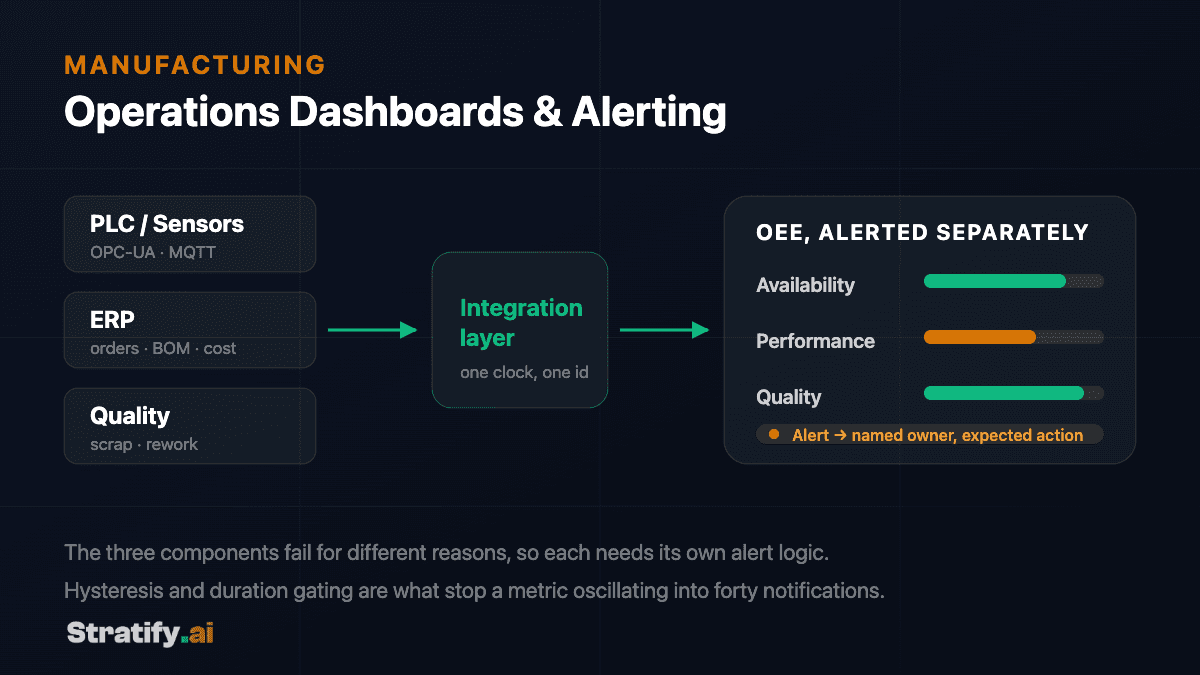
Diagram: PLC sensors, ERP and quality data feed an integration layer into a manufacturing operations dashboard, with availability, performance and quality alerted separately to a named owner.

Paper

Automated Operations Dashboards and Alerting for Manufacturers

Topic

Manufacturing

An automated operations dashboard for a manufacturer pulls live data from production systems, the ERP and plant-floor equipment into a single view, and pairs it with alerting that notifies a named person when a metric crosses a threshold that matters. The distinguishing feature is not the charts — it is that the system decides what deserves attention, rather than leaving that judgement to whoever happens to be looking at the screen.

Alert the components
Not composite OEE — the three parts fail for different reasons
Hysteresis + gating
What stops a metric oscillating into forty notifications
Owner and action
Required on every rule, or it is a status update
Rules over models
AI earns anomaly detection, not working thresholds

Frequently Asked Questions

You pay us once. The development fee is a one-time cost, scoped to the workflows in question and fixed before work starts; at handover the source code, agent logic and IP are yours. After that the only ongoing cost is the LLM subscription the agents run on, and that is not ours — you hold it directly with the model provider and pay them from your own card, so nothing passes through us to be marked up. What it costs depends on how much work the agents do, never on how many people you employ. There is no support contract and no retainer: when you want the agents improved or pointed at a new process, you come back to us and we quote that work. What the development fee comes to depends on how many systems the agent touches and how clean the access to them is, which is why we scope it against a named process rather than quote a range.

A chatbot answers a question and stops. Robotic process automation repeats a fixed sequence of clicks and breaks when the interface behind it changes. An autonomous agent is goal-oriented: it plans the steps, reads unstructured input like email and documents, calls APIs, and follows the task through to completion without a human restarting it at each stage.

No. Our AI agents are designed to integrate directly with your existing software stack (SAP, Salesforce, Dynamics) to automate manual operations. However, where it is financially viable, they can replace seat-licensed third-party tools completely with custom modules you own.

Most custom enterprise AI agents go live within 4–8 weeks. The variable is rarely the agent itself — it is how quickly we can get clean access to the systems it needs to read and write, plus the sandbox testing your governance process requires before it touches production.

Agents are architected to support the controls these regimes require — access scoping, full action logging, data minimisation and retention rules — and can be deployed on-premise or in a private cloud region so data never leaves a boundary you control. Where your procurement process requires a specific certification or attestation from us as a supplier, ask and we will tell you exactly what we hold rather than what we are aligned with.

No — you pay us nothing on a recurring basis at all. You own the custom codebase, agent logic and intellectual property, so there is no licence to renew and no seat count to grow. The one ongoing cost is the LLM subscription the agents run on, which you hold directly with the model provider and pay on your own card. It is metered on how much the agents do, not per head.

Agents are built with explicit escalation boundaries: you define which decisions an agent may take on its own and which must route to a named person. Every action an agent takes is logged against the record it touched, so a wrong decision is traceable and reversible rather than silent. For higher-risk steps — payments, contractual commitments, anything with a regulatory consequence — the default is that the agent prepares the action and a human approves it.

Yes. Our agents handle Arabic and English in the same workflow, including mixed-language input where a customer switches mid-conversation. For domain-specific Arabic — regulatory language, regional dialect in customer messages, sector terminology — we fine-tune on your own material rather than relying on a general-purpose model's handling of it.

Yes. Where data cannot leave your infrastructure, we deploy open-weight models on-premise or in a private cloud region you control, and the agent runs entirely inside that boundary. This is a design decision made at the start of the engagement, because it shapes model selection and the surrounding architecture.

Only what the specific task requires. An agent handling invoice reconciliation needs read access to the invoice store and write access to the reconciliation record — not general access to the finance system. We scope permissions per agent, through service accounts you provision and can revoke, so access is auditable from your side rather than ours.

No. There is no retainer and nothing to renew. The agents keep running once they are live, and because the source code and IP are handed over, your own team or another supplier can maintain them — nothing about the handover leaves you dependent on us. When you do want something more — an escalation rule changed as the business shifts, the agent extended, a second process automated — you come back to us and we scope and quote that piece of work on its own.

Riyadh Skyline
CONTACT US

Let's Build the Future
of Enterprise AI

Have a project in mind or need expert guidance?
We'd love to hear from you.

GLOBAL HEADQUARTERS
Stratify AISecond Floor, Diamond Building,
Salah Ad Din Al Ayyubi Rd, Al Malaz,
Riyadh 12836, Saudi Arabia
EMAIL
[email protected]
PHONE
+966 54 688 0286
Global Reach Map
Global NetworkWorldwide Presence

Global Enterprise Partner

Empowering businesses across North America, Europe, Asia, and the Middle East.

Send Us a Message

An engineer replies within one working day — not a sales sequence. No newsletter, no cold calls.

Your information is secure and never shared.