The Shift to Agentic AI: Why Enterprises Are Moving Beyond Chatbots to Autonomous Workflows
Transitioning from passive conversation interfaces to goal-driven multi-agent orchestration with zero vendor lock-in.

Executive Summary
First-generation enterprise AI adoption focused heavily on conversational chatbots and static text synthesis. The second wave is agentic: autonomous AI systems capable of multi-step reasoning, invoking external APIs, executing complex database queries, and executing routine tasks inside legacy systems like SAP, Odoo, and Zoho. This paper explores why enterprise workflows are adopting goal-driven multi-agent teams, how security guardrails operate outside the model context, and how sovereign deployment preserves full intellectual property ownership.
- Goal vs Prompt
- Agents execute end-to-end tasks autonomously; chatbots wait for line-by-line commands
- Deterministic Guardrails
- Security and RBAC enforced in the API & database layer, not system prompts
- Specialized Subagents
- Domain-specific micro-agents outperform single monolithic LLM prompts
- Zero Lock-In
- Self-hosted & sovereign model deployment keeps data inside your corporate boundary
Key Takeaways
- Conversational AI handles Q&A; Agentic AI executes multi-step business processes from start to finish.
- Multi-agent architectures divide complex jobs into specialized roles (planner, executor, evaluator), dramatically cutting hallucination rates.
- Enterprise security requires deterministic guardrails: database row-level security, schema isolation, and explicit human approval for state-changing write operations.
- Integrating AI agents directly into operational databases (Postgres, Odoo, Zoho) delivers immediate ROI without needing to replace core legacy infrastructure.
- Owning your custom agent workflows and integration code guarantees that AI capabilities become a permanent corporate asset.
The Limits of First-Generation Chatbots
Over the past three years, enterprise AI adoption has been dominated by conversational chat interfaces and copilot sidebars. While these tools demonstrated the raw reasoning and language generation capabilities of Large Language Models (LLMs), they revealed structural limitations in production environments.
Chatbots are fundamentally passive and conversational. They require continuous human intervention at every step, struggle with complex context spanning multiple enterprise databases, and cannot independently take actions in external software systems. When an employee must copy text from a chat box, format it, paste it into an ERP, and verify the transaction manually, the human remains the primary bottleneck.
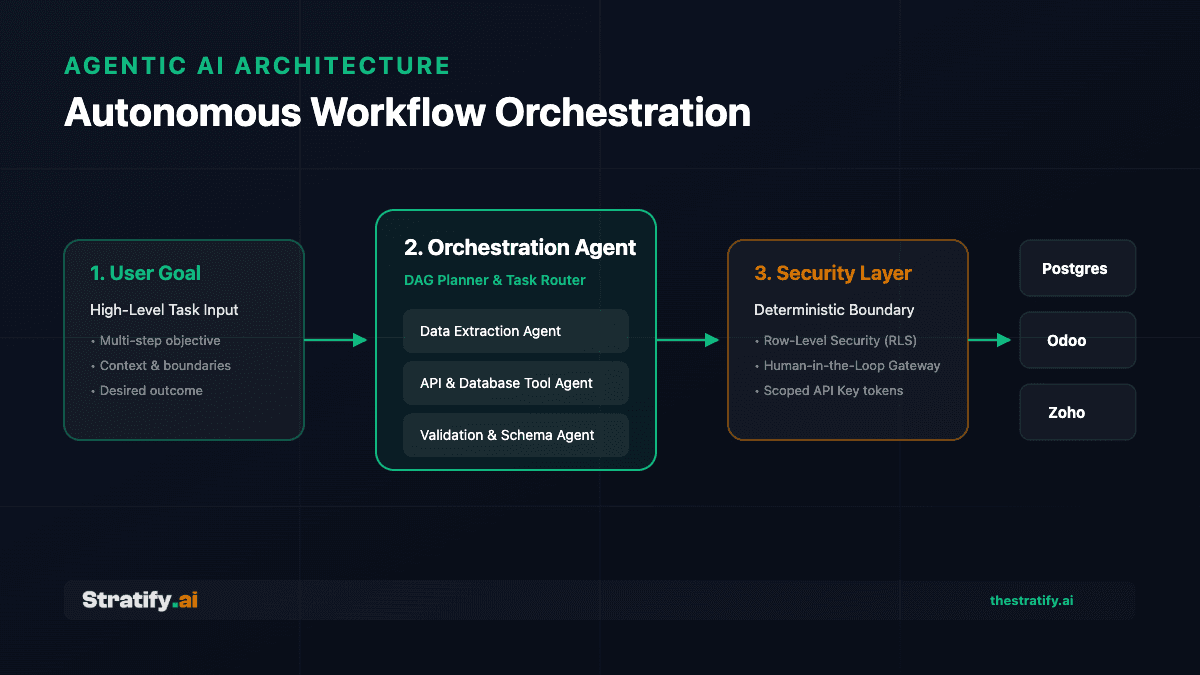
Agentic AI transforms this dynamic. Rather than responding to a prompt with prose, an agent is assigned a goal (e.g., 'Reconcile pending supplier invoices against receiving logs and draft the payment approvals'). The agent plans the necessary steps, queries the relevant databases, calls external service APIs, verifies data integrity, and presents completed artifacts for human sign-off.
Anatomy of an Enterprise Multi-Agent System
Attempting to solve complex operational workflows with a single LLM prompt fails because large contexts lead to instruction drift and hallucinated actions. Modern agentic architectures employ specialized multi-agent teams coordinated by a central orchestrator.
Each subagent operates within a strictly defined domain with specific tools and localized context. A Data Extraction Agent focuses solely on parsing unstructured invoices; a Validation Agent cross-references line items against purchase orders in PostgreSQL; an ERP Integration Agent formats the payload for Odoo or Zoho.
This separation of concerns mirrors high-performing human operational teams, ensuring that failure in one subtask is isolated and recovered automatically before affecting downstream steps.
- Orchestrator Agent
- Deconstructs the user goal into a directed acyclic graph (DAG) of subtasks, assigning tasks to specialized subagents and managing state transitions.
- Specialized Tool Agents
- Equipped with deterministic tools (SQL queries, API handlers, code interpreters) to execute precise data actions with strict typing.
- Evaluator & Verification Agent
- Inspects intermediate outputs against defined schema rules and business logic before passing data to write operations.
- Human-in-the-Loop Gateway
- Intercepts high-consequence actions (payments, data deletions, customer notifications) and requests human authorization.
Architectural Comparison: Chatbots vs. Agentic Workflows
To understand how agentic architectures differ from traditional chat interfaces, consider the following structural capabilities across key enterprise dimensions.
Security, Compliance, and Data Sovereignty
Deploying autonomous agents into production requires strict security controls. A common mistake is relying on system prompts to enforce access rules (e.g., 'Do not look up executive salary tables'). Prompt-based security is inherently fragile and susceptible to prompt injection.
Enterprise agentic design enforces security in the infrastructure layer. Database connection strings used by agent tools carry strict Row-Level Security (RLS) policies matching the requesting user's identity. API tokens are scoped exclusively to necessary endpoints.
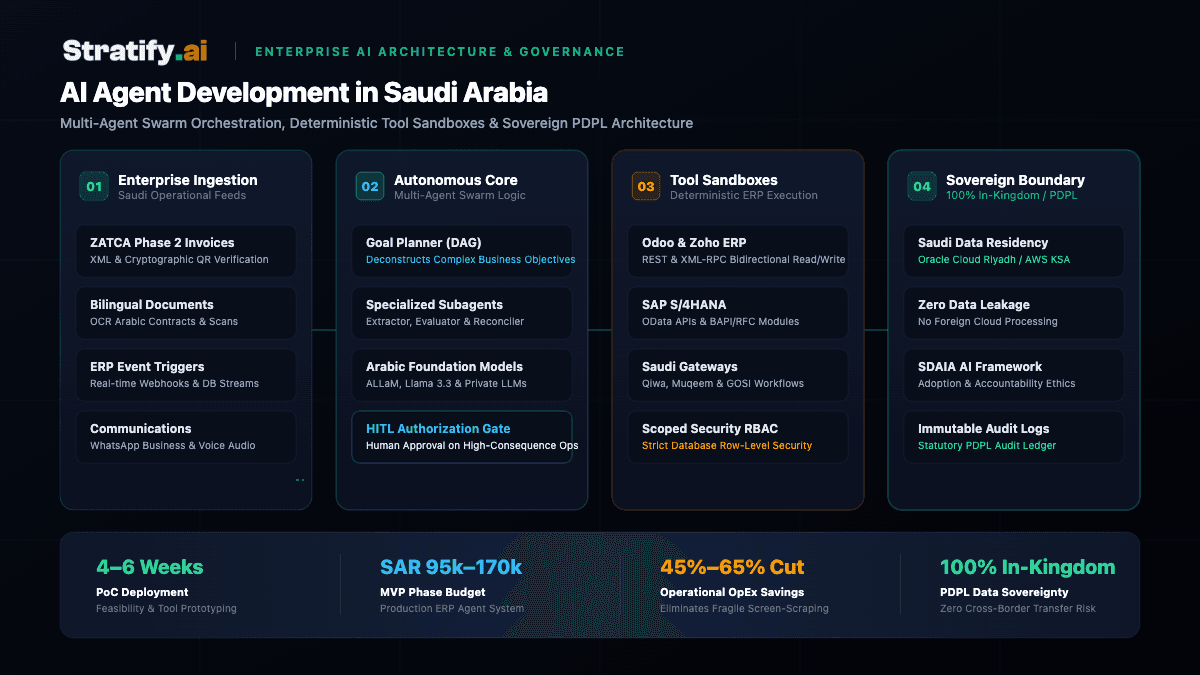
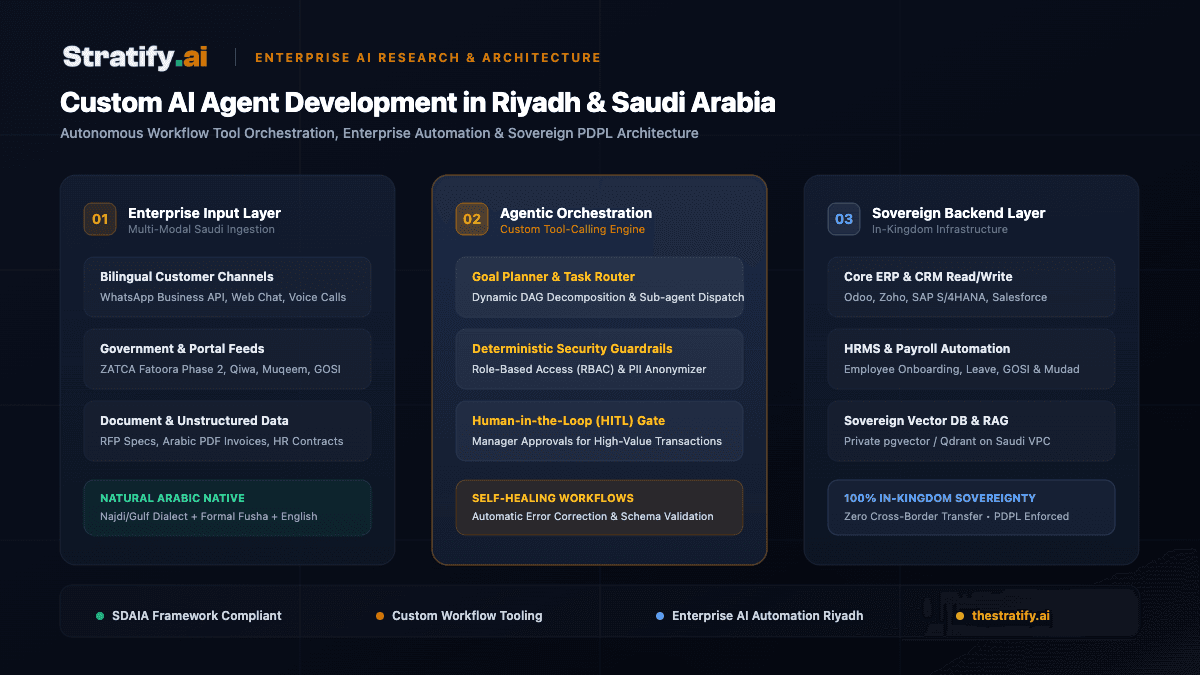
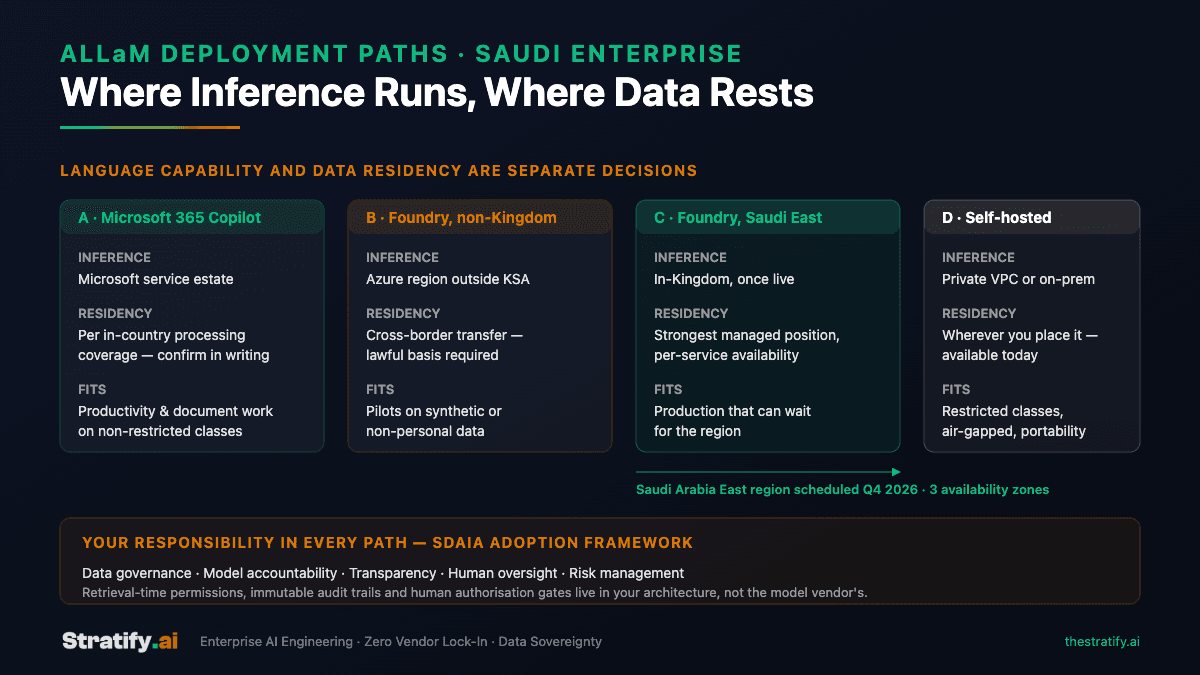
Furthermore, data sovereignty is non-negotiable. By deploying open-weights models or private enterprise instances within your own cloud VPC — the approach described under custom model training and fine-tuning — your sensitive customer and financial data never leaves your security perimeter. What that constraint changes about agent design in a regulated market is set out in our guide to AI agent development in Saudi Arabia and our white paper on AI agents in Saudi enterprise operations.
- Row-Level Database Security
- Agents execute queries under scoped database roles, enforcing authorization at the SQL engine level.
- Immutable Audit Trails
- Every step, tool invocation, prompt input, and API response is logged to an immutable audit store for compliance auditability.
- Deterministic Action Boundaries
- Read-only tools are decoupled from write tools, ensuring agents cannot mutate state without explicit permission checks.
Implementation Roadmap for Enterprise Adoption
Transitioning an organization to agentic workflows should follow a phased, low-risk approach focused on high-frequency, rule-heavy processes.
Phase 1 begins with read-only intelligence: deploying agents to summarize multi-source telemetry, draft reports, and monitor system anomalies. Phase 2 introduces supervised action, where agents draft transactions and queue them for human approval. Phase 3 enables full autonomy for low-risk, pre-approved operational routines.
By building on open frameworks and custom software pipelines rather than closed SaaS tools, organizations preserve total ownership over their workflow intellectual property. Where those agents touch operational reporting, the same argument applies to the dashboard layer — covered in the white paper on manufacturing dashboards and alerting. For budget-planning, see the full breakdown of enterprise AI automation costs in Saudi Arabia.
Architectural Comparison: Chatbots vs. Agentic Workflows
Detailed architectural comparison between Conversational Chatbots and Goal-Driven Agentic Workflows.
| Capability | Agentic AI Workflows | Conversational Chatbots |
|---|---|---|
| Execution Model | Autonomous goal execution via multi-step planning and tool invocation. | Reactive turn-by-turn text response to user input. |
| System Integration | Direct API & database read/write access via validated tool schema. | Limited to web context retrieval or passive copy-paste output. |
| Error & Hallucination Control | Multi-agent verification layers and deterministic schema validation. | Relies entirely on model internal probability and user vigilance. |
| Security & RBAC | Database-level row security, isolated API keys, and audit logging. | System prompt instructions (vulnerable to prompt injection). |
| Ownership & Sovereignty | Custom orchestrated code deployed on customer-controlled cloud/on-prem. | SaaS vendor subscription dependency with closed proprietary APIs. |
Frequently Asked Questions
An AI Chatbot is a passive conversational interface that generates text responses to user prompts. An AI Agent is an goal-driven system that formulates a plan, executes multi-step tasks autonomously, calls external APIs, and interacts with software databases to complete end-to-end business workflows.
Multi-agent systems break complex tasks into narrow, specialized sub-tasks managed by separate micro-agents (e.g., a data extractor, a validator, and a writer). By isolating context and using strict schema checkers between steps, hallucinations are caught and corrected before output reaches production.
Permissions are enforced at the database and API level, not inside the AI prompt. Agents interact with database read replicas or APIs using user-scoped credentials with Row-Level Security (RLS). An agent cannot read or alter data that the underlying API key or user identity is forbidden to access.
Yes. AI agents connect to existing ERPs via standard REST/GraphQL APIs, XML-RPC, or database read replicas. They do not require replacing existing software; instead, they automate manual data entry, reconciliation, and reporting across those systems.
Yes. All custom agent orchestration code, data pipeline scripts, and integration modules engineered by Stratify AI are fully transferred to the client upon project delivery, ensuring zero vendor lock-in and complete control over your technical assets.
Related Articles

Let's Build the Future
of Enterprise AI
Have a project in mind or need expert guidance?
We'd love to hear from you.
Salah Ad Din Al Ayyubi Rd, Al Malaz,
Riyadh 12836, Saudi Arabia
Global Enterprise Partner
Empowering businesses across North America, Europe, Asia, and the Middle East.