AI Agent vs. Chatbot vs. RPA: What Actually Separates Them
The three are structurally different systems, not tiers of the same technology — and treating them as interchangeable is how an 'AI agent' pilot quietly ships as a chatbot.

Executive Summary
Enterprise buyers frequently use 'AI agent', 'chatbot' and 'RPA' as though they sit on one spectrum, ordered roughly by sophistication. They do not. Each is a different architecture, triggered differently, with a different relationship to unstructured input and a different failure mode when the underlying process changes. Confusing the three is not a semantic quibble: a project scoped as an 'AI agent' that is architecturally a chatbot with a system prompt will fail the moment it is asked to complete a multi-step task without supervision, and a business case built on RPA's licensing model will not survive contact with a process that changes screens twice a year. This piece separates the three on the dimensions that actually matter for a build decision.
- Trigger
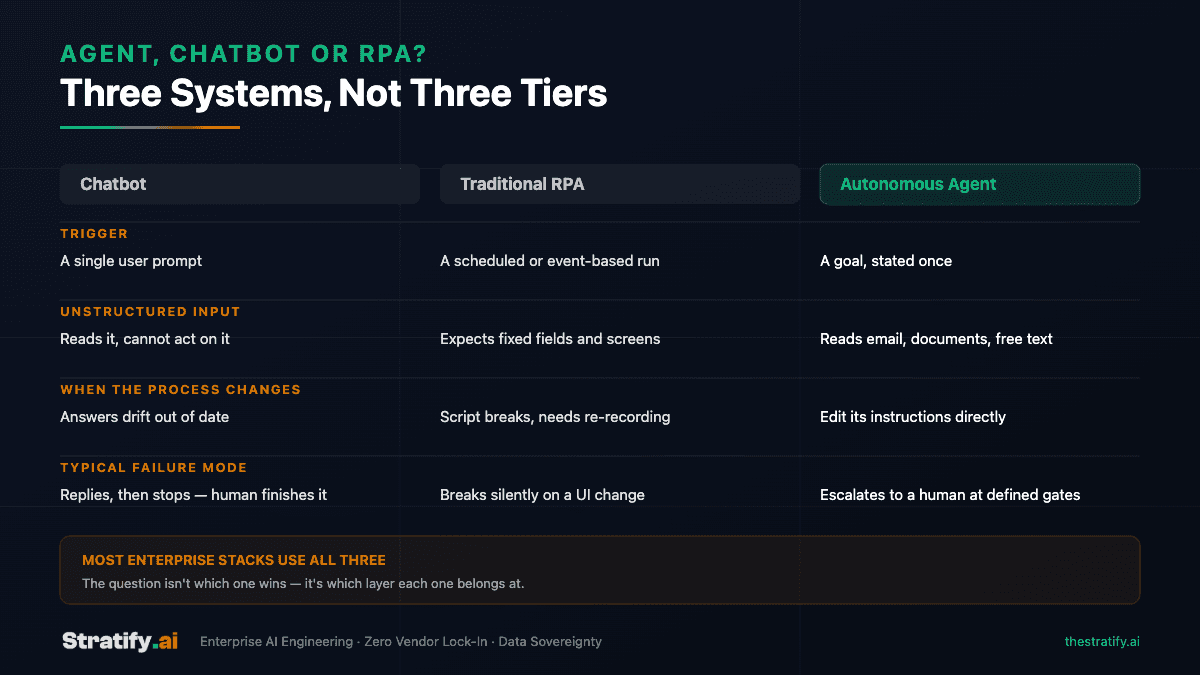
- A prompt starts a chatbot, a schedule or event starts RPA, a goal starts an agent — and only the last one plans its own steps
- Unstructured Input
- Agents read email, documents and free text natively; RPA expects fixed fields and breaks outside them
- Failure Mode
- A chatbot stalls at handoff, RPA breaks silently on interface drift, an agent escalates at the gate you defined
- Not Either/Or
- Most production stacks run all three at once, each at the layer it actually fits
Key Takeaways
- A chatbot is reactive: it answers a prompt and stops. It has no mechanism for carrying a task through multiple steps without a human re-engaging it at each one.
- RPA is deterministic and script-based: it repeats a fixed click-path or field sequence, and it breaks — usually silently — the moment the interface behind it changes.
- An autonomous agent is goal-oriented: given an objective, it plans the steps, reads unstructured input, calls whatever systems it needs, and follows the task to completion, handing off to a human only at the points you define.
- The three differ most sharply on unstructured input and on what happens when the process changes — the two conditions every real enterprise workflow eventually hits.
- The practical question for most organisations is not which one to choose, but which layer of a given workflow each one belongs at — they compose rather than compete.
Three terms, one budget line
The confusion has a practical cost. A procurement conversation that treats 'AI agent', 'chatbot' and 'RPA' as points on a maturity curve — as though an agent is simply a chatbot with more steps, or RPA with a language model bolted on — ends up scoping the wrong system for the problem. A support team that needs an agent capable of reading an incoming email, checking three systems and drafting a resolution will not get that from a chatbot widget, no matter how good the underlying model is, because the chatbot's architecture stops at the reply. Equally, a finance team that wants 'automation' for invoice reconciliation and gets handed an RPA licence will find it brittle the first time a vendor changes their invoice template.
None of the three is a lesser or greater version of the others. They are answers to different questions: what starts the work, what kind of input it can act on, and what happens when the world underneath it shifts. Those three questions are the fastest way to tell which one a given problem actually needs.
What each one actually is
Stripped of vendor framing, the definitions are short. A chatbot is a conversational interface: it receives a prompt and produces a reply, and the interaction ends there — anything that has to happen next is a human's job. RPA is a script that repeats a fixed sequence of UI or field-level actions, recorded once and replayed exactly, with no capacity to interpret input that falls outside the fields it was built against. An autonomous agent is given a goal rather than an instruction — reconcile this month's invoices, qualify this lead, resolve this ticket — and it plans the steps required, calls the systems it needs, and carries the task to completion, checking back with a person only where you have told it to.
- Chatbot — replies and stops
- Turn-based conversation. It can summarise, answer and draft, but it has no mechanism for taking the next step itself; a person copies the output into whatever system needs it.
- RPA — repeats and breaks
- A fixed click-path or field sequence, licensed per bot or per runtime. Reliable exactly as long as the screen or schema underneath it does not move.
- Agent — plans and completes
- Reads unstructured input, decides what to do next, and hands off to a person at the points you define, rather than at the first thing it does not recognise.
Where each one actually breaks
Performance claims are the wrong axis to compare these on — RPA is not slower than an agent, and a chatbot is not a worse agent. The dimensions that separate them are structural, and they show up clearly once a workflow hits real-world conditions: an email that does not match the expected format, a vendor portal that redesigns its layout, or a task that needs five systems checked in sequence rather than one field filled in.
Composed, not competing
In practice, most mature enterprise stacks run some version of all three, and the interesting design question is which layer each one occupies rather than which one wins outright. A chatbot remains the right interface for a person who wants a quick answer and is willing to act on it themselves. RPA remains defensible for a narrow, genuinely stable process — payroll runs against a schema that has not changed in years are not crying out for an agent. An agent earns its place where the task spans multiple systems, involves unstructured input, or needs to keep running without a person babysitting every step.
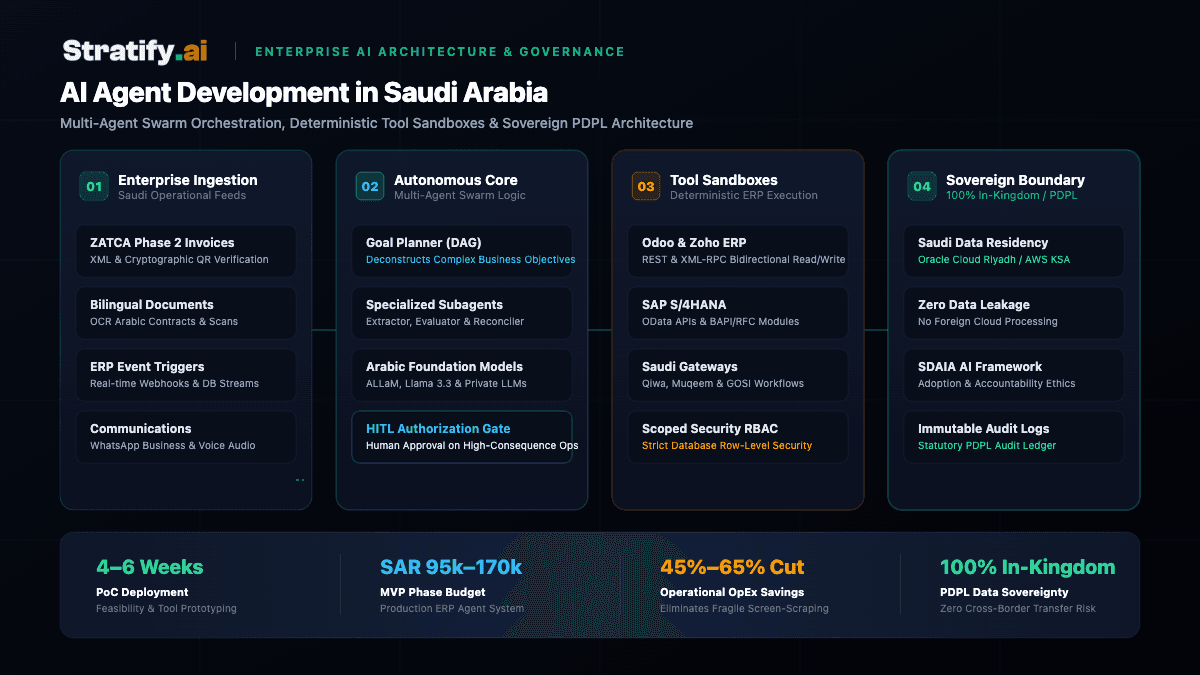
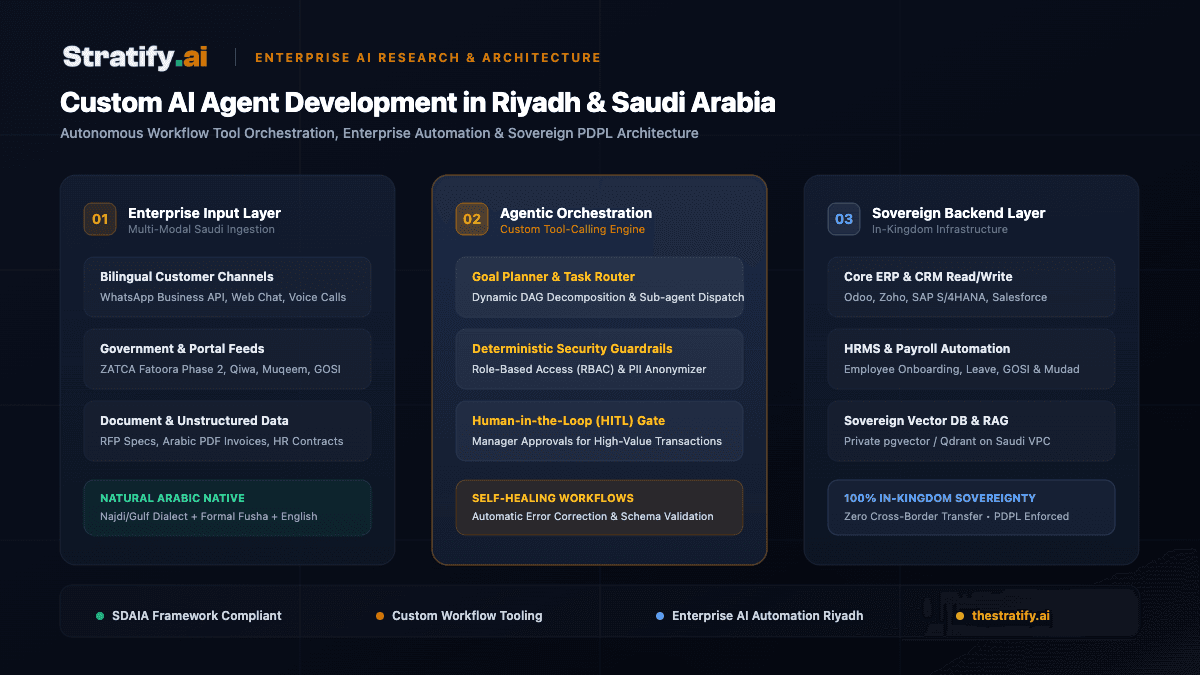
The failure pattern worth avoiding is scoping an agent-shaped problem and building a chatbot to solve it, because a chatbot with a longer system prompt does not become an agent — it becomes a chatbot that produces more convincing text about steps it never took. The comparison worth having before any of the three gets built is set out in more procurement-specific terms — licensing, ownership, and what happens if you leave the vendor — on the autonomous AI agents page; the architectural case for agentic systems generally, including how multi-agent orchestration avoids the single-prompt failure mode, is covered in the shift to agentic AI, our guide to custom AI agent development in Riyadh, and our complete Saudi AI agent development and cost guide.
Where each one actually breaks
How a chatbot, traditional RPA and an autonomous AI agent differ across trigger, input handling, response to process change, and typical failure mode.
| Dimension | Chatbot | Traditional RPA | Autonomous AI Agent |
|---|---|---|---|
| What starts it | A single prompt from a person, each time. | A schedule or a triggering event in another system. | A goal, stated once — the agent plans its own steps from there. |
| Unstructured input | Can read and summarise it, but cannot act on it downstream. | Expects fixed fields and known screen positions; anything else is out of scope. | Reads email, documents and free-text requests natively, as part of the task. |
| When the process changes | Its answers drift out of date; someone has to notice and update it. | The script breaks and needs re-recording against the new interface. | You edit its instructions and governance rules directly — no re-recording. |
| Typical failure mode | Replies convincingly, then the task stalls at handoff to a human. | Fails silently on an interface change, often discovered days later. | Escalates to a named person at the point you defined, rather than failing quietly. |
| Multi-step tasks | Not really — each reply is independent unless a person chains them. | Only the exact sequence it was recorded against, in that order. | Native — planning across steps and systems is the point of the architecture. |
Frequently Asked Questions
No. The difference is architectural, not a matter of degree. A chatbot's interaction ends at its reply; nothing downstream is its responsibility. An agent is assigned a goal, plans the steps needed to reach it, and calls whatever systems are required, carrying the task through to completion. A chatbot given a longer system prompt still stops at the reply — it does not gain the ability to act.
RPA replays a fixed sequence of clicks or field entries recorded against a specific interface. When that interface changes — a vendor portal redesign, a new field on a form — the script has no way to interpret the change, because it was never given a way to understand what the fields mean, only where they sit. The fix is usually not 'more robust RPA'; it is replacing the brittle layer with something that reads the underlying data or interface semantically rather than positionally.
Often yes, for the workflows that were pushing RPA past what it was built for — anything involving unstructured input, decision-making, or a process that changes more than once every few years. For a narrow, genuinely stable process, RPA can remain the more economical choice. The two are not mutually exclusive within one organisation.
A chatbot answers a question and stops. RPA repeats a fixed sequence of actions and breaks when the interface behind it changes. An autonomous agent is goal-oriented: it plans the steps, reads unstructured input like email and documents, calls APIs, and follows the task through to completion without a human restarting it at each stage.
No. They typically sit at different layers and integrate through the same APIs and databases any of them would use independently. An agent can call an existing RPA bot as one of its tools, or read from a system a chatbot also queries, without either being replaced or requiring a shared vendor.
Related Articles

Let's Build the Future
of Enterprise AI
Have a project in mind or need expert guidance?
We'd love to hear from you.
Salah Ad Din Al Ayyubi Rd, Al Malaz,
Riyadh 12836, Saudi Arabia
Global Enterprise Partner
Empowering businesses across North America, Europe, Asia, and the Middle East.