ALLaM on Microsoft Foundry: What the HUMAIN Partnership Actually Changes for Saudi Enterprise AI Architecture
An Arabic language capability announcement is being read as a data residency solution. They are two separate decisions, and conflating them is the expensive mistake.

Executive Summary
On 26 August 2026, HUMAIN and Microsoft announced a long-term collaboration that will bring ALLaM, Saudi Arabia's Arabic foundation model, into Microsoft Foundry and the Microsoft 365 Copilot ecosystem, with Microsoft Forward Deployed Engineers supporting customer deployments. The announcement is a genuine step for Arabic-language enterprise AI in the Kingdom. It is not, on its own, an answer to data residency: Microsoft's Saudi Arabia East datacentre region is scheduled for Q4 2026, no availability dates were published for ALLaM on either platform, and where a model is available is a different question from where inference runs and where personal data comes to rest. This analysis separates the two decisions and sets out what a Saudi enterprise should settle before choosing a deployment path.
- Two Decisions
- Language capability and data residency are independent choices; the announcement addresses only the first
- Q4 2026
- When Microsoft's Saudi Arabia East region is scheduled to open, with three availability zones in the Eastern Province
- No Dates Published
- ALLaM on Foundry and M365 Copilot was announced as a first milestone, with no availability timeline stated
- Residency Is Architectural
- Where inference executes and where personal data rests is determined by deployment topology, not by model choice
Key Takeaways
- The 26 August announcement makes ALLaM reachable inside tools Saudi enterprises already run. It does not change where your data is processed, and it published no availability dates.
- ALLaM originated at SDAIA, the same authority that issues the Kingdom's AI governance frameworks, and development moved to HUMAIN, the PIF-formed national AI company. Procurement and support questions follow that transfer.
- Microsoft's in-Kingdom Azure region is scheduled for Q4 2026, so a deployment starting today is choosing a topology that predates it. Design for the migration rather than assuming the region is present.
- PDPL obligations attach to personal data regardless of which model processes it. An Arabic-capable model in a foreign region is not more compliant than an English one in the same region.
- The durable question is not which model speaks the best Arabic, but which deployment path lets you change your mind about the model later without re-architecting.
What was announced on 26 August, and what was not
HUMAIN and Microsoft announced a long-term strategic collaboration intended to accelerate AI adoption in Saudi Arabia. The concrete first item is ALLaM, the Kingdom's Arabic foundation model, being made available through Microsoft Foundry and brought into the Microsoft 365 Copilot ecosystem, so that organisations can build specialised agents for Arabic-language workplace tasks. Microsoft Forward Deployed Engineers are attached to the collaboration to work alongside customer teams on integration.
Two things are worth noting about what the announcement did not contain. First, no availability dates were given for either platform; the collaboration describes ALLaM as the first technology milestone, with further capability expected in coming months. Second, nothing in it addresses where inference executes or where customer data is processed and stored. Those are the questions a Saudi enterprise subject to the Personal Data Protection Law has to answer, and they are determined by deployment topology rather than by model selection.
This is not a criticism of the announcement. It is a platform availability announcement, and it does the thing platform availability announcements do. The risk is in how it is being read: as though making an Arabic model reachable inside Microsoft's estate settles a residency question that it does not touch.
ALLaM's route from regulator to national AI company
ALLaM did not begin at HUMAIN. It was developed by SDAIA, the Saudi Data and Artificial Intelligence Authority, which mobilised sixteen public entities to assemble the Arabic training corpus behind it. The earlier family included 7B, 13B and 70B variants initialised from Llama 2 weights alongside a 7B model trained from scratch, and those models were made available through IBM watsonx and the Azure AI model catalogue.
Development and commercialisation subsequently moved to HUMAIN, the national AI company formed by the Public Investment Fund, which has described its later 34B model as a clean-slate system trained on proprietary in-Kingdom datasets rather than an iteration of the earlier SDAIA work.
That lineage matters for procurement rather than for engineering. The organisation that authored the Kingdom's AI governance frameworks originated the national model, and the organisation now commercialising it is a state-backed commercial entity. When you are assembling a vendor risk assessment, a support agreement or a model lifecycle commitment, those are different counterparties with different obligations, and the diligence questions should be addressed to the one that actually holds the contract.
The residency question the announcement does not answer
Microsoft has confirmed that customers will be able to run workloads from a Saudi Arabia East datacentre region, located in the Eastern Province with three availability zones, from Q4 2026. Until that region is live and until a given service is actually available within it, a workload running on Microsoft infrastructure for a Saudi customer is running somewhere else.
Microsoft separately offers in-country data residency for Microsoft 365 in a number of countries and in-country processing for Microsoft 365 Copilot interactions in a smaller number. Whether the Kingdom appears on the current version of those lists, and which specific Copilot interactions are covered, is a question to put to Microsoft directly and to get in writing, because both lists change and neither is the same commitment as running inference in an in-Kingdom Azure region.
The distinction that matters under the Personal Data Protection Law, fully enforceable since 14 September 2024, is not which language a model speaks. It is whether personal data leaves the Kingdom, under what transfer basis, and whether you can demonstrate the answer. An Arabic-capable model processing Saudi personal data in a European region is in exactly the same position as an English one doing the same thing. Language capability and data residency are orthogonal, and the only reason they are being discussed together this week is that a single announcement happened to touch both subjects without resolving the second.
None of this argues against the Microsoft path. It argues for stating your residency requirement first, as a constraint, and then selecting a deployment path that satisfies it — the sequence set out in the white paper on AI agents in day-to-day Saudi operations and our guide to custom AI agent development in Riyadh, where residency is decided before model selection rather than after.
Four deployment paths, compared honestly
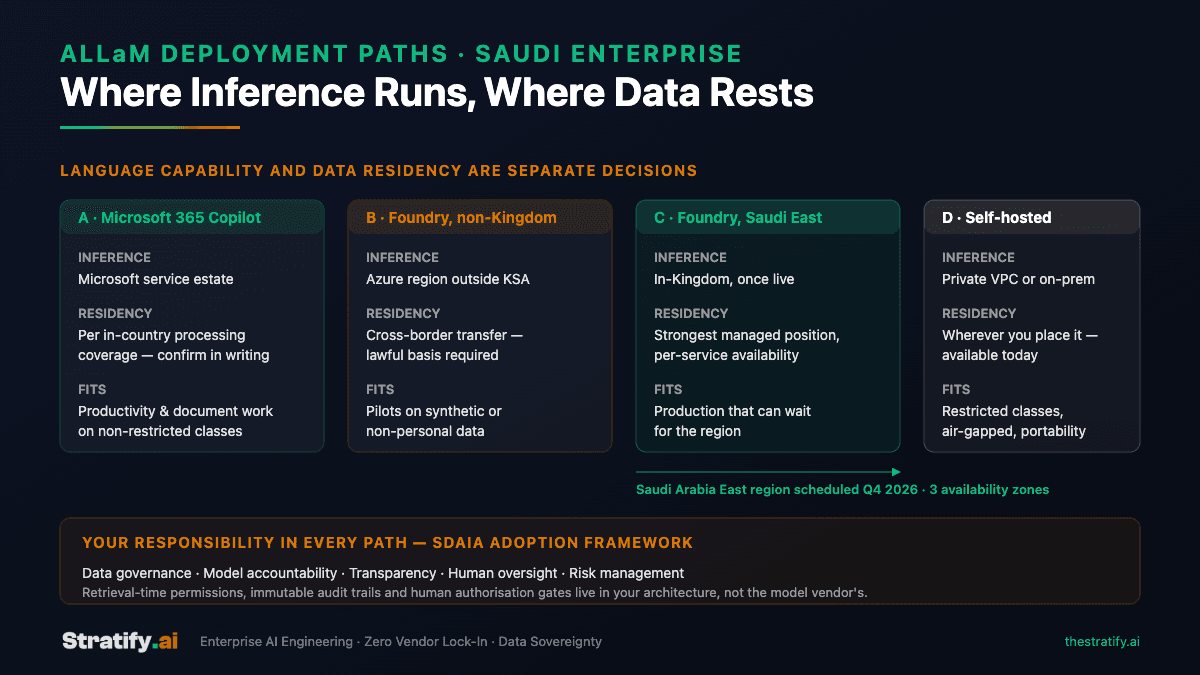
There are four realistic ways a Saudi enterprise can reach an Arabic-capable model today, and they differ mainly in where inference happens and how much control you retain over it. The comparison below is about topology, not about which model is better.
What this changes about decisions you are making now
If you are mid-way through selecting an approach, the announcement should change your timeline more than your architecture. A managed in-Kingdom path on Microsoft becomes materially more attractive once Saudi Arabia East is live, which means a system being designed today is being designed in the window before it opens.
The practical response is to keep the model layer replaceable. Deployments that bind business logic directly to one provider's SDK, prompt format and tool-calling convention are the ones that will be expensive to move when the region opens or when a better Arabic model appears. An abstraction over the model interface, with the orchestration, guardrails and audit logging owned by you rather than by the platform, costs very little at the start and is what makes the migration a configuration change instead of a rebuild. That is the same argument for custom AI application development over closed platforms, and it applies with more force when the platform's regional footprint is still months from completion.
It also changes very little about governance. Whichever path you pick, SDAIA's AI Adoption Framework expects data governance, model accountability, transparency, human oversight and risk management to be demonstrable. Those obligations sit in your architecture — in retrieval-time permissions, immutable audit trails and human-in-the-loop gates on consequential actions — not in the model vendor's marketing. Nothing announced this week moves that work off your side of the boundary.
- Keep the model interface abstracted
- Business logic should not know which model answered. This is what turns a provider or region migration into a configuration change rather than a rewrite.
- Own orchestration and audit yourself
- The record of what an agent accessed and why is a compliance artefact. It should survive you changing model, platform or region.
- Classify data before selecting a path
- Most organisations do not need one answer for everything. Restricted classes can sit on self-hosted infrastructure while general productivity work uses a managed service.
- Get residency commitments in writing
- Regional availability, in-country processing coverage and service-level residency are three different statements. Ask for the one that matches your obligation.
The order in which to settle these questions
The sequence matters more than the individual answers, because settling them out of order is what produces architectures that have to be unwound. Establish the data classification first: which categories of personal data the system will touch, and which of them cannot leave the Kingdom under any transfer basis you are willing to rely on. That single answer eliminates most of the option space before any model is evaluated.
Then establish the residency requirement that follows from it, and only then evaluate models against the paths that satisfy it. Arabic quality, dialect handling and code-switching behaviour are real and important selection criteria — they are simply criteria applied within the set of deployments you are permitted to use, not criteria that override the constraint.
Finally, build the governance layer as though the model will change, because over a system's life it will. Teams that took this ordering seriously a year ago are in a position to adopt ALLaM on Foundry when it becomes available, or to decline it, without either choice being a rebuild. Teams that selected a model first are the ones for whom this week's announcement creates work rather than options. If you would like the sequence applied to a specific estate, that is what our AI systems integration engagements start with.
Four deployment paths, compared honestly
Where inference runs and what you control, across the four realistic ALLaM deployment paths for a Saudi enterprise as of August 2026.
| Deployment path | Where inference runs | Residency position | Fits when |
|---|---|---|---|
| Microsoft 365 Copilot | Microsoft's service estate; governed by Microsoft 365 commitments rather than by a region you select. | Depends on current in-country processing coverage; confirm in writing for your tenant and interaction types. | Productivity and document work on data that is not your most restricted class. |
| Microsoft Foundry, non-Kingdom region | An Azure region outside Saudi Arabia, chosen by you at deployment time. | A cross-border transfer requiring a lawful basis and documentation under PDPL. | Pilots and internal evaluation on synthetic or non-personal data, before the in-Kingdom region opens. |
| Microsoft Foundry, Saudi Arabia East | In-Kingdom, once the region is live and once the specific service is available in it. | Strongest managed-service position, contingent on the Q4 2026 schedule holding and per-service availability. | Production workloads that can wait for the region, and that accept managed-service boundaries. |
| Self-hosted open weights, private VPC or on-premise | Infrastructure you control, in a region or facility you nominate, today. | Determined entirely by where you place it; no third-party inference boundary to reason about. | Restricted data classes, air-gapped requirements, or where model portability is a hard requirement. |
Frequently Asked Questions
Not automatically. Model availability and data residency are separate questions. Microsoft's Saudi Arabia East region is scheduled to open in Q4 2026, so a workload running before then on Microsoft infrastructure is executing in another region. Microsoft also offers in-country processing for some Microsoft 365 Copilot interactions in a set of countries, which is a narrower commitment than in-region inference. Confirm the specific position for your tenant, your services and your interaction types in writing.
No availability dates were published. The 26 August 2026 announcement describes ALLaM as the first technology milestone under the collaboration, with further capability expected in coming months. Treat the timeline as unannounced rather than imminent, and avoid committing a delivery date that depends on it.
ALLaM originated at SDAIA, which assembled its Arabic training corpus with contributions from sixteen public entities and released earlier variants through IBM watsonx and the Azure model catalogue. Development and commercialisation subsequently moved to HUMAIN, the national AI company formed by the Public Investment Fund. For contracting, support and model lifecycle commitments, the relevant counterparty is the one holding your agreement.
It depends on what is failing. If the model retrieves the wrong facts, that is a retrieval problem and a different model will not fix it. If output is factually right but reads as foreign — wrong register for official correspondence, mishandled Gulf dialect, poor code-switching between Arabic and English technical terms — that is a behaviour problem, and an Arabic-native or Arabic-tuned model is the appropriate response. Diagnose which failure you have before treating model choice as the remedy.
Generally no. Pausing forfeits the learning that makes a later migration cheap. The more useful response is to continue on non-restricted data classes while keeping the model layer abstracted and the orchestration, guardrails and audit logging under your own control, so that adopting an in-Kingdom managed path later is a configuration change. Restricted data classes that cannot wait can run on self-hosted infrastructure in the meantime.
No. The framework's five pillars — data governance, model accountability, transparency, human oversight and risk management — are properties of how a system is built and operated, not of which model it calls. Demonstrating them requires retrieval-time permissions, an immutable record of what the system accessed and why, and human authorisation gates on consequential actions. Model provenance does not substitute for any of that.
Related Articles

Let's Build the Future
of Enterprise AI
Have a project in mind or need expert guidance?
We'd love to hear from you.
Salah Ad Din Al Ayyubi Rd, Al Malaz,
Riyadh 12836, Saudi Arabia
Global Enterprise Partner
Empowering businesses across North America, Europe, Asia, and the Middle East.