The Scope of AI Agents in the Real Estate Industry: Autonomous Valuation, 24/7 Leasing, and Intelligent Asset Operations
How multi-agent architectures are replacing fragmented PropTech with autonomous lead qualification, instant lease abstraction, algorithmic underwriting, and automated facility triage.

Executive Summary
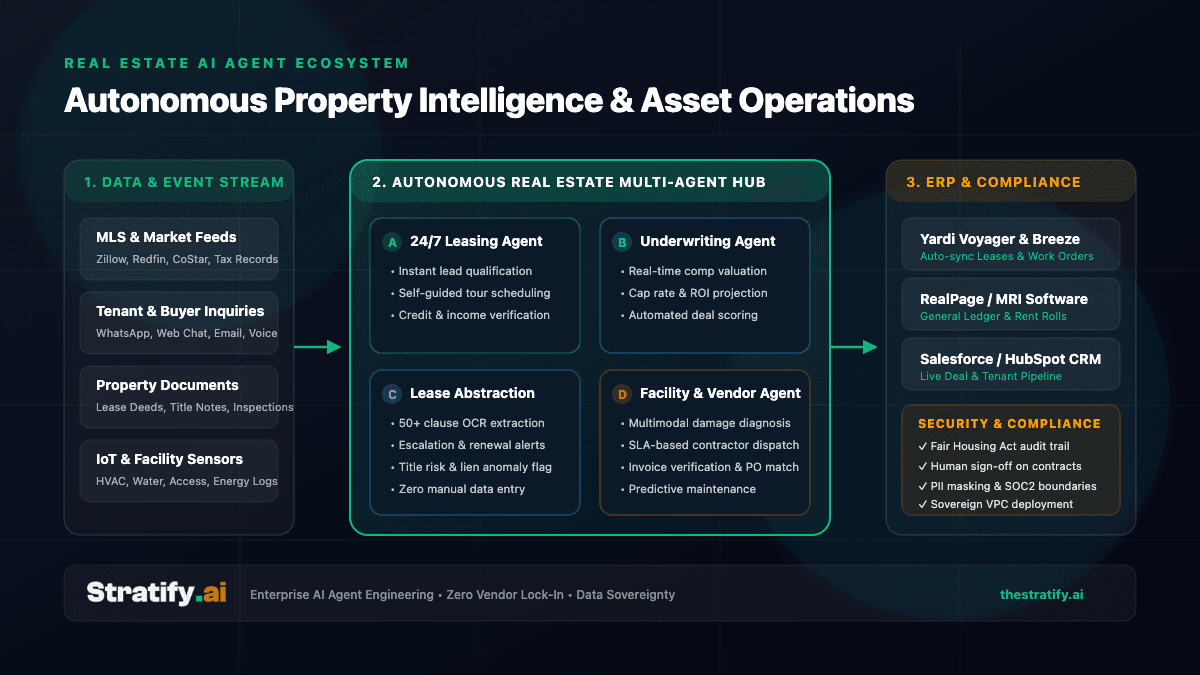
The real estate sector is moving from passive listing portals and static CRM forms to autonomous, goal-driven AI agent teams. Real estate AI agents execute complex, multi-step commercial and residential workflows: qualifying high-intent tenant leads in under 60 seconds, conducting comparative market analyses (CMA) with real-time tax and deed data, abstracting 50+ clause lease agreements into structured Yardi/RealPage entries, and diagnosing property maintenance issues via computer vision before dispatching preferred contractors. This deep-dive examines the operational scope, multi-agent architecture, Fair Housing compliance guardrails, and sovereign deployment models transforming modern PropTech.
- <60s Response
- Instant 24/7 lead qualification, screening, and tour scheduling across WhatsApp, SMS, & web
- Hours to Minutes
- Automated OCR extraction and clause validation on complex 80+ page commercial lease agreements
- Real-Time Underwriting
- Automated Comp valuation, Cap Rate sensitivity modeling, and cash flow forecasting across MLS & tax datasets
- Zero PII Leakage
- Self-hosted private models and deterministic guardrails guaranteeing Fair Housing Act compliance
Key Takeaways
- The traditional PropTech era of siloed point solutions is being superseded by autonomous multi-agent systems connected directly to core property databases.
- Leasing AI agents shorten the lead-to-tour cycle by autonomously verifying renter criteria, answering hyper-local HOA/amenity questions, and syncing self-guided showings.
- Commercial real estate (CRE) underwriting transitions from manual spreadsheet modeling to real-time algorithmic valuation using multi-modal geographic and financial data streams.
- Autonomous facility agents handle maintenance triage through tenant image/video analysis, cross-referencing warranties, and issuing vendor purchase orders within predefined budgetary caps.
- Enterprise real estate firms achieve lasting competitive advantage by deploying custom agent workflows on sovereign cloud infrastructure rather than closed third-party SaaS platforms.
The PropTech Paradigm Shift: From Passive Software to Agentic Autonomy
For more than a decade, the real estate industry relied on digital transformation tools that were fundamentally passive: listing syndicators, digital signature portals, and database-driven Property Management Systems (PMS). While these platforms digitised paper records, they did not eliminate the operational friction that plagues asset managers, commercial brokers, and residential property management teams.
Property management teams still spend a substantial share of the working week manually fielding repetitive tenant inquiries, cross-referencing vendor bids, chasing rent roll discrepancies, and keying data from scanned PDF leases into enterprise ERPs like Yardi Voyager or RealPage. When an inbound buyer or renter submits an inquiry after business hours, the reply typically waits until the next working morning — and a lead that has spent a night unanswered has usually contacted a competitor by then.
AI agents fundamentally redefine this operational model. Unlike simple conversational chatbots that merely recite static FAQ scripts, real estate AI agents are autonomous, goal-oriented software entities capable of multi-step planning, database querying, document verification, and transactional execution across disparate systems without human intervention for routine tasks.
5 High-Impact Pillars: Where AI Agents Transform Real Estate Operations
Enterprise real estate organizations deploying multi-agent architectures focus on five core operational pillars where automation delivers immediate, measurable bottom-line yield and operating expense (OpEx) compression.
- 1. 24/7 Autonomous Leasing & Tenant Onboarding
- Leasing agents engage prospects instantaneously across web, WhatsApp, and voice channels. The agent parses specific requirements (budget, move-in date, pet policies), pre-screens qualifications, validates government IDs, and coordinates digital lockbox codes for unattended self-guided property tours.
- 2. Algorithmic Underwriting & Real-Time Deal Sourcing
- Underwriting agents continuously monitor MLS feeds, municipal planning registers, and auction portals. They ingest zoning bylaws, historical cap rates, neighborhood demographic shifts, and rental yields to produce automated investment memorandums and sensitivity analyses within seconds.
- 3. Commercial Lease Abstraction & Due Diligence
- Document agents parse 100+ page commercial lease deeds, joint venture agreements, and title commitments. They extract critical dates, escalation clauses, tenant improvement allowances, co-tenancy covenants, and renewal options directly into structured database tables with zero manual entry error.
- 4. Multimodal Facility Triage & Vendor Dispatch
- Tenant maintenance requests are diagnosed via uploaded photos and videos using computer vision. The agent checks lease maintenance responsibility clauses, estimates parts cost, verifies contractor insurance certifications, and issues work orders within approved spending thresholds.
- 5. Construction Tracking & Portfolio ESG Optimization
- Asset management agents analyze drone LiDAR scans and site inspection logs to track developer milestone completion against draw schedules. Simultaneously, smart building IoT agents optimize HVAC and lighting schedules to minimize utility costs and track GRESB/ESG compliance.
Architectural Blueprint: Multi-Agent Orchestration in Real Estate
Real estate transactions and property management workflows are highly regulated, multi-stakeholder processes. A single monolithic AI model cannot reliably execute these tasks without catastrophic hallucination risks. Robust enterprise real estate deployments rely on specialized multi-agent teams coordinated by a central Orchestrator.
In this architecture, incoming requests (such as an incoming tenant inquiry or a new property listing packet) are deconstructed into a Directed Acyclic Graph (DAG) of discrete tasks. Specialized micro-agents execute each subtask within isolated security and context sandboxes, validating outputs deterministically against business rules and regulatory boundaries before state changes are committed to the property ledger.
None of this replaces the system of record. The orchestrator reads from and writes back into whatever the firm already runs, which is a question of AI system integration rather than migration — the same pattern described in the white papers on connecting an external dashboard to Zoho or Odoo.
- MLS & Document Ingestion Agent
- Normalizes unstructured data from multiple MLS feeds (RETS, RESO Web API), property deeds, and environmental assessments into a unified relational schema.
- Valuation & Comps Analysis Agent
- Applies automated valuation models (AVMs) with local hyper-submarket micro-trends, recent transactional comps, and replacement cost modeling.
- Lease Verification & Schema Agent
- Performs strict schema enforcement on extracted lease provisions, flagging ambiguous indemnity clauses or conflicting renewal options for legal review.
- ERP & Database Synchronization Agent
- Handles bidirectional read/write transactions into Yardi, RealPage, MRI Software, or custom PostgreSQL databases using scoped, authenticated API tokens.
Strategic Comparison: Traditional PropTech SaaS vs. Autonomous Real Estate AI Agents
To evaluate the structural advantage of adopting agentic architectures over traditional real estate software tools, consider how core business capabilities perform across both paradigms.
Fair Housing Compliance, Risk Management, and Human-in-the-Loop Governance
Deploying AI agents in real estate requires uncompromising adherence to statutory frameworks, particularly the Fair Housing Act (FHA), Equal Credit Opportunity Act (ECOA), and General Data Protection Regulation (GDPR). Autonomous systems must be engineered with absolute immunity against algorithmic bias and steering.
Enterprise agentic architectures achieve this through deterministic outer-layer guardrails rather than soft prompt engineering. Lead qualification criteria (such as income-to-rent multipliers and credit thresholds) are strictly enforced in the deterministic business logic layer. The language model is architecturally forbidden from modifying qualifying criteria or accessing protected demographic attributes.
Furthermore, high-consequence operations—such as executing binding lease agreements, authorizing vendor payments above preset capital limits, or issuing eviction notices—are gated through a Human-in-the-Loop (HITL) authorization console. The agent prepares the synthesized dossier, complete with supporting evidence and contract citations, requiring an authorized property manager's cryptographic or biometric sign-off.
- Deterministic Bias Guardrails
- Protected attributes (race, religion, familial status, disability) are stripped from agent reasoning context to ensure absolute Fair Housing compliance.
- Human-in-the-Loop (HITL) Approvals
- State-changing financial transactions, legal notices, and final lease commitments require explicit human confirmation.
- Cryptographic Audit Trails
- Every interaction, query, qualification decision, and API payload is recorded in an immutable ledger for internal compliance and regulatory review.
Strategic Blueprint: 90-Day Implementation Roadmap for Real Estate Enterprises
For commercial brokerages, REITs, and residential property managers seeking to deploy AI agents, a staged roll-out mitigates risk while producing rapid return on investment (ROI).
Phase 1 (Days 1–30) focuses on High-Velocity Inbound Leasing: Deploying 24/7 lead qualification and tour scheduling agents across web and messaging channels, integrated directly into your existing CRM. Phase 2 (Days 31–60) introduces Intelligent Document Automation: Activating automated commercial lease abstraction and maintenance photo triage with human approval gates. Phase 3 (Days 61–90) activates Autonomous System Orchestration: Connecting verified agents into core ERPs (Yardi/RealPage) for automated work order reconciliation and predictive cash flow underwriting.
By partnering with Stratify AI to engineer custom agentic pipelines on private infrastructure, real estate organizations retain complete ownership of their data assets, proprietary underwriting logic, and technical workflows. If you would rather see the implementation detail first, the white paper on AI agents in day-to-day operations covers task selection, escalation design and the data-residency constraints that shape model choice.
Strategic Comparison: Traditional PropTech SaaS vs. Autonomous Real Estate AI Agents
Operational and technical comparison between Legacy PropTech Software and Autonomous Multi-Agent Real Estate Systems.
| Operational Capability | Autonomous AI Agent System | Traditional PropTech Software |
|---|---|---|
| Lead Engagement & Qualification | Sub-60s autonomous conversational qualification, ID check, and tour booking 24/7/365. | Static web forms requiring manual leasing agent callback during office hours. |
| Underwriting & Market Analysis | Real-time algorithmic financial modeling, comp clustering, and cash flow simulations. | Manual data extraction into disconnected Excel models taking 3–5 business days. |
| Lease Data Ingestion | Instant multi-page OCR clause extraction directly into Yardi/RealPage database schemas. | Manual human lease abstraction billed per deed at professional-services rates, with transcription error rates that scale with volume. |
| Maintenance & Triage | Computer vision triage of tenant photo/video, automated contractor dispatch and PO matching. | Manual ticket queue creation with delayed phone/email coordination with technicians. |
| Fair Housing & Regulatory Guardrails | Deterministic prompt filters, standardized scoring rules, and immutable audit logs. | Dependent on individual human agent training and subjective conversation records. |
| Data Sovereignty & IP Ownership | Custom open-weight models deployed in client-owned private cloud with zero data leak. | Proprietary third-party SaaS platforms holding captive customer data and rent roll analytics. |
Frequently Asked Questions
A real estate chatbot is a reactive, script-based messaging tool that answers basic questions. An AI agent is an autonomous, goal-oriented system capable of taking multi-step actions: accessing MLS listings, verifying prospective tenant income documents, booking calendar slots, generating financial underwriting models, and updating records directly in systems like Yardi or Salesforce without human intervention.
AI agents enforce Fair Housing compliance through deterministic programmatic boundaries rather than loose prompt instructions. Agents operate under standardized, objective screening criteria (such as income ratios and credit scores) with protected demographic attributes systematically masked. All screening evaluations generate an immutable audit log for regulatory compliance.
Yes. Enterprise AI agents connect to platforms like Yardi Voyager, Yardi Breeze, RealPage, MRI Software, AppFolio, and Salesforce via REST/SOAP APIs, secure database connectors, and webhook listeners. They do not replace existing ERP systems; they automate the tedious data entry, reconciliation, and tenant communication workflows between them.
Lease abstraction agents utilize advanced multi-modal Optical Character Recognition (OCR) and specialized Large Language Models to scan complex commercial and residential leases. The agent extracts over 50 distinct data points—including base rent, escalations, CAM charges, break clauses, and renewal deadlines—and validates them before exporting structured records into property management databases.
The returns concentrate in three places: lead response time, which drops from hours to seconds because the agent does not keep office hours; tour booking conversion, which follows directly from that response time; and the hours currently spent on manual lease abstraction and maintenance dispatch. The size of the return depends on portfolio scale, current response times, and how much of the lease library is still unstructured — which is why the first phase of a deployment is scoped to measure it rather than assume it.
With Stratify AI, clients retain 100% ownership of all custom agent code, proprietary prompts, data ingestion pipelines, and trained weights. Solutions can be deployed within the client's own private cloud VPC or on-premise infrastructure, guaranteeing zero vendor lock-in and total data sovereignty.
Related Articles

Let's Build the Future
of Enterprise AI
Have a project in mind or need expert guidance?
We'd love to hear from you.
Salah Ad Din Al Ayyubi Rd, Al Malaz,
Riyadh 12836, Saudi Arabia
Global Enterprise Partner
Empowering businesses across North America, Europe, Asia, and the Middle East.