How Much Does Enterprise AI Automation Cost in Saudi Arabia? A Practical Breakdown for 2026
What CIOs and digital transformation leaders in Saudi Arabia actually pay for AI automation — from a focused proof-of-concept to enterprise-wide multi-agent deployment — and what drives the difference.

Executive Summary
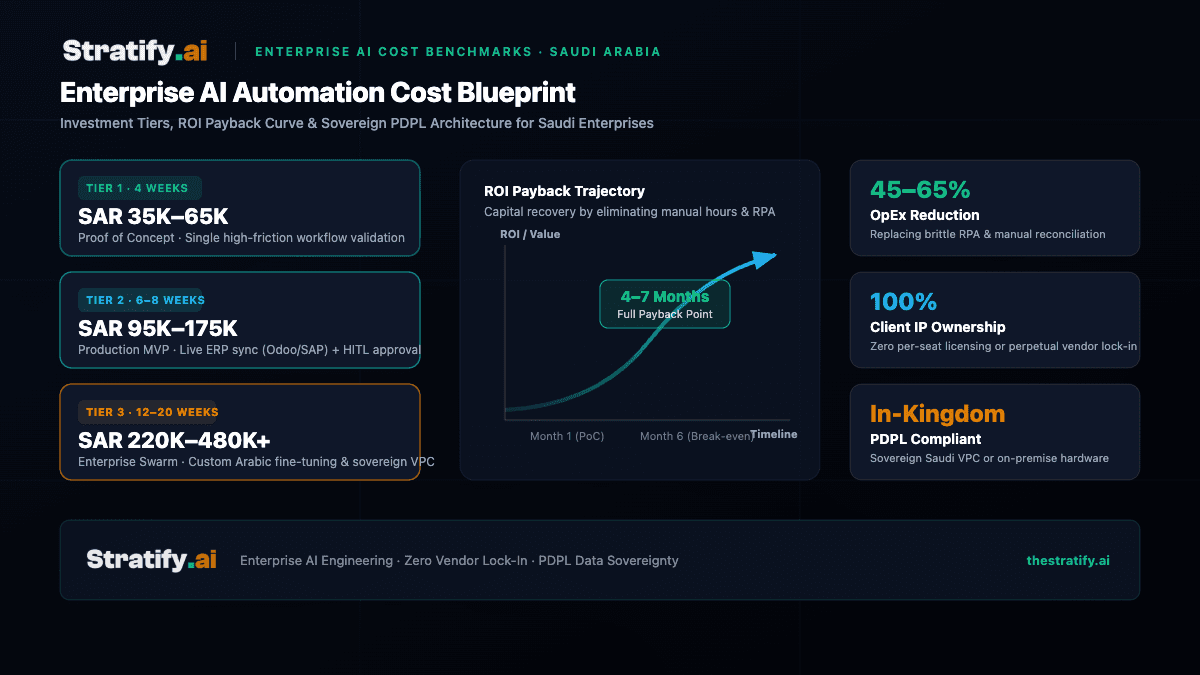
Enterprise AI automation in Saudi Arabia is not a single product with a fixed price — it is a capability investment shaped by integration depth, Arabic language requirements, and data residency obligations under the PDPL. A focused 4-week Proof of Concept typically ranges from SAR 35,000 to SAR 65,000. A production-grade MVP integrated with live ERP systems runs SAR 95,000–175,000. Full enterprise multi-agent deployments — spanning multi-ERP orchestration, custom Arabic fine-tuning, and sovereign in-Kingdom infrastructure — range from SAR 220,000 to SAR 480,000 and above. Most Saudi organizations recover that investment within 4 to 7 months by eliminating fragile RPA licensing, manual reconciliation hours, and after-hours operational gaps. This guide explains what sits behind those numbers: where costs concentrate, which factors drive them up or down, and how to evaluate whether a quoted price represents real value.
- SAR 35K–65K
- Proof of Concept — 4 weeks, single workflow, feasibility-validated
- SAR 95K–175K
- MVP — live ERP integration, bilingual Arabic/English, production-ready
- SAR 220K–480K+
- Enterprise scale — multi-agent swarm, custom fine-tuning, sovereign VPC
- 4–7 Months
- Typical ROI payback for Saudi enterprises replacing RPA and manual workflows
Key Takeaways
- Enterprise AI automation in Saudi Arabia is priced in three engagement tiers: Proof of Concept (PoC), Minimum Viable Product (MVP), and full enterprise deployment — each with distinct scope, risk, and return.
- The biggest cost drivers are ERP integration complexity, bilingual Arabic language handling, and PDPL-compliant in-Kingdom data residency — not the AI model itself.
- A responsible deployment starts with a PoC on a single high-friction workflow before committing to enterprise scale, using measured ROI from that first phase to justify the next.
- Saudi organizations that replace legacy RPA and manual reconciliation workflows with [custom AI agents](/blog/ai-agent-development-saudi-arabia-guide) typically achieve full capital payback within 4 to 7 months.
- Vendor IP ownership terms matter as much as the development fee — the right engagement transfers all custom code, prompts, and trained weights to the client with zero per-seat licensing.
Why AI automation pricing in Saudi Arabia is hard to read
Ask five AI vendors for a quote on 'enterprise AI automation in Saudi Arabia' and you will get five numbers with almost nothing in common. One will quote SAR 15,000 for a chatbot plugin. Another will quote SAR 2 million for a multi-year managed service. Neither is necessarily wrong — they are just answering different questions.
The variance exists because enterprise AI automation is not a product. It is a capability, and the capability a given organization needs depends on what systems it runs, how much of its data is in Arabic, whether it operates under strict PDPL data residency requirements, and which specific workflows it is trying to replace. A vendor who quotes without understanding those factors is either guessing or selling something generic.
This guide offers a grounded breakdown of what enterprise AI automation actually costs in Saudi Arabia in 2026, what drives those costs up or down, and what a realistic return on that investment looks like — based on real-world deployments rather than marketing benchmarks. For context on what these systems actually do before evaluating their cost, see the overview of custom AI agent development in Saudi Arabia and how agentic AI differs from chatbots and RPA.
The three engagement tiers: PoC, MVP, and enterprise scale
Successful AI automation deployments follow a staged investment model rather than a single large commitment. This is not a sales tactic — it is risk management. Each tier produces a measurable output that justifies the next investment.
- Tier 1: Proof of Concept — SAR 35,000 to SAR 65,000
- A PoC targets one high-friction workflow — such as automated ZATCA Phase 2 invoice validation or bilingual supplier inquiry triage — and validates that an AI agent can execute it reliably in a controlled environment. Typical timeline is 3 to 4 weeks. The output is a working system on real data, a measured accuracy baseline, and a documented ROI case for the next phase. The primary value of a PoC is not the agent itself but the clarity it produces: you know exactly what the production system will do before committing to building it.
- Tier 2: MVP Production Deployment — SAR 95,000 to SAR 175,000
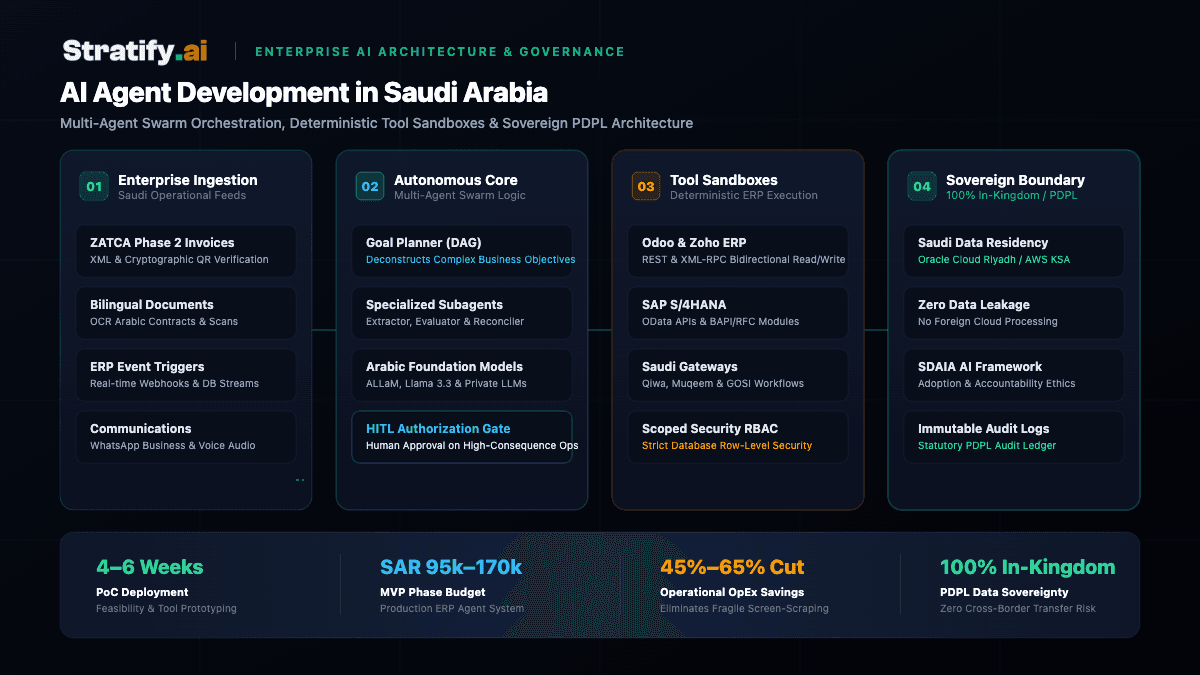
- An MVP takes the validated PoC workflow into production and connects it bidirectionally to the enterprise systems of record — Odoo, SAP, Zoho, Qiwa, or similar. This tier includes authenticated API connectors, a Human-in-the-Loop approval console for high-consequence actions, basic audit logging for PDPL compliance, and staff enablement. Timeline is typically 6 to 8 weeks. At this stage the agent runs in parallel with existing processes for a pilot period before taking over primary responsibility.
- Tier 3: Enterprise Multi-Agent Scale — SAR 220,000 to SAR 480,000+
- The enterprise tier deploys a coordinated swarm of specialized agents across multiple departments — finance, HR, procurement, operations — each with its own capability set, orchestrated by a central planner. This tier includes custom Arabic fine-tuning, multi-ERP synchronization, sovereign in-Kingdom infrastructure provisioning, adversarial security testing, and full operational enablement across teams. Timeline ranges from 12 to 20 weeks depending on integration scope. This is the tier that generates the 45–65% OpEx reductions cited in production deployments.
What actually drives the cost
The line items that account for most of the variance between a SAR 95,000 MVP and a SAR 450,000 enterprise deployment are not always the ones organizations expect. The AI model itself — Gemini, GPT, ALLaM, or an open-weight alternative — is rarely the dominant cost. Infrastructure and integration engineering are.
- ERP integration depth
- Connecting an AI agent to SAP via OData or BAPI, or to Odoo via XML-RPC, requires authenticated bidirectional connectors with schema validation and self-healing error handling. Each additional ERP or government portal (Qiwa, Muqeem, ZATCA) adds engineering scope. A single-ERP MVP costs materially less than a four-system enterprise deployment — which is why the PoC tier deliberately limits integration to one system.
- Arabic language engineering
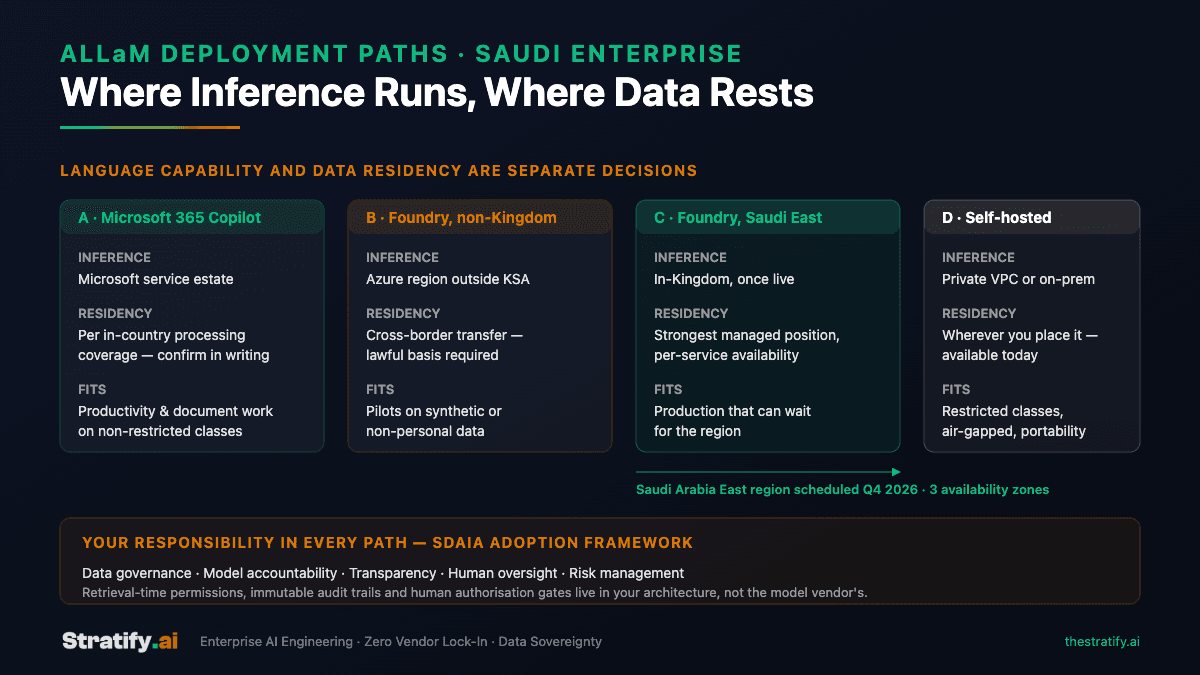
- Generic English AI systems fail in Gulf enterprise environments not because they do not understand words but because they do not understand context — the mix of Najdi business formality, Hijazi conversational tone, and English technical terminology that characterizes real Saudi enterprise communication. Handling this correctly requires either fine-tuned Arabic foundation models (such as ALLaM, as covered in the [ALLaM architecture analysis](/blog/allam-microsoft-foundry-saudi-enterprise-architecture)) or carefully engineered prompt pipelines with bilingual validation layers. Either path adds real engineering time.
- PDPL-compliant data residency
- Under Saudi Arabia's Personal Data Protection Law, organizations face significant penalties if personal or commercially sensitive data crosses international borders without a lawful basis. For an enterprise AI system, this means inference compute, vector databases, and orchestration servers must run inside Saudi cloud regions — OCI Riyadh/Jeddah, local AWS zones, or on-premise hardware. Provisioning and hardening sovereign infrastructure adds cost that a generic SaaS tool avoids by simply disregarding the requirement. It is a real cost, but it is also what makes the deployment legally defensible.
- Agent orchestration and governance architecture
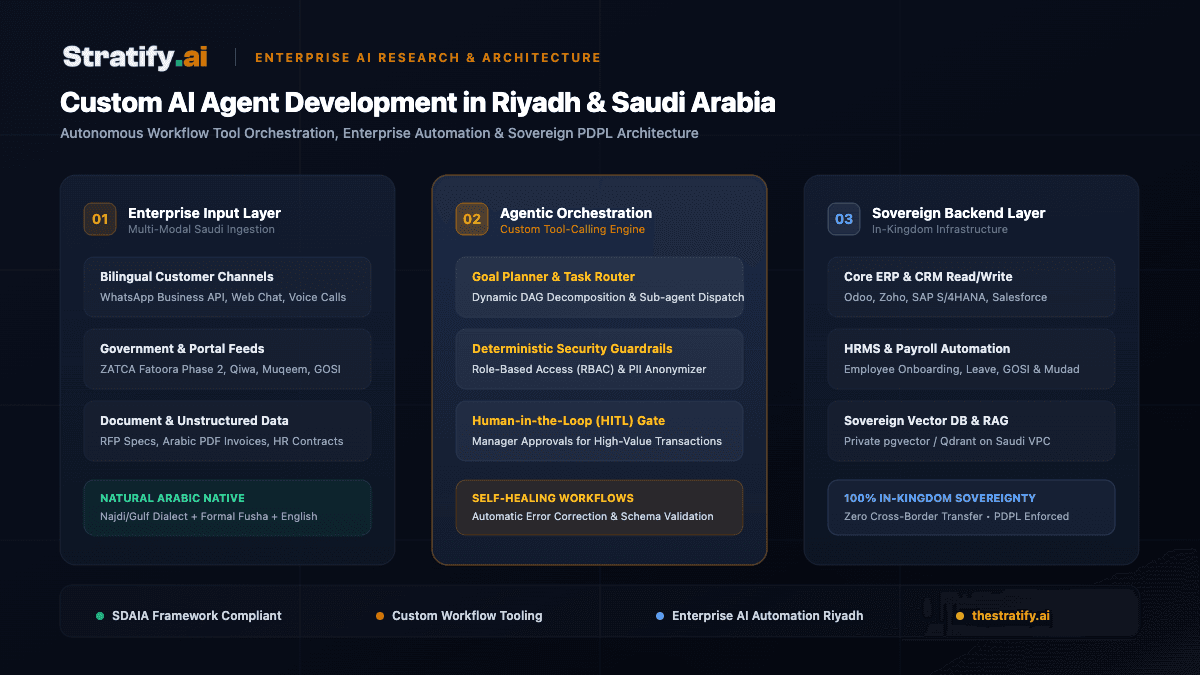
- A single AI agent calling one API is simple. A multi-agent system where specialized domain agents (invoice validator, document parser, compliance checker) are coordinated by a central orchestrator — each with isolated context windows and deterministic tool sandboxes — is significantly more complex to design, test, and operate. The orchestration layer is where most of the engineering effort concentrates in enterprise deployments, and it is what separates a system that works in a demo from one that works reliably in production.
Comparing the cost against what you are replacing
The most useful way to evaluate enterprise AI automation cost is not to compare vendor quotes against each other but to compare them against the fully loaded cost of the current state. In Saudi enterprise environments, that typically means three categories of spend that AI automation eliminates or substantially reduces.
Legacy RPA licensing is the first category. A traditional RPA bot for a single process typically costs SAR 40,000 to SAR 90,000 per year in licensing alone, not counting the IT time required to maintain it when SAP screen positions shift or a supplier changes their invoice format — which happens several times a year. A custom AI agent connected to SAP's published OData and BAPI interfaces does not have this maintenance surface because it is not reading pixel positions.
Manual administrative labor is the second category. Knowledge workers in finance, HR, and operations who spend 15 to 25 hours per week cross-referencing documents between disconnected systems represent a measurable OpEx line that most organizations have simply accepted as a cost of doing business. The shift to agentic AI workflows converts that recurring labor cost into a one-time capital investment with a defined payback period.
After-hours operational gaps are the third category, and the most frequently underestimated one. A supplier that cannot get an invoice status at 11pm, a tenant inquiry that waits until Monday morning, a procurement request that misses a price validity window — these are real revenue and relationship costs that are difficult to measure but straightforward to attribute once an agent is running 24/7.
Hidden costs that change the real number
Several cost categories are genuine but often omitted from initial vendor quotes — not necessarily through deception, but because they only become visible once implementation begins. Understanding them before signing a contract protects both the budget and the timeline.
Data quality remediation is the most common surprise. AI agents are only as useful as the data they can read. If a Saudi enterprise's vendor master in SAP contains duplicate entries, or its Odoo product catalog mixes Arabic and English field names inconsistently, or its document archive contains scanned PDFs that OCR cannot reliably parse — these are not problems the AI agent creates, but they are problems it exposes. Budgeting for a data quality sprint before agent deployment is not optional; it is what determines whether the PoC numbers hold in production.
Staff enablement and change management is the second category most organizations underinvest in. An AI agent that automates invoice matching does not save time if the finance team continues processing invoices manually because they do not trust the agent's output or do not understand how to review its decisions. A 2 to 4 day enablement programme — covering how the agent works, how to interpret its confidence signals, and how the Human-in-the-Loop approval console functions — is a small investment relative to the project cost and a large one relative to adoption speed.
Infrastructure management is the third, particularly for sovereign in-Kingdom deployments. Provisioning OCI or AWS compute within Saudi regions, configuring VPC networking, setting up vector database clusters, and establishing monitoring and alerting all require either internal cloud engineering capacity or managed infrastructure services. Factor this in, particularly if the organization's current IT team has not managed GPU-enabled cloud infrastructure before.
Finally, consider whether the planned integration covers all relevant entry points. An agent that handles email invoices but not WhatsApp supplier messages, or that processes Odoo records but not the linked SharePoint document library, will deliver partial results in environments where those channels carry real volume. Scope creep is less a vendor problem and more a consequence of enterprise integration being more interconnected than it first appears.
How to evaluate a vendor quote
When reviewing a proposal for enterprise AI automation in Saudi Arabia, four questions will tell you more than the total number on the cover page.
First: does the scope include a PoC before the full build, or does it jump straight to production? A vendor confident enough in their approach to start with a measurable PoC — even if that costs extra in the short term — is demonstrating that they expect to be held accountable for results. A vendor who insists on a large upfront contract before producing anything working is asking for trust they have not yet earned.
Second: who owns the IP at delivery? The correct answer is that the client owns all custom agent code, prompt libraries, fine-tuned model artifacts, and integration schemas with no ongoing licensing fees attached. Anything that ties the client to a per-seat or per-call fee for software the client paid to have built is vendor lock-in, not a service.
Third: where does inference actually run? For any workflow touching personal data, payroll, commercial contracts, or government-regulated information, the answer must be inside Saudi Arabia — in the client's private VPC, in a dedicated OCI or AWS region, or on on-premise hardware. A vendor who cannot answer this question specifically is not considering PDPL compliance as a requirement.
Fourth: what is the maintenance model after go-live? Custom AI systems require monitoring, model updates, and periodic prompt revision as the business context changes. Clarity on who owns that ongoing responsibility — and at what cost — matters as much as the build fee.
For a practical view of what these systems look like in production — including the architecture, use cases, and implementation roadmap — see the guide to AI agent development in Saudi Arabia or the deep-dive on AI agents in real estate operations as a concrete industry example. When you are ready to scope a deployment for your organization, request a confidential architecture consultation with the Stratify AI engineering team in Riyadh.
Comparing the cost against what you are replacing
Total cost comparison between Enterprise AI Agents, Legacy RPA, and SaaS Copilots for Saudi Arabia enterprise operations over a 3-year horizon.
| Cost Dimension | Custom AI Agent (Stratify AI) | Legacy RPA Platform | Generic SaaS Copilot |
|---|---|---|---|
| Initial build cost (SAR) | SAR 95,000–480,000 one-time (client owns all IP) | SAR 40,000–90,000/bot/year in licensing + build fees | SAR 0 build, but SAR 120–180/user/month ongoing |
| Annual maintenance | Low — no screen-scraping surface to break; API-connected | High — breaks on every UI update, SAP transport, or format change | None (vendor managed), but no customization possible |
| PDPL / data residency | 100% in-Kingdom — private VPC or on-premise, no cross-border transfer | On-premise runtime, but no intelligent governance controls | Multi-tenant foreign cloud — cross-border transfer liability |
| Arabic language capability | Native bilingual — Najdi, Hijazi, Gulf business + MSA + English | None — RPA has no language understanding | Generic MSA translation, no dialect or context handling |
| ERP integration model | Bidirectional authenticated APIs — OData, BAPI/RFC, XML-RPC | Brittle UI screen-scraping — breaks on layout changes | Sidebar integrations only — cannot execute database transactions |
| Typical 3-year TCO (SAR) | SAR 120,000–550,000 (capital payback in 4–7 months) | SAR 200,000–400,000 (perpetual licensing + maintenance, no payback) | SAR 130,000–220,000 (perpetual SaaS with no IP ownership) |
Frequently Asked Questions
It depends on scope. A focused Proof of Concept validating one workflow costs SAR 35,000–65,000 over 3 to 4 weeks. A production MVP with live ERP integration costs SAR 95,000–175,000 over 6 to 8 weeks. Full enterprise multi-agent deployments spanning multiple departments, custom Arabic fine-tuning, and sovereign in-Kingdom infrastructure range from SAR 220,000 to SAR 480,000 and above. Most Saudi organizations achieve full capital payback within 4 to 7 months by eliminating legacy RPA licensing and manual processing costs.
The returns concentrate in three areas: elimination of legacy RPA licensing (SAR 40,000–90,000 per bot per year), reduction in manual administrative labor by 45–65%, and 24/7 operational coverage that prevents after-hours revenue and relationship losses. The size of the return depends on the specific workflows targeted — which is why responsible deployments start with a PoC that measures the baseline before committing to enterprise scale.
Yes, materially. PDPL-compliant deployment requires in-Kingdom inference compute, sovereign VPC provisioning, database-level Row-Level Security, and immutable audit logging — none of which come standard with generic SaaS AI tools. This infrastructure investment adds cost upfront but removes ongoing legal and regulatory exposure. Organizations that skip this step and later face a PDPL audit typically face remediation costs far exceeding the avoided infrastructure spend.
Gulf enterprise environments use a distinctive mix of formal Modern Standard Arabic, regional dialects (Najdi, Hijazi), and English technical terminology within the same document or conversation. Generic English AI models misread this code-switching and produce unreliable outputs. Handling it correctly requires either Arabic-specific foundation models like ALLaM or fine-tuned open-weight alternatives, which adds engineering effort that is not required for English-only deployments.
Start with a PoC. The purpose of a Proof of Concept is to produce a working system on real data before committing to full-scale investment — giving you a measured accuracy baseline, a validated ROI case, and confidence that the specific workflow you have chosen is a good fit for AI automation. Organizations that skip the PoC and proceed directly to enterprise scope typically encounter integration surprises and data quality issues mid-build that a PoC would have identified at a fraction of the cost.
With Stratify AI, the client retains 100% ownership of all custom agent code, prompt libraries, tool-calling schemas, fine-tuned model weights, and integration connectors upon project delivery. There are no per-seat fees, no runtime licensing charges, and no vendor lock-in. The client can deploy, modify, and extend the system independently after handover.
Related Articles

Let's Build the Future
of Enterprise AI
Have a project in mind or need expert guidance?
We'd love to hear from you.
Salah Ad Din Al Ayyubi Rd, Al Malaz,
Riyadh 12836, Saudi Arabia
Global Enterprise Partner
Empowering businesses across North America, Europe, Asia, and the Middle East.