AI for Supply Chain & Operations Automation in Saudi Arabia: A Practical Guide for Growing Businesses
From manual purchase orders and reactive stockouts to a connected, self-monitoring supply chain — what AI integration looks like for Saudi operations teams and how to start without disrupting what already works.

Executive Summary
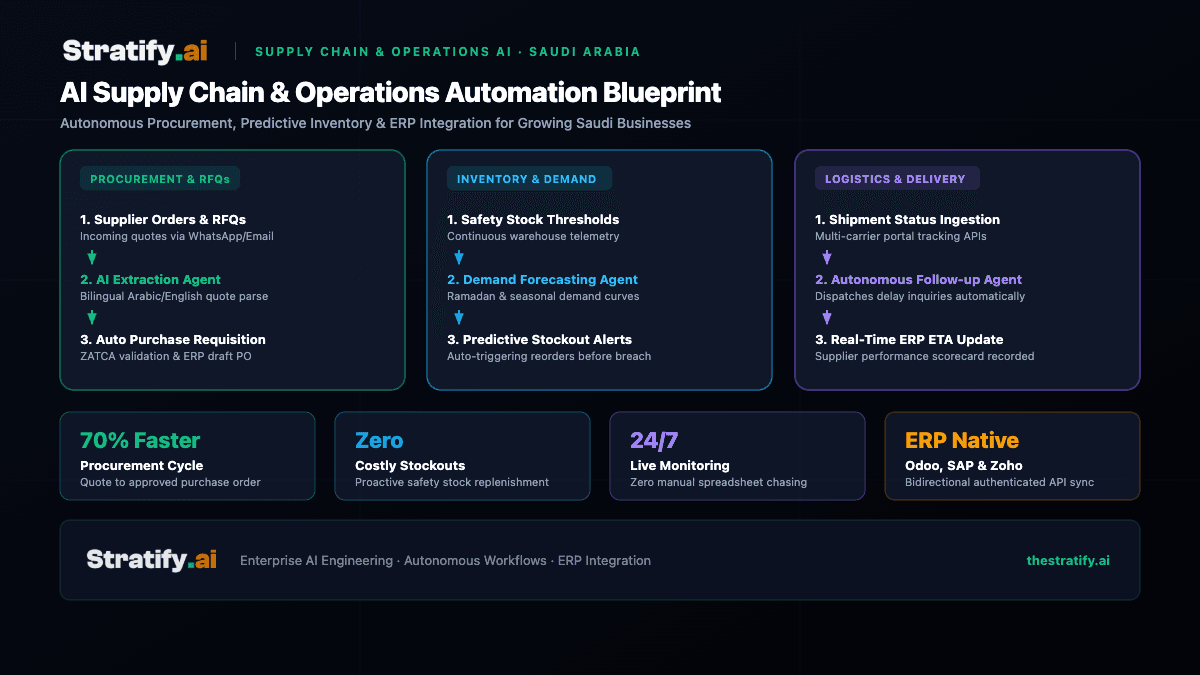
Operations and supply chain management is where most growing Saudi businesses lose the most time without realising it. A procurement officer manually chasing three suppliers for quotes. A warehouse manager discovering a stockout only after a customer complains. A logistics coordinator copy-pasting shipment updates between a supplier WhatsApp message and an ERP system. These are not technology failures — they are coordination gaps that AI integration closes by connecting the tools the business already uses and letting agents handle the routine monitoring and triggering. This guide covers exactly what that looks like in practice: which operations workflows AI handles well, how it connects to ERPs like Odoo and SAP, what it costs for a growing business, and how to start without disrupting what currently works.
- 70% Faster
- Procurement cycle from supplier quote request to approved purchase order
- 24/7 Monitoring
- Inventory levels, supplier lead times, and delivery status — no manual checking
- Zero Stockouts
- Demand forecasting agents trigger reorders before safety stock is breached
- ERP Connected
- Agents read and write directly into Odoo, SAP, or Zoho — no duplicate data entry
Key Takeaways
- Supply chain and operations automation for Saudi businesses is not about replacing ERP systems — it is about connecting them and adding the monitoring layer that catches problems before they become stockouts, delays, or compliance failures.
- The highest-value starting points are the workflows where staff spend the most time on coordination: purchase requisition generation, supplier follow-up, inventory threshold alerts, and delivery status tracking.
- AI integration connects directly to [Odoo](/white-papers/odoo-erp-ai-dashboard-chat-with-data), [SAP](/blog/sap-ai-integration-odata-bapi-rfc), and Zoho via authenticated APIs — it does not require migrating data or replacing existing software.
- Growing businesses (5–100 staff) typically see the fastest return because manual coordination overhead is proportionally higher and the workflows are simpler to automate than large enterprise multi-system deployments.
- A PoC targeting one supply chain workflow — such as automated reorder triggering or supplier quote aggregation — typically costs SAR 35,000–65,000 and produces measurable results within 4 weeks.
Where operations time actually goes — and why it compounds
In most Saudi businesses with 5 to 100 staff, supply chain and operations management sits in a grey zone: too complex to fully manually manage, too specific to the business to be handled by generic software alone. The result is a set of recurring manual coordination tasks that nobody has officially assigned but everyone ends up doing.
A procurement coordinator who manually requests quotes from five suppliers via WhatsApp, collates the responses into a spreadsheet, and then types the winning price into Odoo as a purchase order. A warehouse manager who checks stock levels by walking the floor or exporting a report every morning. A sales team that discovers a product is out of stock when a customer calls to ask why their order has not shipped. An operations lead who spends an hour on a Friday afternoon chasing delivery confirmations from three logistics providers.
None of these tasks requires a human decision. They require information retrieval, comparison, and a trigger — exactly what AI agents handle well. The coordination gap compounds because these tasks happen every day, across every supplier, every SKU, and every shipment, and each one is too small to justify dedicated staff but too frequent to absorb without operational drag.
This is the specific problem AI supply chain integration solves — not by replacing the ERP or the warehouse, but by adding the autonomous monitoring and triggering layer that connects them and handles the routine coordination that currently falls between them.
The five operations workflows AI handles first
Not every supply chain workflow is a good early target for AI automation. The ones that deliver the fastest return share three characteristics: they are high-frequency (happening daily or weekly), they are rule-based (the decision logic is clear and consistent), and they currently require a human to retrieve information from one system and act on it in another. Here are the five that matter most for growing Saudi businesses.
- 1. Automated reorder triggering and purchase requisition generation
- An inventory monitoring agent watches stock levels against defined safety thresholds and lead times. When a product crosses its reorder point, the agent generates a draft purchase requisition in the ERP — populated with the preferred supplier, last negotiated price, and standard quantity — and routes it for one-click approval. The procurement coordinator reviews and approves rather than initiating from scratch. For businesses running Odoo, this connects directly via XML-RPC; for SAP, via OData or BAPI calls as described in the guide to SAP AI integration.
- 2. Supplier quote aggregation and comparison
- Rather than manually requesting quotes from multiple suppliers and collating responses by hand, a procurement agent sends standardized quote requests to pre-approved suppliers via email or WhatsApp Business, parses incoming responses (including Arabic text and attached PDFs), and builds a structured comparison table in the ERP. The agent flags the lowest compliant quote and surfaces any delivery time or payment terms differences for the buyer to review. What previously took a procurement officer 3–4 hours takes the agent under 10 minutes.
- 3. Demand forecasting and seasonal inventory planning
- An analytics agent reads historical sales data from the ERP, applies seasonality patterns (including Saudi National Day periods, Ramadan demand shifts, and summer slowdowns), and produces weekly demand forecasts with confidence ranges. When forecasts diverge from current stock plans, the agent sends an alert with a recommended purchasing action. For businesses in retail, F&B, or industrial supply, this converts reactive stockout management into proactive inventory positioning.
- 4. Delivery tracking and logistics follow-up
- A logistics agent monitors shipment status across carriers and freight forwarders, cross-referencing expected delivery dates against ERP purchase orders. When a shipment is delayed beyond a threshold, the agent sends an automated follow-up to the carrier, updates the ERP with the revised ETA, and alerts the operations team and relevant customer service staff. No one needs to check carrier portals manually or remember to follow up.
- 5. Supplier performance scoring and compliance tracking
- An evaluation agent tracks on-time delivery rates, invoice accuracy, and quality rejection rates per supplier over rolling periods. It flags suppliers falling below performance thresholds, surfaces trends before they affect operations, and generates a monthly supplier scorecard for the procurement lead. For Saudi businesses with ZATCA Phase 2 obligations, the same agent validates incoming electronic invoice QR codes and flags discrepancies before they reach accounts payable.
How AI connects to the ERP you already run
The most common concern Saudi operations managers raise when evaluating AI supply chain integration is whether it requires replacing or migrating away from their existing ERP. It does not. AI agents connect to whatever the business already runs — they read data from it, act on it, and write results back into it. The ERP remains the system of record throughout.
For businesses running Odoo, the connection uses XML-RPC — a published, stable interface that Odoo exposes for exactly this kind of external integration. An AI agent can query stock quantities, create purchase orders, read vendor pricelists, and update delivery statuses without touching the Odoo UI. The white paper on chatting with your Odoo data covers the architecture in detail.
For SAP environments, the connection routes through OData services for standard business objects and BAPI/RFC calls for transactional operations not covered by OData — a pattern covered in the SAP AI integration guide. For Zoho Inventory or Zoho Books, REST APIs provide the equivalent access.
The integration pattern is the same across all three: the AI agent holds authenticated credentials scoped to exactly the data it needs to read and write, sits outside the ERP entirely, and interacts with it the same way any other external system would. This is why the integration survives ERP upgrades — it was never built against the ERP's internals.
For businesses not yet on a structured ERP, or running operations primarily across spreadsheets and WhatsApp, AI integration typically pairs with a lightweight ERP implementation rather than adding automation to unstructured data. Getting the data foundation right first is what determines whether the automation works reliably in production.
What this looks like for a growing Saudi business specifically
The supply chain automation conversation in Saudi Arabia often defaults to large enterprise deployments — multi-warehouse SAP implementations with hundreds of SKUs and complex multi-tier supplier networks. But the same integration pattern scales down significantly, and for businesses in the 5 to 100 staff range, the return comes faster because the manual coordination overhead is proportionally higher.
A trading company in Riyadh with 12 staff and 300 active SKUs across two suppliers might spend 15 hours a week on manual procurement coordination: requesting quotes, following up on deliveries, updating stock records, and chasing payment confirmations. An AI integration connecting their Odoo instance to their supplier email and WhatsApp threads can recover most of that time within the first month of operation — not by adding headcount, but by handling the coordination that currently happens between systems.
Similarly, a light manufacturing business in Jeddah with an established SAP environment might be sitting on rich operational data that never gets used for planning because extracting and interpreting it requires manual report generation. An AI layer connected via OData — similar to the architecture described in the manufacturing dashboards and alerting whitepaper — turns that passive data into active monitoring: production throughput alerts, component shortage warnings, and daily operational summaries delivered to the operations manager's inbox.
The Vision 2030 industrialization agenda, including the development of new logistics corridors and the National Industrial Development and Logistics Program (NIDLP), is creating new demand for supply chain visibility and efficiency across Saudi sectors. Businesses that build automated operations infrastructure now are better positioned to scale into these expanding markets than those managing the same workflows manually as volume grows.
Cost and timeline for supply chain AI integration
Supply chain and operations automation sits within the same investment model as other AI integration projects — starting with a focused Proof of Concept before committing to a broader deployment. A detailed breakdown is in the enterprise AI automation cost guide, but the supply chain context is worth making concrete.
A 4-week PoC targeting one workflow — typically automated inventory monitoring and reorder triggering — costs SAR 35,000 to SAR 65,000 and produces a working system connected to the live ERP. The output is not a prototype: it is a production agent handling real purchase requisitions, with a measured baseline showing exactly how many hours of manual coordination it replaces and what stockout events it prevented. That baseline is what justifies the next investment.
A full operations automation suite — covering procurement, inventory, logistics follow-up, and supplier scoring — connected bidirectionally to the ERP typically runs SAR 95,000 to SAR 175,000 over 6 to 8 weeks. For businesses in sectors with complex logistics requirements (construction materials, food & beverage, industrial spare parts), timeline and cost increase with the number of supplier integrations and data sources.
The comparison that matters is not the development cost against zero — it is against the current cost of the manual coordination it replaces. For a business where three people spend 10–15 hours each per week on procurement and stock management, the payback calculation is straightforward.
Where to start: a practical first step
The most effective starting point for supply chain AI integration is the workflow where manual coordination is most visible and most measured. For most Saudi operations teams, that is either purchase requisition generation (where the gap between inventory reality and ERP records is widest) or delivery tracking (where the most staff time disappears into follow-up that produces no value).
The PoC approach — pick one workflow, connect it to the live ERP, measure the result in 4 weeks — is not caution for its own sake. It is the fastest way to produce a number the rest of the business can act on. A workflow that was taking 15 staff-hours per week and now takes 1 hour of oversight is a business case for expanding the system, not just a technology demonstration.
If your business already has a structured ERP in place, the integration is a configuration and engineering problem rather than a data migration problem — which means the timeline to a working system is short. If operations are still primarily spreadsheet and WhatsApp-driven, the right first conversation is about what the data foundation looks like before adding the automation layer on top of it.
Stratify AI works with growing Saudi businesses at both stages. Whether you are looking to add intelligence to an existing Odoo or SAP environment or want to understand what the right operational infrastructure looks like for your sector, the AI integration service page outlines the engagement model, and the contact page is the fastest way to start a conversation. If you want the broader context on what AI agents can do across operations — not just supply chain — the overview of 15 business processes Saudi enterprises automate today is a useful companion read.
Cost and timeline for supply chain AI integration
Comparison of manual supply chain coordination against AI-integrated operations for Saudi growing businesses.
| Operation | With AI Integration | Manual Process |
|---|---|---|
| Purchase order generation | Auto-generated from inventory threshold breach; routed for one-click approval | Procurement staff manually initiates, requests quotes, types into ERP |
| Supplier quote comparison | Agent collects responses, parses Arabic/English, builds comparison in ERP — under 10 minutes | 3–4 hours of manual collection, spreadsheet entry, and comparison per round |
| Delivery tracking | Agent monitors carrier portals, sends automated follow-ups, updates ERP ETA | Staff checks carrier websites manually and sends WhatsApp follow-ups |
| Stockout detection | Alert fired before safety stock is breached; reorder triggered automatically | Discovered when customer order cannot be fulfilled or stock count shows zero |
| ZATCA invoice validation | Agent validates QR code and tax registration on every incoming e-invoice | Manual spot-check or no check until audit |
| Supplier performance review | Monthly scorecard auto-generated from ERP data — on-time rate, accuracy, rejections | Periodic manual report if capacity allows — often skipped |
Frequently Asked Questions
Yes — and growing businesses often see faster returns than large enterprises because the manual coordination overhead is proportionally higher and the workflows are simpler to automate. A business with 5 to 50 staff spending significant time on procurement follow-up, inventory tracking, and delivery monitoring can recover most of that coordination time within the first month of an AI integration, connected to whichever ERP or inventory system the business already uses.
No. AI agents connect to your existing ERP — Odoo, SAP, Zoho, or others — via published APIs and read/write data directly. The ERP remains the system of record. The AI layer adds monitoring, triggering, and coordination on top of what you already run, without migrating data or disrupting current processes.
The highest-value starting point is usually automated inventory monitoring and purchase requisition generation — the workflow where a stock level crossing a threshold automatically triggers a draft purchase order for approval. It is rule-based, high-frequency, and easy to measure: the number of manual requisitions that become automated approvals is a direct ROI signal within weeks.
Supply chain AI agents in Saudi Arabia are engineered to parse Arabic text in supplier emails, WhatsApp messages, and attached PDF quotes alongside English content. They extract structured data — prices, quantities, delivery terms, payment conditions — regardless of whether the supplier communicates in Arabic, English, or a mix of both, and normalize everything into a consistent ERP-ready format.
A procurement AI agent validates incoming electronic invoices against ZATCA Phase 2 requirements: checking the cryptographic QR code, verifying the supplier's VAT registration, and flagging any discrepancies before the invoice reaches accounts payable. This runs on every inbound invoice automatically, replacing periodic manual spot-checks with continuous compliance coverage.
A focused 4-week Proof of Concept targeting one workflow — such as automated inventory monitoring and reorder triggering — typically costs SAR 35,000 to SAR 65,000 and delivers a working system connected to the live ERP. A full operations automation suite covering procurement, inventory, logistics, and supplier scoring runs SAR 95,000 to SAR 175,000 over 6 to 8 weeks. Most businesses achieve full payback within 4 to 6 months by recovering manual coordination time and reducing stockout-related revenue losses.
Related Articles

Let's Build the Future
of Enterprise AI
Have a project in mind or need expert guidance?
We'd love to hear from you.
Salah Ad Din Al Ayyubi Rd, Al Malaz,
Riyadh 12836, Saudi Arabia
Global Enterprise Partner
Empowering businesses across North America, Europe, Asia, and the Middle East.