PDPL and Enterprise AI in Saudi Arabia: What Companies Need to Know Before Deploying AI Agents
A comprehensive legal and architectural blueprint for Saudi enterprise leadership: navigating in-Kingdom data residency, cryptographic PII protection, deterministic tool sandboxes, and SDAIA AI governance standards.

Executive Summary
As Saudi enterprises accelerate digital transformation under Vision 2030, the legal and operational stakes of deploying artificial intelligence have fundamentally changed. With the Kingdom's Personal Data Protection Law (PDPL) fully enforceable since September 2024, organizations face severe statutory penalties — including fines up to SAR 5,000,000 and criminal liability — if personal data, employee records, or confidential commercial information is transferred across international borders without explicit lawful exemptions. Off-the-shelf foreign cloud LLMs and generic SaaS copilots process enterprise prompts through shared international data centers, creating an unacceptable compliance risk. This guide delivers a definitive technical and legal blueprint for Saudi leadership: how to architect autonomous AI agents with 100% in-Kingdom data residency, enforce cryptographic PII redaction, isolate transactional ERPs via deterministic tool sandboxes, and establish audit-ready human-in-the-loop governance aligned with the Saudi Data and Artificial Intelligence Authority (SDAIA) framework.
- Zero Data Leakage
- 100% in-Kingdom compute across Oracle Cloud Riyadh/Jeddah, AWS local zones, or on-premise
- SAR 5M Shield
- Complete statutory protection against PDPL Article 29 cross-border transfer violations
- Real-Time PII Masking
- Sub-10ms cryptographic redaction of National IDs, Iqamas, IBANs, and Qiwa payroll records
- SDAIA Aligned
- Fully audited against NDMO data classifications and SDAIA ethical AI governance pillars
Key Takeaways
- The Saudi Personal Data Protection Law (PDPL), fully enforceable since September 2024, prohibits the unauthorized cross-border transfer of personal data, making foreign multi-tenant AI APIs a direct regulatory liability.
- Deploying [custom AI agent systems](/services/ai-agents) within sovereign Saudi infrastructure (such as Oracle Cloud Infrastructure Riyadh/Jeddah or on-premise clusters) guarantees complete data residency while securing 100% client IP ownership.
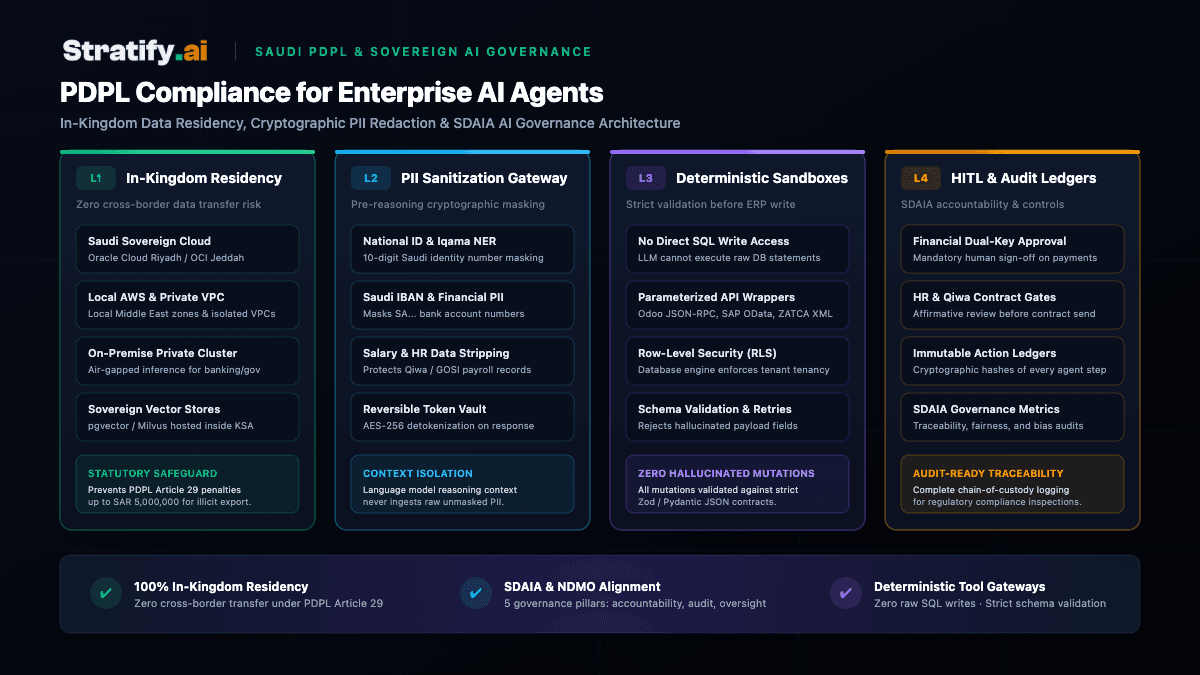
- A production-grade compliance architecture demands four defense-in-depth layers: sovereign in-Kingdom compute, pre-reasoning PII redaction, deterministic tool sandboxes with Row-Level Security (RLS), and human-in-the-loop governance.
- Language models must never be granted direct SQL write access to enterprise systems of record; all interactions with [Odoo](/blog/odoo-ai-agent-erp-architecture) or [SAP](/blog/sap-ai-integration-odata-bapi-rfc) must execute through parameterized API contracts validating schema boundaries.
- Aligning with the Saudi Data and Artificial Intelligence Authority (SDAIA) AI Adoption Framework ensures immutable cryptographic audit logging for every automated action, as detailed in our analysis of [AI agents in Saudi enterprise operations](/white-papers/ai-agents-daily-operations-saudi-enterprises).
The Saudi PDPL Mandate: Why Public Cloud AI is an Enterprise Liability
In commercial hubs across Riyadh, Jeddah, and the Eastern Province, enterprise adoption of artificial intelligence has reached an inflection point. While initial corporate pilots focused on experimental chatbots and unstructured text generation, corporate boards and risk committees are confronting a stark regulatory reality: the Kingdom of Saudi Arabia's Personal Data Protection Law (PDPL), enacted under Royal Decree No. M/19 and amended by Royal Decree No. M/148, is fully enforceable under the oversight of the Saudi Data and Artificial Intelligence Authority (SDAIA).
Under PDPL Article 29, transferring personal data outside the Kingdom is strictly restricted. Cross-border transfers are permissible only under narrow statutory exceptions: specific intergovernmental agreements, international treaties to which the Kingdom is party, or explicit regulatory exemptions where the destination jurisdiction provides an equivalent level of protection and the transfer is strictly limited to the minimum necessary data. For enterprise technology leaders, this creates an acute operational problem with generic SaaS AI tools.
When employees query consumer-grade generative AI interfaces or third-party cloud copilots hosted in North America or Europe, sensitive customer identities, employee payroll slips from Qiwa, internal financial ledgers, and National ID numbers are transmitted through foreign multi-tenant inference clusters. This constitutes an illicit cross-border data transfer under Saudi law. Organizations found in violation face statutory fines up to SAR 5,000,000 (which may be doubled for repeat infractions), confiscation of commercial proceeds, and potential criminal sanctions for intentional disclosure of sensitive records.
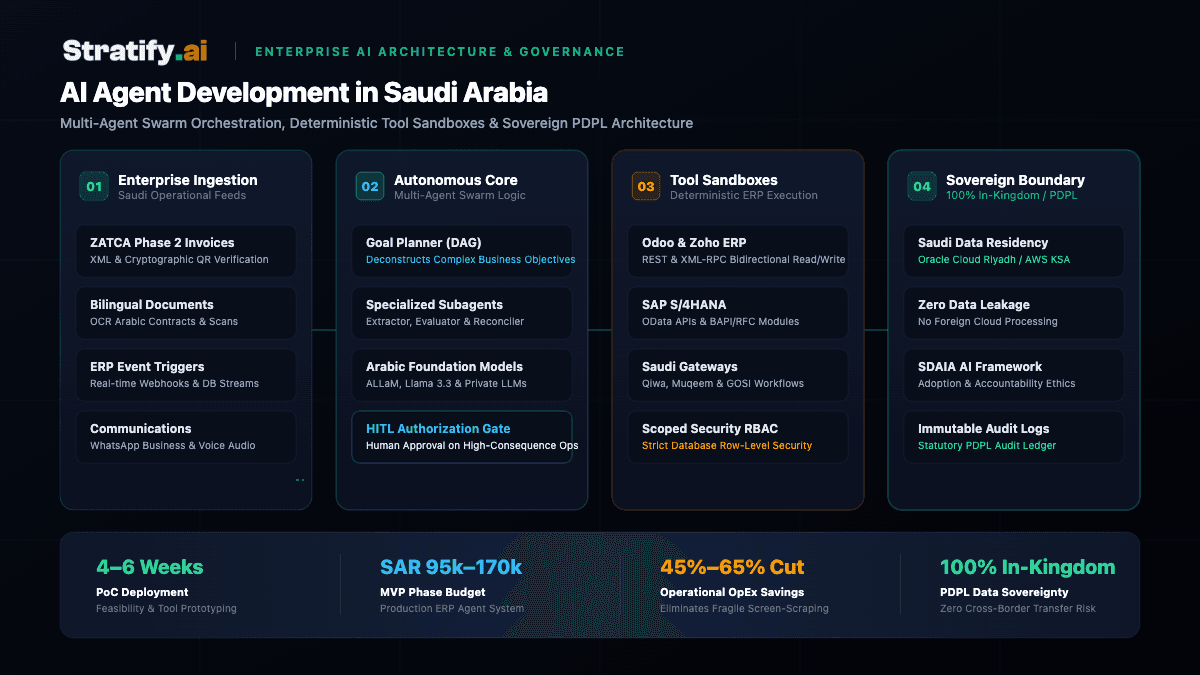
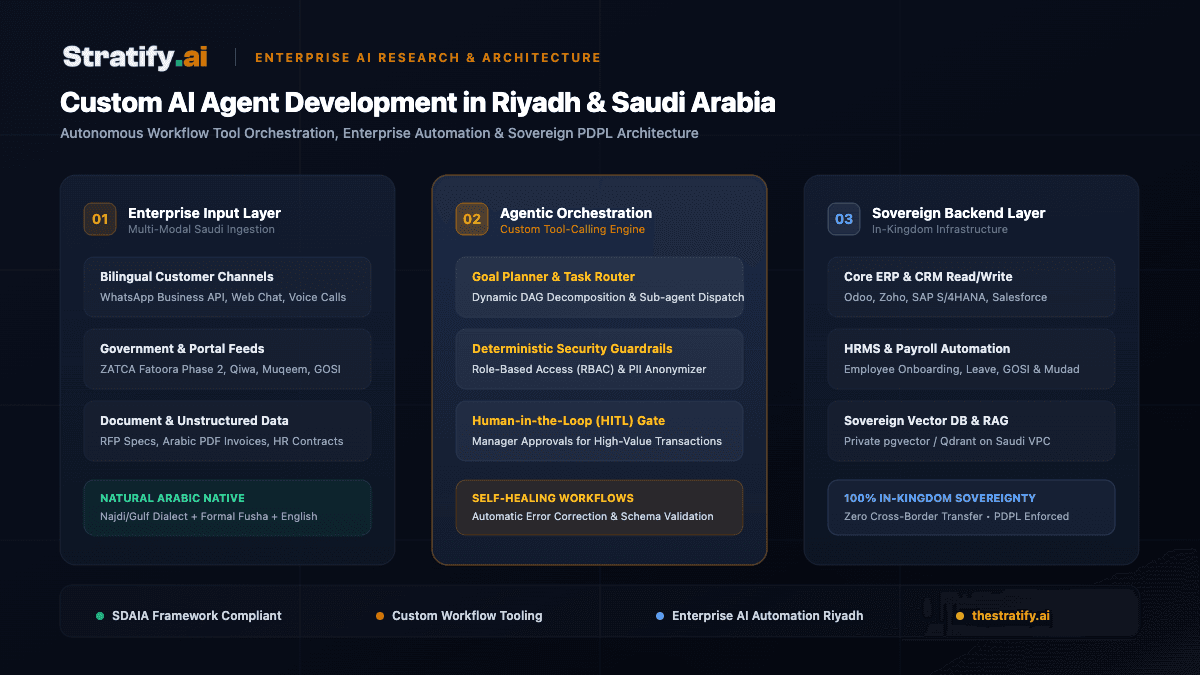
To capture the productivity gains of autonomous software without incurring catastrophic legal exposure, Saudi enterprises are transitioning to sovereign architectures. As outlined in our nationwide Saudi AI agent development guide and our strategic analysis of custom AI agent development in Riyadh, the solution is not to abandon artificial intelligence, but to architect sovereign execution environments engineered specifically for compliance.
The 4-Layer Sovereign Architecture for Enterprise AI Compliance
Ensuring PDPL compliance requires more than signing standard foreign vendor addendums or relying on generic terms of service. True regulatory immunity demands an architectural defense-in-depth strategy where security guardrails are enforced at the infrastructure, network, and application layers. Stratify AI engineers enterprise AI agent ecosystems across four deterministic compliance tiers.
Layer 1: Sovereign In-Kingdom Infrastructure. All compute resources — including Large Language Model (LLM) inference servers, vector databases (e.g. pgvector, Milvus), cache layers, and orchestration logic — reside physically within the borders of Saudi Arabia. This is achieved through enterprise tenancies in Saudi cloud regions (such as Oracle Cloud Infrastructure regions in Riyadh and Jeddah, local AWS Middle East zones, or Google Cloud Dammam) or on-premise private GPU clusters provisioned within the client's corporate data center.
Layer 2: PII Detection, Sanitization & Cryptographic Tokenization. Before any document, customer communication, or ERP record enters the model's context window, it passes through an automated redaction gateway. This gateway employs specialized Arabic Named Entity Recognition (NER) models and deterministic regular expressions tuned for Saudi identifiers: 10-digit National IDs, Iqama numbers, Saudi commercial IBANs (SA followed by 22 digits), phone numbers, and Qiwa employment contract IDs. Identified PII is replaced with non-identifying cryptographic surrogates (e.g. `[NATIONAL_ID_A72B]`).
Layer 3: Deterministic Tool Sandboxes & Database Row-Level Security (RLS). Language models are probabilistic engines and must never be given unrestricted access to execute raw SQL statements against operational databases. In our sovereign architecture, agents interact with core systems through strictly typed, parameterized API tool wrappers. Each tool enforces input schema validation using Zod or Pydantic. If an agent hallucinates a parameter or attempts an unpermitted database operation, the sandbox deterministically intercepts and rejects the call. At the database layer, PostgreSQL Row-Level Security (RLS) ensures agents inherit the precise permission boundary of the authorized user.
Layer 4: Human-in-the-Loop (HITL) Governance & Cryptographic Ledgers. In alignment with SDAIA's mandate for algorithmic accountability, high-consequence business actions cannot be executed autonomously. Operations involving financial disbursements above pre-authorized limits, contract issuance, employee status alterations, or ZATCA tax adjustments are routed to an authenticated human supervisor through interactive approval workflows. Every step in the decision graph is hashed and written to an immutable audit ledger, guaranteeing complete chain-of-custody tracking.
- 1. Physical In-Kingdom Residency
- Zero-data-leakage compute boundaries running inside Saudi sovereign cloud data centers (Oracle Cloud Riyadh/Jeddah, AWS KSA) or private air-gapped clusters.
- 2. Real-Time Bilingual PII Redaction
- Sub-10ms tokenization of Saudi National IDs, Iqamas, IBANs, and salary figures before text enters the model reasoning context.
- 3. Parameterized API Execution Sandboxes
- Strictly typed REST/GraphQL and RPC connectors with database Row-Level Security, preventing unvetted SQL mutations or privilege escalation.
- 4. Cryptographic Audit Trails & HITL Controls
- Immutable transaction logs capturing input tokens, tool parameters, model outputs, and mandatory human supervisor cryptographic sign-offs.
Deployment Comparison: Foreign Cloud AI vs. Hybrid SaaS vs. Sovereign Custom Agents
Saudi CIOs, CTOs, and General Counsel must evaluate the trade-offs between different AI delivery models. Understanding where compute executes, where customer records are stored, and who owns the resulting intellectual property is critical to avoiding regulatory non-compliance.
SDAIA Governance Framework: The Five Pillars of Enterprise AI Stewardship
Beyond statutory data residency, enterprise AI initiatives in Saudi Arabia must comply with the overarching governance frameworks established by the Saudi Data and Artificial Intelligence Authority (SDAIA). SDAIA's National Data Management Office (NDMO) and AI Ethics Principles set clear expectations for how organizations design, deploy, and monitor algorithmic systems.
Our sovereign AI engineering practice translates SDAIA's theoretical principles into concrete software controls across five non-negotiable pillars:
1. Fairness & Non-Discrimination: In automated workflows — such as HR screening, loan pre-qualification, or vendor scoring — models are systematically evaluated against localized demographic bias. Agents are audited to ensure algorithms do not penalize applicants based on regional dialect, gender, or nationality, and align with national Saudization (Nitaqat) objectives.
2. Reliability & Safety: Autonomous systems deployed in mission-critical environments must be deterministic. By utilizing constrained decoding, structured JSON output enforcement, and automated self-healing retry loops, agents operate within strictly bounded operational corridors. If an agent encounters an unresolvable anomaly, it fails gracefully to a human operator.
3. Transparency & Explainability: Black-box AI decisions are legally indefensible in regulated industries. For every decision an agent makes — whether approving a vendor invoice in AI finance workflows or flagging an inventory stockout — the system generates a human-readable explanation trace outlining the data points evaluated, the business rules consulted, and the reasoning chain followed.
4. Privacy & Security: Integrating defense-grade encryption standards (AES-256 for data at rest, TLS 1.3 for data in transit) and zero-trust authentication. API tokens, database connection strings, and ZATCA cryptographic certificates are stored in encrypted hardware security modules (HSMs) or enterprise secret managers, never exposed in agent prompts.
5. Accountability & Oversight: Establishing clear lines of human ownership. Every autonomous micro-agent is mapped to an internal corporate owner. Mandatory dual-key authorization workflows ensure that high-stakes commercial commitments can never be made without explicit human verification.
- NDMO Data Classification Integration
- Automated tagging and enforcement of data classifications (Public, Restricted, Confidential, Top Secret) across all vector stores and agent retrieval pipelines.
- Auditable Explainability Traces
- Comprehensive rationale logging that translates complex multi-step reasoning chains into plain-language audit dossiers for legal and compliance teams.
- Zero-Trust Credential Isolation
- Enterprise secrets, ERP tokens, and cryptographic keys are isolated in private secret vaults with strict role-based rotation cycles.
- Continuous Drift & Hallucination Monitoring
- Automated observability pipelines that monitor model accuracy, token latency, and factual alignment in production, triggering automatic alerts upon behavioral drift.
The 5-Stage PDPL AI Readiness Checklist for Saudi CIOs & Legal Counsel
Before authorizing the deployment of an autonomous AI agent into production, technology leaders and corporate legal counsel should conduct a structured compliance audit. Skipping foundational governance steps creates immense technical and legal debt that can derail enterprise AI adoption.
Stage 1: Personal Data Inventory & Mapping. Document all internal systems of record containing personal data (ERP, CRM, HRMS, payroll). Identify which specific data fields an AI agent requires to fulfill its business objective, adhering strictly to the PDPL data minimization principle: collect and process only what is strictly necessary.
Stage 2: Infrastructure & Inference Sovereignty Audit. Verify the physical location of model inference and embedding infrastructure. If using cloud APIs, confirm contractually that compute executes within Saudi data centers (e.g. OCI Riyadh, local AWS regions) and that telemetry, prompts, and completions are excluded from vendor model retraining.
Stage 3: Tool Boundary & Security Sandboxing. Ensure language models are decoupled from direct database access. Audit tool-calling contracts to verify that all database mutations execute through parameterized API wrappers enforcing Row-Level Security (RLS) and schema validation, as demonstrated in our Odoo AI agent architecture and SAP integration blueprints.
Stage 4: Human-in-the-Loop Threshold Configuration. Define clear operational boundaries for autonomous execution. Establish exact financial, legal, and operational thresholds above which human approval is mandatory, configuring dual-key sign-offs for payments, contract dispatch, and HR actions.
Stage 5: Incident Response & Statutory Breach Protocols. Under PDPL regulations, organizations must notify SDAIA within 72 hours of becoming aware of a data breach that could cause harm to personal data subjects. Establish automated alerting rules within your agent observability platform to instantly flag unauthorized access attempts or suspicious token extraction patterns.
For an in-depth financial perspective on budgeting for sovereign infrastructure and compliance hardening, consult our executive guide on enterprise AI automation cost in Saudi Arabia.
Partnering for Sovereign Enterprise AI in Saudi Arabia
Navigating the intersection of cutting-edge agentic artificial intelligence and stringent Saudi data protection laws requires specialized engineering expertise. At Stratify AI, we do not deliver generic chatbot wrappers or off-the-shelf SaaS subscriptions that expose your business to legal liability. We architect, build, and deploy production-grade, sovereign AI agent ecosystems tailored to your enterprise systems and regulatory obligations.
Our Riyadh-based engineering practice provides end-to-end delivery: from initial workflow discovery and PDPL data sensitivity audits to custom agent orchestration, secure ERP integration with Odoo, SAP, and Zoho, and sovereign in-Kingdom deployment with 100% intellectual property handover.
Whether your organization is seeking to automate high-volume procurement, streamline bilingual HR onboarding, accelerate financial reconciliation, or build bespoke AI applications, partner with the sovereign AI leaders in the Kingdom. Explore our custom AI agent development services, learn about our AI systems integration practice, discover our custom AI application development, or schedule a confidential architecture review with our engineering practice in Riyadh today.
Deployment Comparison: Foreign Cloud AI vs. Hybrid SaaS vs. Sovereign Custom Agents
Architectural, regulatory, and commercial comparison between Foreign Public Cloud APIs, Generic Hybrid SaaS, and Sovereign Custom AI Agents engineered for Saudi enterprises.
| Compliance Dimension | Sovereign Custom Agent (Stratify AI) | Generic Hybrid Enterprise SaaS | Foreign Public Cloud API (US/EU) |
|---|---|---|---|
| Physical Compute Location | 100% In-Kingdom (Oracle Cloud Riyadh/Jeddah, local AWS, or private on-premise). | Frontend in KSA, but backend LLM inference routed through foreign multi-tenant clusters. | Public multi-tenant data centers in North America or Western Europe. |
| Saudi PDPL Compliance | Full statutory compliance under Article 29; zero international data transfer liability. | High regulatory risk; requires complex cross-border transfer agreements and user consent. | Direct violation of Saudi data residency statutes for PII and regulated sector data. |
| PII Sanitization & Masking | Automated Arabic/English NER gateway tokenizes Iqamas, National IDs, and IBANs before inference. | Generic keyword filtering; fails on colloquial Gulf Arabic and localized formatting. | Raw user prompts sent directly to external vendor logging and retraining pipelines. |
| ERP Tool Execution Safety | Deterministic parameterized API wrappers with database Row-Level Security (RLS). | Basic webhook integration; lacks fine-grained database authorization controls. | Conversational interface only; cannot execute transactional ERP database operations. |
| SDAIA Governance Alignment | Immutable cryptographic audit ledgers recording every tool invocation and human sign-off. | Black-box logging controlled by vendor; external logs unavailable for local regulatory audits. | Zero compliance auditability; prompts retained on vendor terms for 30+ days. |
| Intellectual Property Ownership | 100% client ownership of orchestration source code, prompt libraries, and tool schemas. | Vendor owns platform IP; client locked into recurring per-user SaaS license fees. | Rented access to proprietary closed model; zero asset equity or IP retention. |
| Arabic Dialect Capability | Native handling of Najdi, Hijazi, Gulf business terms, and localized government acronyms. | Generic Modern Standard Arabic translated via foreign cloud translation engines. | Literal translation lacking domain context for Saudi commercial law and business norms. |
Frequently Asked Questions
Under the Saudi PDPL, organizations that unlawfully transfer personal data across borders or disclose sensitive personal records face statutory administrative fines up to SAR 5,000,000, which can be doubled for repeated violations. In addition, individuals responsible for intentional unauthorized disclosure of sensitive data may face criminal penalties, including imprisonment for up to two years. Regulatory authorities may also order the confiscation of commercial proceeds generated from the non-compliant processing.
Using foreign public cloud AI APIs for processing personal data, employee records, or confidential commercial information is severely restricted under PDPL Article 29. Unless the enterprise has established explicit lawful grounds or regulatory exemptions and verified that the destination jurisdiction guarantees an equivalent level of protection, routing personal data through foreign multi-tenant endpoints constitutes an unlawful cross-border transfer. For regulated sectors (banking, healthcare, government, and critical national infrastructure), data must remain 100% in-Kingdom.
Sovereign AI agents incorporate localized pre-processing gateways trained specifically on Saudi commercial and government formats. These gateways identify and cryptographically redact 10-digit Saudi National IDs, Iqamas, Saudi IBANs (SA followed by 22 digits), Qiwa contract IDs, and ZATCA tax numbers before information enters the language model's reasoning context. Reversible token vaults allow the system to re-insert necessary details into the final verified output within a secure execution sandbox.
The Saudi Data and Artificial Intelligence Authority (SDAIA) is the national regulatory and supervisory authority overseeing both data protection (through the National Data Management Office / NDMO) and artificial intelligence adoption in the Kingdom. SDAIA enforces the PDPL, issues regulatory guidelines for cross-border data transfers, and sets national AI Ethics and Governance frameworks. Enterprise AI deployments must align with SDAIA's standards for data residency, algorithmic fairness, transparency, and human oversight.
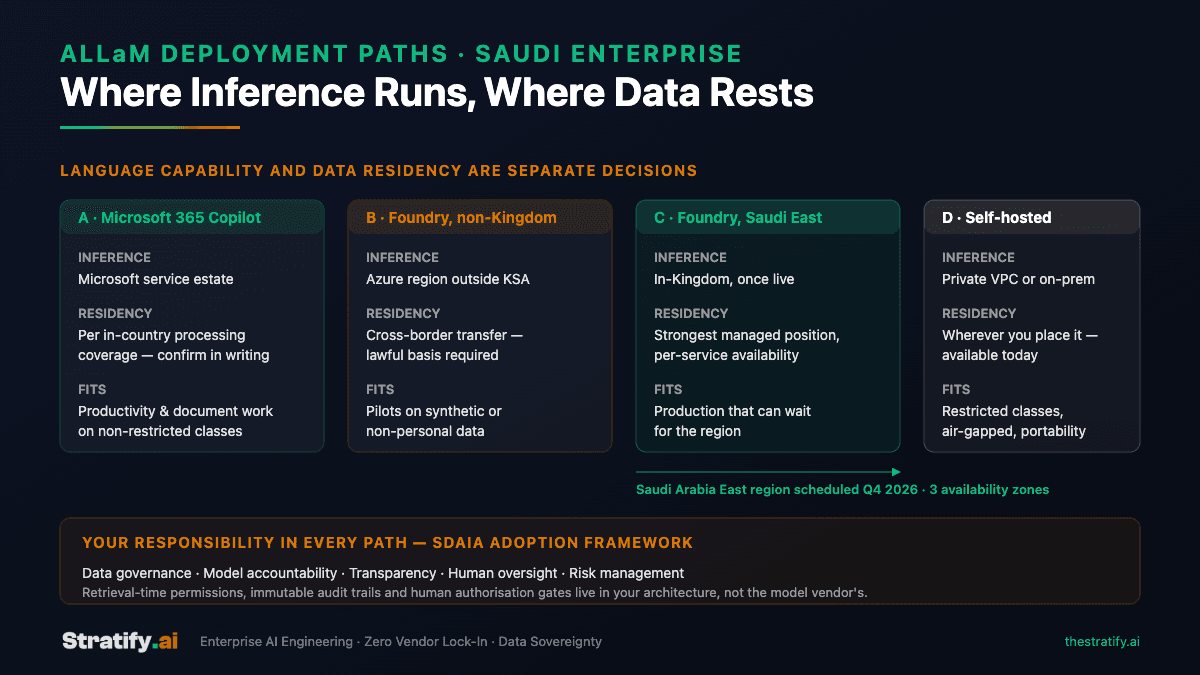
No. Modern enterprise agentic architectures do not rely on massive, general-purpose public models. By deploying state-of-the-art open-weight models (such as Llama 3.3 70B, DeepSeek-R1, or localized models like ALLaM) within private Saudi cloud tenancies (Oracle Cloud Riyadh/Jeddah or local AWS zones) and augmenting them with domain-specific Retrieval-Augmented Generation (RAG) and deterministic API tool sandboxes, sovereign agents frequently achieve higher task accuracy, lower latency, and zero data leakage compared to generic public cloud chatbots.
With Stratify AI, the enterprise client retains 100% ownership of all intellectual property, including custom agent orchestration source code, proprietary tool-calling schemas, prompt libraries, vector embeddings, and fine-tuned model weights. All systems operate entirely within the client's sovereign infrastructure with zero vendor lock-in and zero recurring per-user licensing taxes.
Related Articles

Let's Build the Future
of Enterprise AI
Have a project in mind or need expert guidance?
We'd love to hear from you.
Salah Ad Din Al Ayyubi Rd, Al Malaz,
Riyadh 12836, Saudi Arabia
Global Enterprise Partner
Empowering businesses across North America, Europe, Asia, and the Middle East.