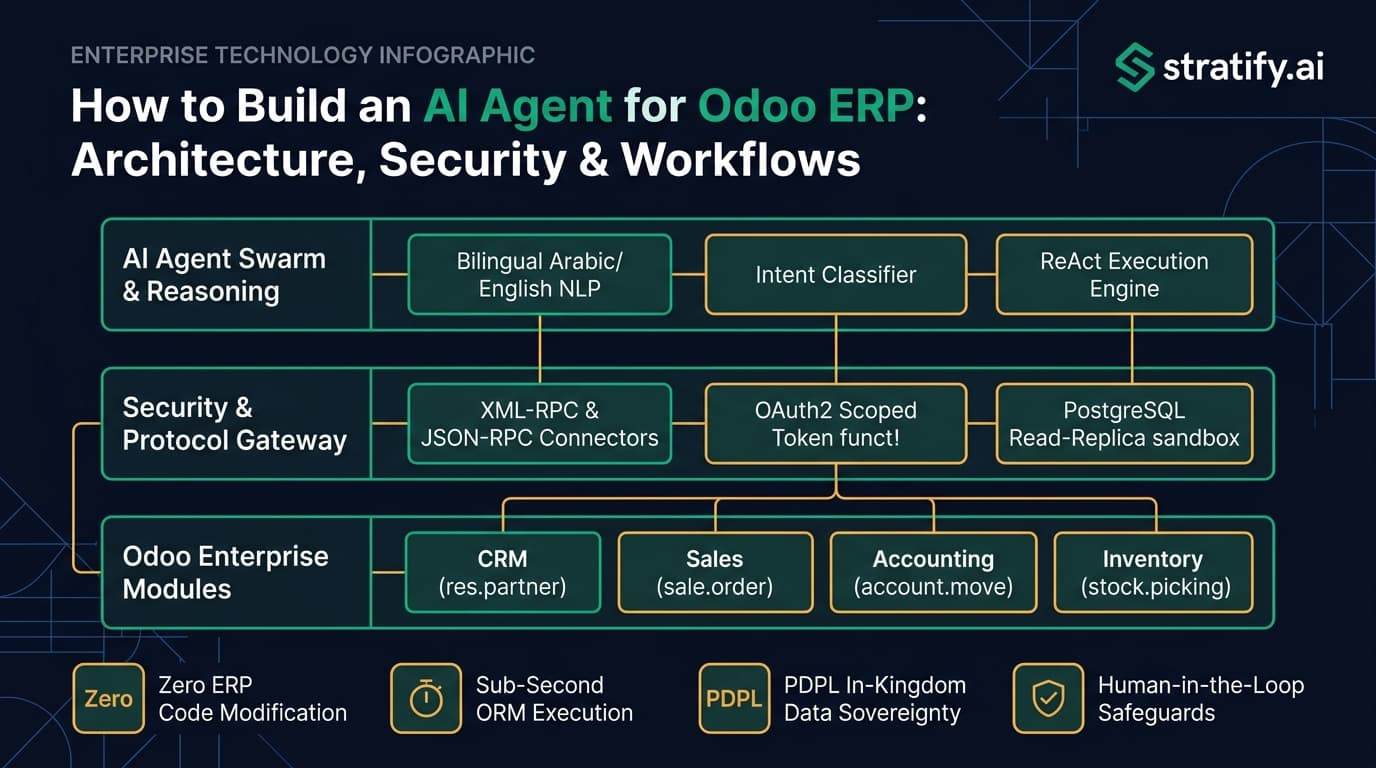
How to Build an AI Agent for Odoo ERP: Architecture, Security & Real-World Use Cases
How autonomous AI agents connect to Odoo's ORM via external APIs, execute deterministic business logic, and automate enterprise workflows without breaking core upgrades.

Executive Summary
Integrating an autonomous AI agent with Odoo ERP transforms static enterprise data into active business execution. While read-only dashboards provide retroactive analytics, an Odoo AI agent autonomously validates inbound customer requests, drafts sales quotations, matches vendor bills with purchase orders, and alerts operations to inventory bottlenecks. This guide details the production architecture: how to balance external API tool-calling (XML-RPC / JSON-RPC) with PostgreSQL read replicas for RAG, enforce strict multi-company access boundaries under Saudi Arabia's Personal Data Protection Law (PDPL), and implement human-in-the-loop safeguards on financial transactions.
- Zero Core Mods
- Uses standard external API; fully upgrade-proof across Odoo v16/17/18
- <850ms
- Round-trip tool latency for synchronous ORM method execution
- 100% PDPL
- Private VPC / on-premise deployment ensures data residency in Saudi Arabia
- 4–6 Weeks
- Typical deployment timeline for a production multi-agent ERP workflow
Key Takeaways
- An autonomous Odoo AI agent operates through the standard ORM external API, preserving all record rules, constraints, multi-company boundaries, and automated numbering without core code modifications.
- Dual-path architecture is essential: write actions and state transitions must go through the ORM, while high-volume analytical vector search (RAG) queries read from a PostgreSQL read-replica to protect transactional database performance.
- Authentication should rely on dedicated system user accounts with restricted security groups and API keys, never personal employee credentials or raw database administrator credentials.
- Bilingual natural language processing (Arabic and English) enables seamless handling of RFQs, purchase orders, and supplier WhatsApp communications across Saudi enterprise supply chains.
- High-value state transitions — such as confirming purchase orders or posting accounting entries above pre-set financial thresholds — should always mandate human-in-the-loop approvals via interactive notifications.
Why Odoo Needs Autonomous AI Agents, Not Just Dashboards
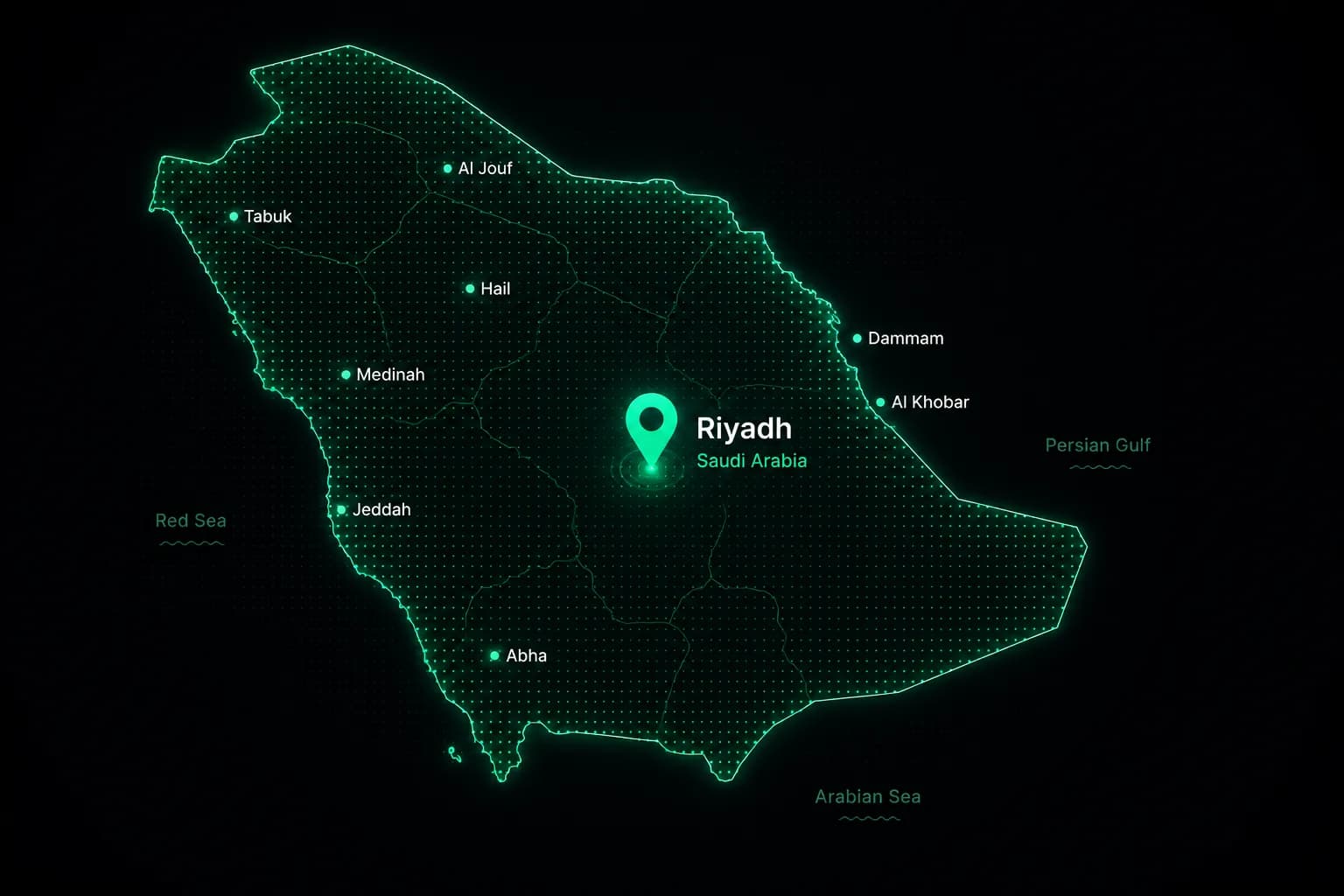
Over the past three years, hundreds of enterprises across Riyadh, Jeddah, and the Eastern Province have deployed Odoo to unify accounting, inventory, procurement, and CRM. However, an ERP system is only as fast as the humans operating it. In a typical mid-sized trading or manufacturing company, staff spend up to 25 hours per week reading customer RFQs from emails, retyping product specifications into Odoo sales quotations, verifying warehouse stock in `stock.quant`, and cross-checking supplier invoices against purchase order lines in `account.move`.
Traditional automation tools like RPA or static cron jobs fall short because enterprise data is messy: customer emails contain colloquial Arabic product descriptions, attached PDF quotations have non-standard layouts, and discounts depend on contextual negotiations. Conversely, simple chat-with-data dashboards answer questions about historical numbers but cannot take operational action. A dashboard can tell you that inventory for a critical spare part is low; an autonomous Odoo AI agent drafts the purchase order, identifies the lowest-bidding approved vendor, and pings the procurement manager on Telegram for approval.
By combining large language models (LLMs) equipped with structured tool-calling capabilities and Odoo's mature Python-based ORM, enterprises can build autonomous workflows that understand unstructured intent, query the ERP deterministically, and execute transactions safely. This shift from passive reporting to active execution is the foundation of agentic AI in enterprise operations.
- Autonomous vs Reactive Execution
- An AI agent initiates workflows based on event streams (inbound emails, inventory drops, webhooks) rather than waiting for an analyst to manually run a report.
- Bilingual Semantic Translation
- Translates regional and colloquial Arabic commercial inquiries into exact Odoo SKU IDs, customer partner IDs, and standard delivery terms.
- Zero Core Source Code Forking
- Communicates entirely through standard external RPC APIs, ensuring ERP upgrades from Odoo 16 to 17 or 18 never break the AI layer.
The Technical Architecture: JSON-RPC, XML-RPC & PostgreSQL Read Replicas
Odoo offers two official remote procedure call (RPC) interfaces: XML-RPC at `/xmlrpc/2/object` and JSON-RPC at `/jsonrpc`. Both expose the same underlying ORM methods (`search_read`, `create`, `write`, `unlink`, and custom button methods like `action_confirm`). When an AI agent decides to execute a tool, it communicates with Odoo over these endpoints.
Writing directly to Odoo's PostgreSQL database with raw SQL is an anti-pattern that frequently corrupts data. Odoo models rely heavily on computed stored fields, inverse triggers, and automated sequence generators (such as generating `SO2026/00142`). Bypassing the ORM means these triggers never fire, stock moves are never recorded in `stock.valuation.layer`, and accounting journal entries fall out of balance. Every write operation must flow through Odoo's ORM layer.
However, using the ORM for high-frequency semantic search, vector embeddings, and large-scale reporting can severely degrade the performance of Odoo's production web workers. The optimal architecture uses a dual-path design: the agent writes and modifies records via JSON-RPC/XML-RPC, while the agent's semantic memory and Retrieval-Augmented Generation (RAG) engine queries an asynchronous, read-only PostgreSQL replica. This isolation protects the live ERP from analytical query spikes.
Security, RBAC & Saudi PDPL Data Governance
Deploying AI agents that interact with financial ledgers and customer records requires rigorous access control and regulatory compliance. Under Saudi Arabia's Personal Data Protection Law (PDPL) administered by the Saudi Data and AI Authority (SDAIA), commercial entities must ensure that customer personally identifiable information (PII) is processed lawfully, with data residency strictly maintained within the Kingdom.
To satisfy both security and regulatory mandates, an Odoo AI agent should never authenticate using an administrator account or shared credentials. The agent must be provisioned as a distinct system user (`res.users`) assigned to a dedicated Security Group with least-privilege access. For instance, a Quoting Agent requires `read` and `write` rights on `sale.order` and `res.partner`, but should have zero read permissions on payroll (`hr.payslip`) or bank statements.
Furthermore, for enterprise holding companies operating multiple commercial registrations (CRs) within a single Odoo multi-company instance, the AI gateway must strictly inject the contextual `allowed_company_ids` header on every RPC call. This prevents accidental cross-company data leakage between independent legal entities.
- Dedicated API Key Authentication
- Use Odoo API Keys generated under User Preferences instead of raw user passwords, allowing instantaneous revocation without changing system credentials.
- Multi-Company Strict Isolation
- In multi-company environments, enforce company_id domain filters on every query to ensure the agent cannot read or cross-contaminate orders between subsidiaries.
- Private VPC & Sovereign Hosting
- Deploy LLM inference and agent orchestrators inside private Saudi cloud infrastructure (such as AWS Riyadh region, Oracle Cloud Jeddah, or on-premise Kubernetes) to ensure complete data residency.
- Comprehensive Audit Logging
- Every action executed by the AI agent logs the original user prompt, tool arguments, and Odoo return payload into a tamper-evident audit ledger.
Three High-Impact Workflows Built with Odoo AI Agents
When structured correctly, an Odoo AI agent delivers immediate productivity gains across revenue-generating and cost-sensitive departments. Below are three production workflows deployed for Saudi enterprises:
1. Autonomous RFQ-to-Quotation Processing: When a prospect submits an RFQ via email, web form, or WhatsApp with unstructured item lists and technical descriptions, the agent parses the SKUs, matches them against Odoo's `product.template` using semantic search, checks warehouse availability via `stock.quant`, applies customer-specific price lists (`product.pricelist`), and creates a draft quotation in `sale.order`. If the total order value exceeds SAR 25,000, it notifies the account executive for final sign-off before emailing the customer.
2. Automated Vendor Bill Matching & ZATCA Verification: Inbound supplier PDF bills are ingested by an OCR and LLM extraction pipeline. The agent validates the supplier's National Unified Number (700) and VAT number against `res.partner`, matches line items against open purchase orders (`purchase.order.line`), verifies the ZATCA Phase 2 cryptographic QR code, and drafts the vendor bill in `account.move`. If prices and quantities match within a 1% tolerance, the bill is queued for disbursement without human manual entry.
3. Intelligent Inventory Reordering & Stockout Prevention: Running as an event-driven or hourly scheduled agent, the model evaluates historical depletion velocity, seasonal Ramadan/Hajj demand spikes, and supplier lead times. When stock approaches safety thresholds, it generates draft purchase requisitions in `purchase.order` and drafts inquiry emails to alternative pre-approved vendors, slashing stockout risks by over 60%.
- Sales Automation Pipeline
- crm.lead → Intent Extraction → Product Match → sale.order Draft Quotation → Account Executive Sign-off.
- Finance & Accounting Pipeline
- Inbound PDF Invoice → ZATCA QR Validation → PO 3-Way Match → account.move Draft Vendor Bill.
- Procurement & Warehouse Pipeline
- stock.quant Threshold Check → Lead Time Calculation → purchase.order Creation → Reorder Alert.
Step-by-Step Implementation Guide & Best Practices
Building an enterprise-ready Odoo AI agent typically follows a four-phase rollout over 4 to 6 weeks. The key is starting with a focused, measurable workflow rather than attempting to automate the entire ERP simultaneously:
Phase 1: Dynamic Schema Discovery (Week 1): Every Odoo deployment features custom fields (`x_studio_*` or custom Python modules). The AI gateway must introspect Odoo's metadata tables (`ir.model` and `ir.model.fields`) at initialization time. By caching the active field definitions, the agent always knows which fields are required and valid on models like `sale.order` without hardcoding.
Phase 2: Tool Calling & Sandboxing (Weeks 2–3): Define deterministic tool schemas for the LLM using JSON Schema format. For example, define `search_products(query: str, limit: int)` and `create_sales_order(partner_id: int, order_lines: list)`. Test these tools in an Odoo staging environment against simulated edge cases (e.g. out-of-stock products, blocked customers with negative credit limits).
Phase 3: Human-in-the-Loop Safeguards (Weeks 4–5): Build guardrails for state transitions. Safe read operations (`search_read`) execute autonomously. Low-risk write operations (creating draft quotes or updating partner phone numbers) proceed automatically. However, destructive or financial actions (validating invoices, confirming delivery orders, or processing refunds) must require human confirmation via interactive mobile or web notifications.
Phase 4: Monitoring, Logging & Evaluation (Week 6): Deploy telemetry tracking tool latency, token consumption, and agent reasoning trajectory. Set up automated alerts if an RPC call returns an Odoo `AccessError` or `ValidationError` so engineering can refine prompt constraints immediately.
If your organization runs Odoo Enterprise or Community and wants to evaluate how autonomous agents can eliminate operational bottlenecks, explore our AI integration services and custom AI agent development capabilities, read our deep dive on AI finance automation & ZATCA reconciliation, or review our comprehensive enterprise AI automation cost guide for investment benchmarks. You can also schedule an architectural consultation directly with our engineering team in Riyadh.
The Technical Architecture: JSON-RPC, XML-RPC & PostgreSQL Read Replicas
Technical comparison of Odoo ERP integration pathways for autonomous AI agents
| Integration Pathway | Target Operations | Access Rules Applied? | Average Latency | Production Safety |
|---|---|---|---|---|
| JSON-RPC / XML-RPC | Drafting Quotes, Confirming POs, Updating Partners | Yes (record rules & user groups enforced) | 120ms – 450ms | High — validates ORM constraints & triggers |
| PostgreSQL Read Replica | Vector embeddings, historical trend queries, semantic search | No (query must filter by company_id) | 15ms – 80ms | Zero impact on live transactional workers |
| Direct SQL on Primary DB | Discouraged (historical custom scripts) | No (bypasses all security rules) | 5ms – 30ms | High Risk — potential table locks & corrupted sequences |
| Webhook / Bus Notifications | Real-time event triggers (e.g. invoice payment received) | Yes (filtered on event dispatch) | Instant (<50ms) | Safe — push-based asynchronous notification |
Frequently Asked Questions
Yes. Both Odoo Enterprise and Odoo Community expose identical external web services (JSON-RPC and XML-RPC) on standard installations (Odoo.sh, self-hosted on AWS/GCP, or on-premise Linux servers). The agent connects over standard HTTPS endpoints using API keys, so the architecture is fully compatible with both editions and does not require third-party marketplace modules.
No, provided the integration connects via external RPC APIs rather than modifying core Python modules. Because the agent interacts as an external client calling standard ORM methods (`search_read`, `create`, `write`), upgrades to Odoo core code, Studio layouts, or database migrations will not break the AI agent as long as the underlying model fields remain consistent.
The agent reasoning layer is equipped with bilingual Arabic and English foundation models fine-tuned on regional business terminology. It accurately maps colloquial Gulf and Saudi phrasing (including Najdi, Hijazi, and standard commercial Arabic) to standardized Odoo product SKUs, partner records, and accounting categories, even when product descriptions in Odoo are stored in English.
All high-impact actions operate behind strict human-in-the-loop (HITL) gates. The agent is restricted to creating records in 'Draft' state (e.g. quotation in `draft` state, vendor bill in `draft` state). Transitioning an order to 'Confirmed' or posting a journal entry above a specified financial threshold (e.g. SAR 10,000) automatically triggers an interactive approval notification to the designated manager.
Yes. When engineered with dedicated private VPC hosting or on-premise model inference within Saudi Arabia, all data processing, vector embeddings, and ERP transactions remain inside the Kingdom's borders. No customer personal identifiable information (PII) or financial ledgers are transmitted to public, multi-tenant AI services outside Saudi Arabia.
A focused Proof of Concept (PoC) targeting a single workflow — such as automated RFQ parsing to draft sales quotation — is typically delivered in 4 weeks for SAR 35,000 to SAR 65,000. Full multi-workflow enterprise agent suites covering procurement, sales, and accounting reconciliation take 6 to 8 weeks and range from SAR 95,000 to SAR 175,000, with source code and intellectual property transferred 100% to the enterprise.
Related Articles

Let's Build the Future
of Enterprise AI
Have a project in mind or need expert guidance?
We'd love to hear from you.
Salah Ad Din Al Ayyubi Rd, Al Malaz,
Riyadh 12836, Saudi Arabia
Global Enterprise Partner
Empowering businesses across North America, Europe, Asia, and the Middle East.