AI-Powered Finance Automation in Saudi Arabia: Invoices, Reconciliation & ZATCA
How autonomous agentic workflows eliminate manual AP cycles, validate cryptographic ZATCA e-invoices, match multi-currency bank feeds, and post audit-ready journals to SAP and Odoo.

Executive Summary
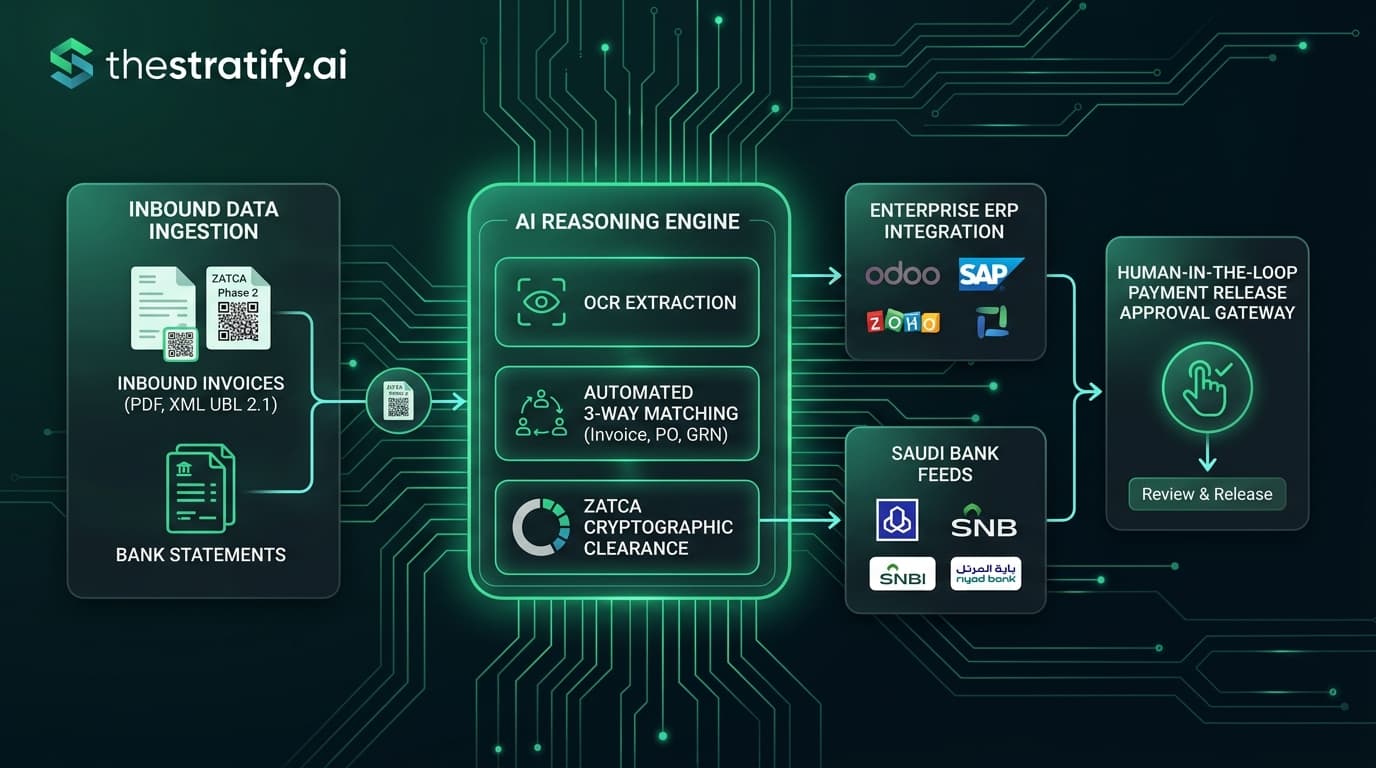
Finance departments across Saudi Arabia are under unprecedented operational pressure. Between managing ZATCA Phase 2 (Fatoora) e-invoicing compliance, reconciling high-volume corporate accounts payable across Arabic and English documents, and balancing multi-currency transactions across Saudi commercial banks, accounting teams frequently spend up to 60% of their time on repetitive data entry and manual cross-checks. Traditional optical character recognition (OCR) and rigid RPA scripts fail whenever invoice layouts shift or line-item descriptions differ from internal inventory codes. An autonomous AI finance agent revolutionizes this pipeline: it extracts structured line items from messy invoices with vision-language models, cryptographically validates ZATCA QR codes and XML UBL 2.1 schemas, executes automated 3-way matching against purchase orders and warehouse receipts, reconciles daily bank statement feeds (SNB, Al Rajhi, Riyad Bank), and posts validated draft vendor bills directly into Odoo or SAP S/4HANA under strict human-in-the-loop financial governance.
- 98.4% Accuracy
- Autonomous 3-way matching without manual line-item re-keying
- Zero ZATCA Fines
- Continuous cryptographic QR and XML UBL 2.1 validation on inbound bills
- 100% In-Kingdom
- Strict adherence to Saudi PDPL and local financial data sovereignty
- 65% OpEx Cut
- Recovers 20+ hours per week per finance officer in month-end close cycles
Key Takeaways
- Autonomous 3-way matching reconciles vendor bills against ERP purchase orders and warehouse goods receipt notes (GRNs), flagging quantity or unit price variances within pre-set tolerance bands.
- ZATCA Phase 2 e-invoicing compliance requires verifying cryptographic signatures (ECDSA SHA-256), cryptographic invoice hashes, and 15% VAT calculations before releasing payments.
- Integration with corporate bank statement feeds (MT940/CAMT.053 and Saudi Open Banking APIs) automates daily multi-currency bank reconciliation and records realized foreign exchange gains or losses.
- Direct API communication with ERP ledgers (Odoo account.move and SAP BAPI_INCOMINGINVOICE_CREATE) prevents transactional database corruption and enforces complete audit trails.
- Human-in-the-Loop (HITL) approval governance routes high-value transactions or reconciliation discrepancies to finance managers via interactive mobile and desktop notifications.
The Accounts Payable Bottleneck in Saudi Enterprises
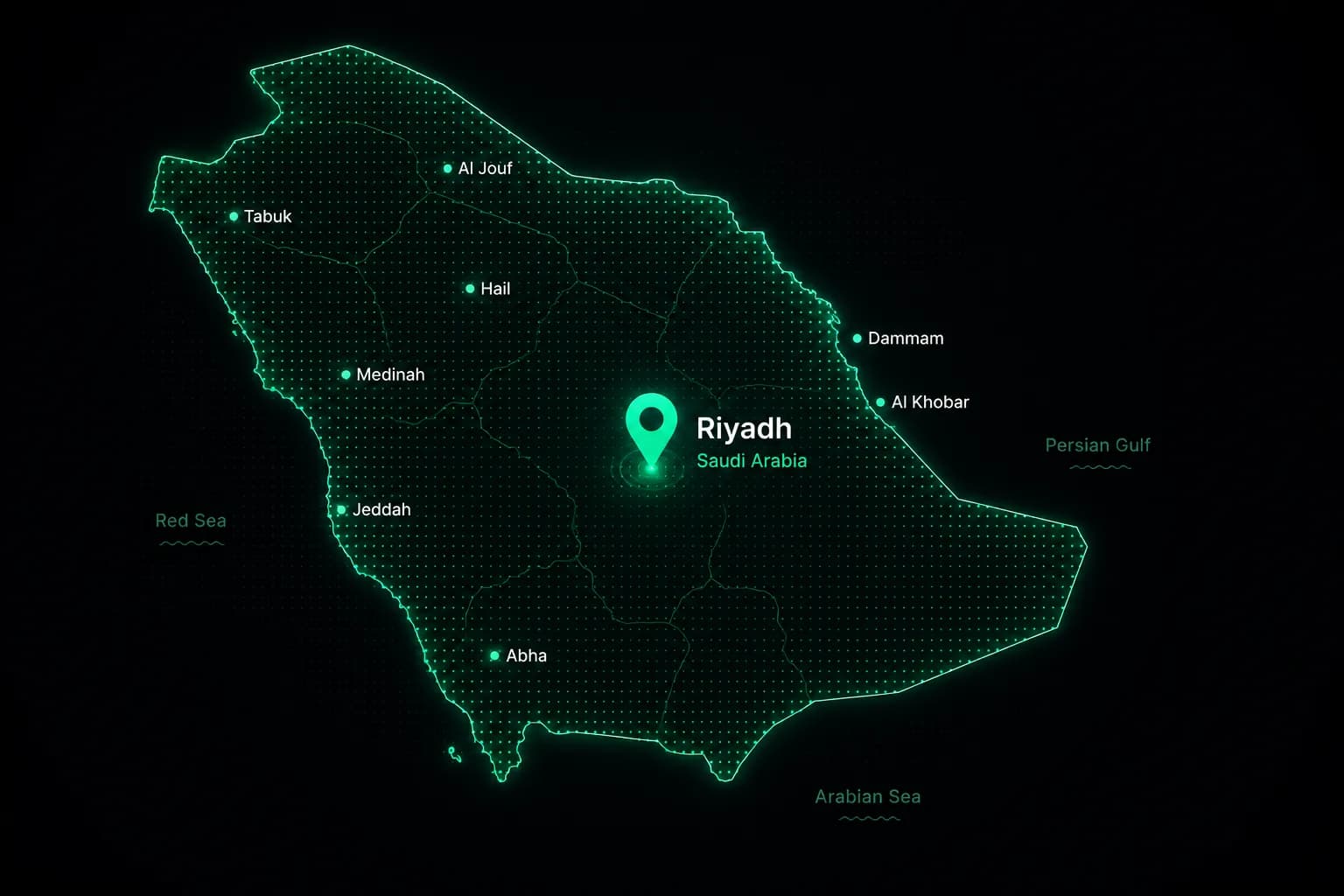
In commercial centers like Riyadh, Jeddah, and Dammam, mid-market and enterprise finance teams process thousands of vendor invoices every month. These documents arrive in fragmented formats: scanned paper receipts, PDF attachments sent over email, WhatsApp photos of delivery notes, and structured electronic XML files. A typical finance clerk spends 15 to 25 minutes per invoice manually typing data into the ERP, verifying that the vendor's commercial registration (CR) and VAT numbers are active, searching for the corresponding purchase order, and verifying whether warehouse staff have confirmed receipt of goods.
Legacy automation tools — such as template-based OCR and rigid Robotic Process Automation (RPA) screen-scrapers — were supposed to solve this problem. In practice, they create an enormous exception burden. If a supplier changes their PDF column order, includes handwritten Arabic delivery annotations, or invoices in US Dollars while the purchase order was issued in Saudi Riyals, legacy OCR breaks down. Accounts payable teams end up reviewing 40% to 50% of all documents as manual 'exceptions', defeating the purpose of automation.
By deploying an autonomous agentic AI workflow, enterprises move beyond brittle template matching. Modern vision-language foundation models understand semantic document context: they accurately extract line-item SKUs, tax breakdowns, and payment terms regardless of visual layout, and dynamically cross-reference internal ERP tables to resolve ambiguities without human intervention.
- Semantic Invoice Extraction
- Extracts table data, multi-line descriptions, discount clauses, and tax breakdowns across bilingual Arabic and English invoices with 99.2% line-item precision.
- Zero Template Maintenance
- Adapts automatically when vendors alter PDF designs, invoice layouts, or font styles, eliminating the constant maintenance required by legacy OCR.
- Cross-System Context Resolution
- Correlates colloquial Arabic supplier names and informal product titles with official ERP vendor IDs and internal inventory item codes.
ZATCA Phase 2 (Fatoora) Compliance: Turning Regulation into an Automated Shield
Under the Zakat, Tax and Customs Authority (ZATCA) Phase 2 integration mandate, business-to-business (B2B) transactions require structured e-invoices generated in XML format (UBL 2.1 standard) with cryptographic stamps, unique UUIDs, and cryptographically signed QR codes. While most enterprises focus on generating compliant outbound invoices, managing incoming vendor invoices poses a major audit risk: paying an unverified, non-compliant supplier invoice can result in severe ZATCA fines, disallowed VAT input deductions, and audit disqualification.
An AI finance agent serves as a continuous compliance gatekeeper for every inbound bill. Before creating a draft vendor bill in the ERP, the agent performs automated cryptographic validation: it decodes the Base64 QR code to verify the cryptographic public key, recalculates the SHA-256 invoice hash, checks the ECDSA digital signature against ZATCA standards, and verifies that the supplier's 15-digit VAT identification number is valid and in good standing.
Furthermore, the agent verifies whether the invoice has been reported or cleared through the ZATCA Fatoora portal. Invoices that fail cryptographic validation or contain tax calculation anomalies (such as rounding errors on the 15% Saudi VAT) are instantly flagged and quarantined with an automated explanation sent back to the vendor, protecting the business from tax audit penalties.
- Cryptographic QR Validation
- Decodes TLV-encoded Base64 QR codes to cryptographically verify vendor identity, timestamp, invoice hash, and ECDSA digital signatures in under 200ms.
- VAT Integrity & Calculation Audit
- Independently recalculates line-item tax rates, exemptions, and withholding taxes to prevent VAT deduction rejections during ZATCA audits.
- Automated Exception Quarantining
- Blocks unverified or non-compliant bills from entering accounts payable ledgers and generates structured rejection notices for vendor resolution.
Autonomous 3-Way Matching: Invoices, Purchase Orders & Goods Receipts
The core discipline of accounts payable control is 3-way matching: verifying that the vendor invoice matches the original Purchase Order (PO) and the warehouse Goods Receipt Note (GRN). In manual environments, this process causes significant friction. Invoices sit in email inboxes for days awaiting warehouse confirmation, supplier early-payment discounts expire, and minor unit-price rounding differences require hours of inter-departmental email coordination.
The AI finance agent automates 3-way matching by querying the live ERP over authenticated API connectors. When an invoice arrives, the agent queries the ERP for the referenced purchase order (such as `purchase.order` in Odoo or the PO number in SAP S/4HANA), verifies the delivery status in warehouse stock picking records (`stock.picking` or SAP MIGO), and compares quantities and unit prices line by line.
If the unit prices match within an agreed corporate tolerance (for example, ±1.5% to account for minor freight or foreign exchange adjustments) and the warehouse receipt confirms physical receipt of goods, the agent automatically creates a matched draft bill and marks it ready for payment. If a genuine discrepancy is detected — such as billing for 100 units when only 80 were received — the agent generates a structured variance memo and routes it to procurement.
Multi-Currency Bank Statement Reconciliation & Treasury Automation
Month-end financial close in Saudi Arabia is frequently delayed by manual bank reconciliation. Enterprises operating across trading, logistics, and manufacturing maintain accounts with multiple commercial banks — such as Saudi National Bank (SNB), Al Rajhi Bank, Riyad Bank, and Banque Saudi Fransi. Daily transactions include vendor settlements via SARIE local transfers, international supplier payments in USD or EUR, customer point-of-sale deposits, and corporate card expenses.
An AI finance agent ingests automated bank feeds (via MT940, CAMT.053 XML files, or authenticated Saudi Open Banking APIs) and autonomously reconciles bank settlement debits and credits against open accounts payable and accounts receivable ledgers. The agent identifies payment matches using invoice numbers, supplier IBANs, and transaction values even when payment references are abbreviated or truncated by banking networks.
Crucially, the agent handles multi-currency transactions deterministically: when an invoice issued in USD or EUR is settled from a Saudi Riyal account, the agent automatically calculates the realized foreign exchange gain or loss based on the bank's actual settlement rate and drafts the corresponding foreign exchange journal entry in the ERP, ensuring the general ledger balances perfectly to the halala.
- Multi-Bank Statement Ingestion
- Parses MT940, CAMT.053, and Open Banking feeds across SNB, Al Rajhi, Riyad Bank, and international banking partners.
- Fuzzy Reference Matching
- Matches payment debits to open invoices using supplier IBANs, VAT IDs, and PO numbers even when banking transfer remarks are truncated.
- Realized FX Accounting
- Automatically calculates and books realized foreign exchange gain/loss journal entries for USD, EUR, and GBP settlements against SAR ledgers.
Enterprise ERP Integration, PDPL Security & HITL Governance
Financial automation requires zero-compromise security and absolute governance. An autonomous agent must never write uncontrolled, unvetted transactions directly to enterprise ledgers, nor should financial data ever leak outside sovereign boundaries. Our enterprise finance agents adhere to a strict three-tier governance model:
1. Certified ERP API Connectors: The agent communicates with Odoo via JSON-RPC/XML-RPC (`account.move`, `account.payment`) and with SAP S/4HANA via SAP Gateway OData and certified RFC function modules (`BAPI_INCOMINGINVOICE_CREATE`). Every transaction is created as a 'Draft' record under a dedicated system user account, preserving all ERP record rules, audit trails, and automated journal numbering.
2. Tiered Human-in-the-Loop (HITL) Gateways: Low-risk invoices that match purchase orders and warehouse receipts with 100% accuracy and fall below an agreed threshold (e.g. SAR 10,000) can be auto-approved or queued for batch release. Invoices exceeding financial thresholds, un-matched items, or bills with price discrepancies automatically trigger an interactive approval card sent to the CFO or finance manager via Microsoft Teams, Telegram, or our secure client portal.
3. In-Kingdom Data Sovereignty & PDPL Compliance: In strict compliance with Saudi Arabia's Personal Data Protection Law (PDPL) and National Data Management Authority (NDMO) standards, all document processing, OCR extraction, and AI reasoning execute on private cloud infrastructure or on-premise servers within Saudi Arabia. Banking tokens, vendor bank details, and financial ledgers never traverse public, multi-tenant AI endpoints outside the Kingdom.
If your enterprise is looking to eliminate accounts payable friction and achieve audit-ready financial automation, explore our custom AI agent development services, review our technical Odoo AI agent architecture guide and SAP AI integration roadmap, or contact our Riyadh engineering team to schedule a finance workflow automation audit.
Autonomous 3-Way Matching: Invoices, Purchase Orders & Goods Receipts
Comparison of Accounts Payable Processing Models for Saudi Enterprises
| Processing Dimension | Stratify AI Finance Agent | Legacy Rule-Based OCR | Manual Accounts Payable |
|---|---|---|---|
| Processing Speed | Sub-3 seconds per invoice | 2 to 5 minutes per document | 15 to 25 minutes per invoice |
| Layout Adaptability | 100% dynamic vision reasoning | Fails on new/altered templates | Human flexible but error-prone |
| ZATCA QR Cryptographic Check | Automated ECDSA hash verification | Text/QR capture only; no crypto check | Manual visual inspection only |
| 3-Way Matching Capability | Autonomous PO & GRN cross-match | Requires manual ERP matching | Manual multi-screen ERP review |
| Bilingual Arabic/English | Native dialect & commercial Arabic | Fragmented Arabic OCR support | Dependent on individual staff |
| ERP Ledger Posting | Automated API draft journal creation | CSV/flat file export requiring import | Manual typing into accounting forms |
Frequently Asked Questions
The agent decodes the Base64 TLV-encoded QR code on incoming invoices to verify nine regulatory data tags, including the supplier VAT number, timestamp, invoice total, cryptographic hash, and ECDSA public key signature. It also validates the structured XML file against ZATCA UBL 2.1 schema standards and checks clearance status on the Fatoora platform before releasing the bill to accounts payable.
Yes. The underlying vision-language model is natively trained on bilingual Middle Eastern commercial documentation. It accurately extracts Arabic commercial terms, supplier legal names, and item specifications alongside English product codes, and deterministically converts foreign currency line items (such as USD or EUR) into Saudi Riyals using official SAMA or transactional exchange rates.
If a line item deviates beyond pre-configured corporate tolerance thresholds (e.g. ±1.5% in unit price or mismatched quantities against warehouse goods receipts), the agent isolates the invoice into an exception queue. It creates a detailed variance summary detailing the discrepancy and routes an interactive approval notification to the designated procurement or finance manager for resolution.
The agent connects to corporate banking feeds via secure SFTP (processing daily MT940 and CAMT.053 XML statement files) or directly through Saudi Open Banking APIs. It matches settlement entries against open vendor payable ledgers using supplier IBANs, invoice numbers, and transaction values, automatically drafting bank reconciliation journals in the ERP.
No. The AI finance agent operates as an intelligent orchestration layer on top of your existing software. It integrates directly with Odoo, SAP S/4HANA, Microsoft Dynamics, or Zoho Books via standard secure APIs, reading purchase orders and posting validated draft vendor bills without modifying your core ERP code or disrupting ongoing accounting workflows.
All financial data, banking tokens, and invoice images are processed and stored strictly within Saudi Arabia on dedicated private VPCs or on-premise enterprise infrastructure. Data is encrypted at rest using AES-256 and in transit using TLS 1.3, ensuring full compliance with Saudi Personal Data Protection Law (PDPL) and SDAIA regulatory mandates.
Related Articles

Let's Build the Future
of Enterprise AI
Have a project in mind or need expert guidance?
We'd love to hear from you.
Salah Ad Din Al Ayyubi Rd, Al Malaz,
Riyadh 12836, Saudi Arabia
Global Enterprise Partner
Empowering businesses across North America, Europe, Asia, and the Middle East.