Sovereign AI in Saudi Arabia: When Should Enterprises Use Private Cloud or On-Premise AI?
When Should Enterprises Use Private Cloud or On-Premise AI?

Executive Summary
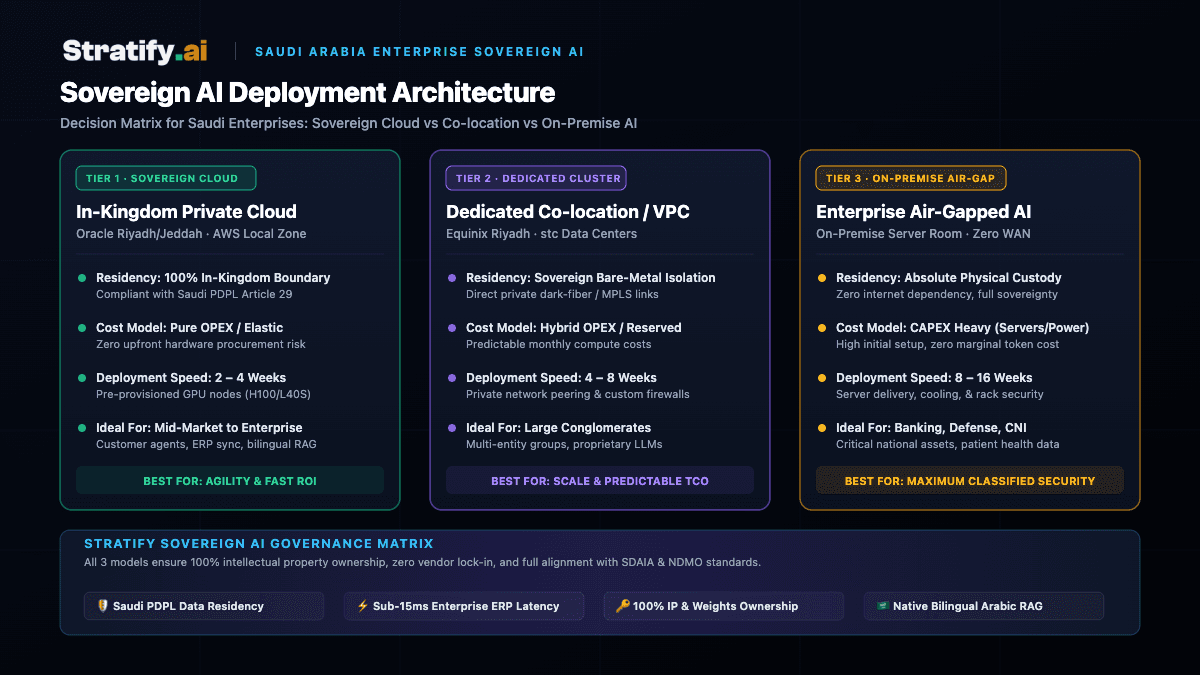
Deploying artificial intelligence across Saudi enterprise environments requires balancing model intelligence, operational agility, and absolute regulatory compliance. As SDAIA enforces strict data residency under the Personal Data Protection Law (PDPL), forward-thinking organizations are moving away from foreign public API wrappers toward sovereign AI architectures. This engineering guide evaluates the three primary deployment models — Sovereign In-Kingdom Private Cloud, Dedicated Co-location, and Air-Gapped On-Premise AI — analyzing infrastructure costs, inference latency, hardware procurement realities, and long-term total cost of ownership (TCO) to help Saudi CISOs and technical leaders choose the right sovereign strategy.
- Decision Matrix
- Comparative evaluation of In-Kingdom Cloud, Co-location, and On-Premise Air-Gap across 6 operational dimensions
- PDPL Article 29
- Architectural patterns satisfying statutory cross-border transfer limits and SDAIA data residency rules
- Sub-15ms Latency
- Optimized local peering and optical direct-connect topologies with Odoo, SAP, and core ERP systems
- 65%+ TCO Savings
- Cost inflection analysis comparing foreign per-token API taxes against flat-rate private GPU nodes
Key Takeaways
- Public multi-tenant AI APIs present severe legal and commercial liabilities under Saudi PDPL Article 29 due to unauthorized cross-border personal data transmission and proprietary IP leakage.
- Sovereign In-Kingdom Private Cloud offers the optimal balance of fast time-to-value (2–4 weeks), elastic GPU scaling (NVIDIA H100/L40S), and 100% regulatory compliance for 80% of enterprise workloads.
- On-premise air-gapped deployments remain mandatory for defense, national critical infrastructure (CNI), banking core settlement logic, and highly classified sovereign datasets.
- Modern open-weight enterprise models (Llama 3.3 70B, DeepSeek-R1, and localized Arabic models like ALLaM) running on private inference servers match or exceed public models on domain-specific enterprise tasks when paired with Retrieval-Augmented Generation (RAG).
- Sovereign AI delivers dramatic cost advantages at scale: organizations processing over 1 million tokens daily achieve 50% to 70% lower compute costs on dedicated private infrastructure compared to recurring public API subscriptions.
The Sovereign Imperative: Beyond Public Cloud Convenience
For Saudi enterprises embarking on digital transformation under Vision 2030, artificial intelligence is no longer an experimental innovation project — it is core operational infrastructure. Autonomous agents now reconcile multi-million Riyal vendor invoices, qualify high-value commercial real estate prospects, automate complex government portal filings, and optimize supply chains spanning Jeddah Islamic Port and King Abdulaziz Port in Dammam.
However, the convenience of standard foreign public cloud AI endpoints (such as public US-hosted endpoints from OpenAI, Anthropic, or Microsoft) comes with severe regulatory and operational risks. Under the Kingdom's Personal Data Protection Law (PDPL), overseen by the Saudi Data and Artificial Intelligence Authority (SDAIA) and the National Data Management Office (NDMO), organizations face strict statutory restrictions on transmitting personal data, employee records, and sensitive corporate information outside Saudi national borders.
Article 29 of the PDPL explicitly restricts cross-border personal data transfers unless specific sovereign exemptions, adequacy decisions, or binding corporate agreements are satisfied. For regulated sectors — including banking, healthcare, telecom, and government contracting — data residency inside the Kingdom is absolute. Relying on foreign multi-tenant APIs risks statutory fines up to SAR 5,000,000, potential criminal liability for deliberate disclosures, and catastrophic leakage of proprietary corporate IP into public model training datasets.
This regulatory landscape has accelerated the shift toward Sovereign AI: artificial intelligence infrastructure, models, data pipelines, and orchestration engines that reside entirely within the sovereign legal and physical boundaries of Saudi Arabia. The question facing Saudi enterprise leadership is no longer whether to adopt sovereign AI, but which deployment topology best balances security, latency, complexity, and total cost of ownership.
Architectural Comparison: Sovereign Cloud vs Co-location vs On-Premise
Enterprise architects must evaluate three primary sovereign deployment models. Each topology represents a distinct compromise between physical custody, capital expenditure, operational maintenance overhead, and deployment velocity.
The following comparative matrix outlines the operational parameters of each architecture within the Saudi corporate ecosystem:
| Architectural Dimension | Tier 1: In-Kingdom Private Cloud | Tier 2: Dedicated Co-location / VPC | Tier 3: Air-Gapped On-Premise AI | | :--- | :--- | :--- | :--- | | **Primary Providers** | Oracle Cloud Riyadh/Jeddah, AWS Local Zone | Equinix Riyadh, stc Data Centers, Mobily DC | Enterprise Private Datacenter / Server Room | | **Data Residency Boundary** | 100% In-Kingdom Sovereign Cloud Boundary | Physical Private Cage / Dedicated Server Rack | Direct Physical Facility Custody (Zero WAN) | | **Hardware Procurement** | Zero hardware lead times; instant provisioning | 4–6 weeks server and rack configuration | 8–16 weeks server delivery, power & cooling setup | | **Compute Scaling** | Elastic scaling (instant GPU add/remove) | Scalable within leased rack footprint | Fixed capacity based on physical chassis | | **Latency to Core ERP** | 10–25ms via local peering / AWS Direct Connect | 5–12ms via direct private dark fiber / MPLS | <2ms direct LAN connection to on-premise ERP | | **Financial Model** | 100% OPEX (predictable monthly compute) | Hybrid OPEX (rack lease + amortized hardware) | 100% CAPEX (hardware purchase, facility power) | | **Compliance Suitability** | PDPL compliant for standard enterprise workloads | Compliant for financial services & healthcare | Mandatory for Defense, Intelligence, CNI & Top-Secret | | **Engineering Overhead** | Low; cloud provider manages virtualization | Moderate; enterprise manages OS & networking | High; enterprise manages physical hardware & cooling |
Understanding these structural differences enables enterprise leaders to map specific corporate workloads to the appropriate hosting tier, avoiding both compliance breaches and unnecessary capital over-expenditure.
Tier 1: In-Kingdom Private Cloud — Agility and Elastic Scale
For approximately 75% to 80% of Saudi commercial enterprises — including retail conglomerates, logistics operators, hospitality groups, and professional service firms — an In-Kingdom Private Cloud tenancy represents the optimal deployment sweet spot.
Major hyperscalers have established sovereign cloud regions within the Kingdom. Oracle Cloud Infrastructure (OCI) operates hyperscale sovereign cloud data centers in Riyadh and Jeddah, with advanced sovereign AI superclusters equipped with NVIDIA H100 and A100 Tensor Core GPUs. Similarly, local availability zones from AWS and Google Cloud in Dammam and Riyadh allow organizations to deploy containerized LLMs without a single packet crossing international borders.
In an In-Kingdom private cloud topology, Stratify AI deploys high-throughput open-weight models (such as Llama 3.3 70B, DeepSeek-R1, Mistral Large, or the localized Arabic ALLaM model) inside dedicated, isolated Virtual Private Clouds (VPCs). Using state-of-the-art inference engines like vLLM or NVIDIA TensorRT-LLM, the models run within hardened Docker containers behind private reverse proxies.
The enterprise connects its core systems of record — such as Odoo ERP, SAP S/4HANA, or Microsoft Dynamics — to the private AI VPC through secure site-to-site IPsec VPN tunnels or dedicated cloud peering (like Oracle FastConnect or AWS Direct Connect). Enterprise personal data, customer records, and financial ledgers never touch the public internet.
The primary advantage of Tier 1 is operational velocity. Rather than waiting 12 to 16 weeks for server procurement, customs clearance, and data center rack installation, an enterprise can spin up a production-ready sovereign AI inference cluster in less than three weeks, scaling GPU allocation dynamically as workflow adoption expands.
Tier 2 & 3: On-Premise and Dedicated Co-Location — When Physical Custody Is Mandatory
While sovereign cloud regions satisfy the legal baseline of PDPL Article 29 for standard commercial enterprises, certain institutional contexts legally mandate absolute physical custody and zero external network connectivity.
Specifically, air-gapped on-premise AI deployments are essential for:
1. **Defense, Aerospace, and National Security:** Entities handling sovereign classified data where national security guidelines prohibit third-party shared infrastructure regardless of encryption standards.
2. **Critical National Infrastructure (CNI) & Energy:** Supervisory Control and Data Acquisition (SCADA) systems, industrial process controls, and petrochemical facilities where external network ingress creates unacceptable operational vulnerability.
3. **Banking Core Settlement Systems:** SAMA-regulated institutions processing high-frequency interbank transactions, SWIFT settlement messages, and core ledger operations that require sub-millisecond execution over local optical LAN connections.
4. **Classified Biomedical & Genomic Research:** Hospitals and research institutes handling sensitive Saudi citizen genomic sequences or clinical trial IP.
In an on-premise or co-located architecture, Stratify AI engineers deploy turnkey AI appliances directly into the client's tier-3/tier-4 data center facility (such as Equinix Riyadh or the client's private server hall). These appliances leverage enterprise GPU servers (such as Dell PowerEdge XE9680 or HPE Cray systems equipped with NVIDIA H100/H200 SXM5 GPUs) connected via high-bandwidth InfiniBand fabrics.
The AI inference stack runs in an air-gapped configuration: the models, vector databases (such as localized Qdrant or Milvus clusters), and agent orchestration engines are pre-packaged and deployed without requiring outbound internet access. Model updates and security patches are delivered via cryptographically signed offline transport media, guaranteeing absolute zero data exfiltration risk.
Total Cost of Ownership (TCO) & Inference Economics: The 3-Year Reality
A frequent misconception among enterprise procurement teams is that public API subscriptions are always cheaper than dedicated sovereign infrastructure. While public APIs require zero upfront capital, their marginal cost curve escalates aggressively as agentic automation reaches enterprise scale.
Consider an enterprise operating 10 autonomous AI agents handling customer support, accounts payable reconciliation, bilingual HR screening, and sales qualification. Across these workflows, the agents process an average of 3,000,000 tokens per day (input context + output completions).
- **Public Foreign API Route:** At blended market rates of $3.00 to $5.00 per million tokens for premium reasoning models, 3M daily tokens equals approximately SAR 125,000 to SAR 160,000 per month in pure API subscription fees. Over three years, the enterprise spends SAR 4,500,000 to SAR 5,700,000 on recurring token taxes — without accumulating any proprietary intellectual property or sovereign infrastructure assets.
- **Sovereign In-Kingdom Cloud (Tier 1):** Leasing a dedicated node with two NVIDIA L40S or A100 GPUs within a Saudi Oracle Cloud or AWS region costs approximately SAR 30,000 to SAR 45,000 per month. Crucially, private GPU nodes deliver fixed, flat-rate compute: whether your agents process 500,000 tokens or 10,000,000 tokens per day, the monthly infrastructure bill remains completely flat. Over three years, compute costs total roughly SAR 1,200,000 to SAR 1,600,000 — saving over 65% compared to public token APIs.
- **On-Premise Bare-Metal Deployment (Tier 3):** Procuring an enterprise-grade AI server with dual NVIDIA H100 GPUs, enterprise storage, and optical networking represents a capital expenditure of approximately SAR 750,000 to SAR 950,000. Factoring in data center rack space, electricity, cooling, and three-year hardware maintenance (SAR 15,000/month), the total 3-year cost is approximately SAR 1,400,000. At high inference volumes (5M+ daily tokens), on-premise infrastructure delivers the lowest marginal cost per token of any architecture.
For a detailed financial breakdown of budgeting sovereign automation across personnel, licensing, and integration, explore our executive guide on enterprise AI automation costs in Saudi Arabia.
Strategic Deployment Framework: How to Execute Your Sovereign AI Transition
Transitioning from experimental AI tools to a production-grade sovereign AI ecosystem requires a structured, multi-phase engineering approach. Stratify AI recommends a pragmatic four-stage methodology tailored to Saudi regulatory frameworks:
Phase 1: Workload Classification & Data Sensitivity Mapping. Conduct a comprehensive inventory of enterprise data flows. Categorize data according to SDAIA classification standards: Public, Restricted, Confidential, and Top Secret. Identify all instances of personal data subject to PDPL Article 29.
Phase 2: Hosting Topology Selection. Assign workloads to hosting tiers based on classification. Route standard document processing and customer engagement to In-Kingdom Private Cloud (Tier 1). Reserve on-premise air-gapped clusters (Tier 3) strictly for core financial transactions, defense contracting, or confidential executive intelligence.
Phase 3: Model Selection & Domain Fine-Tuning. Select appropriate open-weight foundational models. Avoid deploying oversized 400B+ models where highly optimized 70B parameter models (such as Llama 3.3 70B or localized Arabic models) achieve identical accuracy at 80% lower inference latency. Augment the models with sovereign Retrieval-Augmented Generation (RAG) pipelines backed by in-Kingdom vector stores.
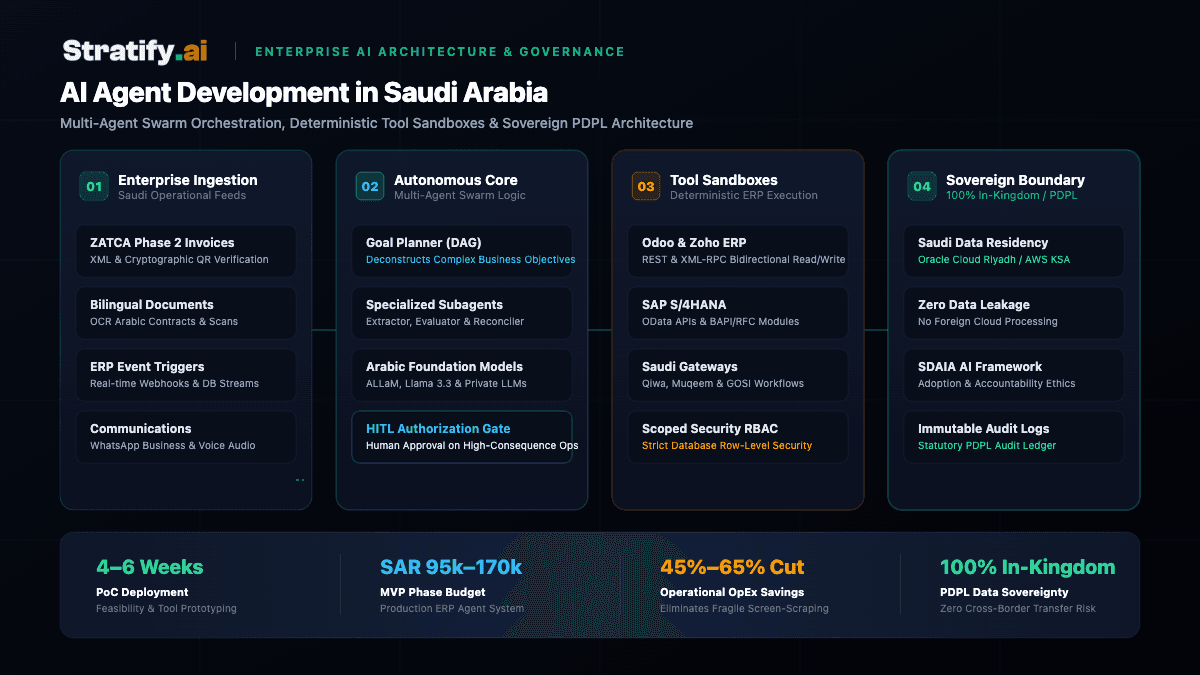
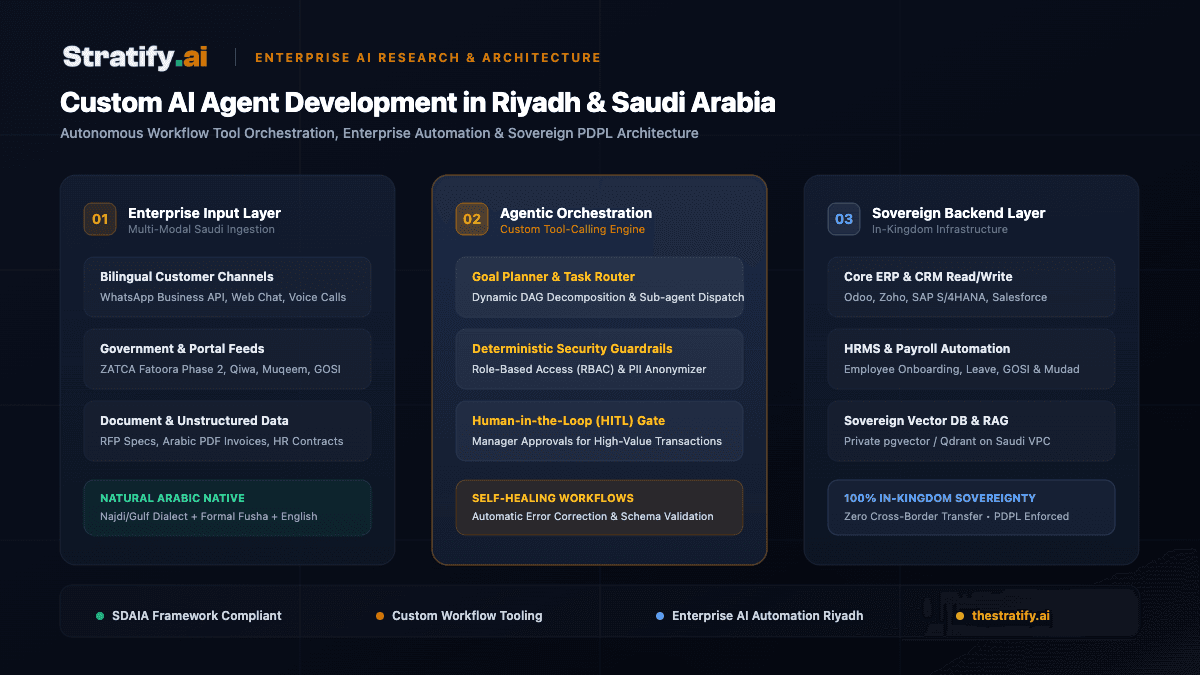
Phase 4: Tool-Calling Hardening & ERP Integration. Connect the sovereign AI agent runtime to your systems of record using deterministic API gateways. Implement strict Row-Level Security (RLS) and mutual TLS (mTLS) encryption so that AI agents access data strictly within authorized enterprise boundaries, supported by human-in-the-loop sign-off protocols for critical financial actions.
To understand the specific compliance requirements governing agent deployment under local privacy laws, review our detailed guide on Saudi PDPL compliance for enterprise AI agents.
Partner with Saudi Arabia's Sovereign AI Engineering Specialists
Building and operating sovereign AI infrastructure requires multidisciplinary engineering capabilities spanning distributed systems, GPU cluster optimization, cybersecurity, and deep knowledge of Saudi regulatory frameworks. Off-the-shelf software vendors and generalist IT integrators frequently lack the specialized expertise needed to deploy air-gapped models or optimize high-throughput private inference engines.
At Stratify AI, our Riyadh-based engineering team specializes exclusively in architecting, deploying, and governing sovereign AI ecosystems for the Kingdom's leading enterprises. We do not deliver black-box SaaS tools or foreign API wrappers. We deliver custom, production-grade autonomous agent systems deployed directly into your sovereign Saudi cloud tenancy or private data center, complete with 100% intellectual property transfer and zero vendor lock-in.
Whether your organization is seeking to deploy an elastic AI cluster on Oracle Cloud Riyadh, implement private dedicated LLMs for SAP or Odoo ERP systems, or build custom autonomous agent workflows, partner with the trusted leaders in sovereign AI. Explore our custom AI agent development services, discover our bespoke AI application development practice, or schedule a confidential sovereign AI consultation with our engineering leaders in Riyadh today.
Frequently Asked Questions
Sovereign AI refers to artificial intelligence infrastructure, foundational models, data pipelines, and orchestration engines that operate entirely within the geographic, physical, and legal jurisdiction of a nation. In Saudi Arabia, Sovereign AI ensures that enterprise data and customer records remain 100% in-Kingdom, fully compliant with the Personal Data Protection Law (PDPL) and SDAIA regulatory frameworks, while preventing corporate intellectual property from leaking into foreign commercial AI training sets.
In-Kingdom Private Cloud (hosted in Saudi regions such as Oracle Cloud Riyadh/Jeddah or AWS Local Zones) provides elastic GPU scalability, rapid deployment (2–4 weeks), and full PDPL residency compliance under an operational expenditure (OPEX) model, making it ideal for 80% of enterprise workloads. On-Premise AI requires dedicated physical hardware in the company's server room (CAPEX model), takes 8–16 weeks to procure and deploy, but provides absolute physical custody and air-gapped isolation essential for defense, banking core settlements, and critical national infrastructure.
Yes. For specific enterprise workflows — such as invoice reconciliation, contract review, Arabic customer support, and ERP tool calling — state-of-the-art open-weight models (such as Llama 3.3 70B, DeepSeek-R1, and localized models like ALLaM) augmented with domain-specific Retrieval-Augmented Generation (RAG) and structured API tools routinely match or outperform generic public models, while delivering 50% lower latency and zero data leakage.
The financial inflection point typically occurs around 1,000,000 to 1,500,000 processed tokens per day across the organization. Below this threshold, public APIs carry lower upfront overhead. Above this volume, the recurring token subscription costs of public cloud APIs exceed the flat-rate monthly lease of dedicated sovereign GPU nodes. Enterprises processing over 3M tokens daily save between 50% and 70% by running on dedicated private cloud or on-premise infrastructure.
Sovereign AI models connect to enterprise ERPs via private, isolated network channels — such as Cloud Direct Connect, site-to-site IPsec VPNs, or internal optical LAN connections. The AI agents interact with the ERP strictly through published API gateways (such as SAP OData/BAPI or Odoo JSON-RPC) operating with mutual TLS (mTLS) encryption, dedicated service credentials, and Row-Level Security, ensuring that agent actions strictly adhere to corporate authorization policies.
With Stratify AI, the client organization retains 100% legal and technical ownership of all project deliverables. This includes custom agent orchestration code, vector databases, prompt engineering libraries, integration middleware, and any fine-tuned model weights. All assets reside exclusively in the client's sovereign infrastructure, ensuring zero vendor lock-in and full enterprise control.
Related Articles

Let's Build the Future
of Enterprise AI
Have a project in mind or need expert guidance?
We'd love to hear from you.
Salah Ad Din Al Ayyubi Rd, Al Malaz,
Riyadh 12836, Saudi Arabia
Global Enterprise Partner
Empowering businesses across North America, Europe, Asia, and the Middle East.